

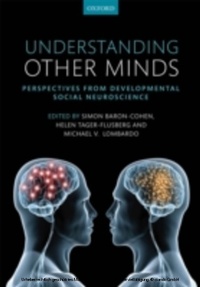
Understanding Other Minds
Perspectives from developmental social neuroscience
3rd Edition
Published on 22. August 2013
520 pages
978-0-19-166880-7 (ISBN)
Description

This book comprises 26 exciting chapters by internationally renowned scholars, addressing the central psychological process separating humans from other animals: the ability to imagine the thoughts and feelings of others, and to reflect on the contents of our own mindsa theory of mind (ToM).
The four sections of the book cover developmental, cultural, and neurobiological approaches to ToM across different populations and species. The chapters explore the earliest stages of development of ToM in infancy, and how plastic ToM learning is; why 3-year-olds typically fail false belief tasks and how ToM continues to develop beyond childhood into adulthood; the debate between simulation theory and theory theory; cross-cultural perspectives on ToM and how ToM develops differently in deaf children; how we use our ToM when we make moral judgments, and the link between emotional intelligence and ToM; the neural basis of ToM measured by evoked response potentials, functional magnetic resonance imaging, and studies of brain damage; emotional vs. cognitive empathy in neuropsychiatric conditions such as autism, schizophrenia, and psychopathy; the concept of self in autism and teaching methods targeting ToM deficits; the relationship between empathy, the pain matrix and the mirror neuron system; the role of oxytocin and fetal testosterone in mentalizing and empathy; the heritability of empathy and candidate single nucleotide polymorphisms associated with empathy; and ToM in non-human primates.
These 26 chapters represent a masterly overview of a field that has deepened since the first edition was published in 1993.
More details
Other editions
Additional editions
Simon Baron-Cohen | Michael Lombardo | Helen Tager-Flusberg
Understanding Other Minds
Perspectives from developmental social neuroscience
Book
08/2013
3rd Edition
Oxford University Press
€100.44
Shipment within 15-20 days
Persons
Simon Baron-Cohen is Professor Developmental Psychopathology at the University of Cambridge and Fellow at Trinty College, Cambridge. He is Director of the Autism Research Centre (ARC) in Cambridge. He holds degrees in Human Sciences from New College, Oxford, a PhD in Psychology from UCL, and an M.Phil in Clinical Psychology at the Institute of Psychiatry in London. He held lectureships in both of these departments before moving to Cambridge in 1994. He is author of Mindblindness (1995), The Essential Difference (2003), Prenatal Testosterone in Mind (2005), and Zero Degrees of Empathy (2011). He has edited a number of scholarly anthologies including Understanding Ohter Minds (1993, 2000, and 2013), Synaesthesia (1997), and The Maladapted Mind (1997). He has also written books for parents and teachers including Autism and Asperger Syndrome: The Facts (2008), and Teaching Children with Autism to Mindread (1999). He has celebrated art in autism in An Exact Mind (2004).
Michael V. Lombardo received a BA from the University of California, Davis and PhD from the University of Cambridge. Soon after his PhD he took up a research fellowship from Jesus College, Cambridge and a postdoctoral research fellowship from the British Academy. Dr. Lombardo is currently a research associate and Director of MRI at the Autism Research Centre at the University of Cambridge. His interdisciplinary work focuses on understanding autism, self-referential and social cognition, human brain development, and the early effects that hormones have for programming later development.
Helen Tager-Flusberg received her Bachelors in Science in Psychology from University College London, and her doctorate from Harvard University. From 1978 through 2001 she was a Professor in the Department of Psychology at the University of Massachusetts -Boston. From 1996 - 2001 she also held the position of Senior Scientist at the Eunice Kennedy Shriver Center/UMass Medical Center. Since 2001 Dr. Tager-Flusberg has been at Boston University in the Department of Anatomy and Neurobiology and Pediatrics at the School of Medicine and now as Professor of Psychology at Boston University, where she is the Director of the Autism Center of Excellence. Dr. Tager-Flusberg has conducted research on autism and other neurodevelopmental disorders investigating developmental changes in language and social cognition using behavioral and brain imaging methodologies.
Content
- Section 1: Theory of Mind: Development/Cognitive
- 1: Victoria Southgate: Early manifestations of mind reading
- 2: Andrew N. Meltzoff and Alison Gopnik: Learning about the Mind from Evidence: Children's development of intuitive theories of perception and personality
- 3: Henry M. Wellman and Candida C. Peterson: Theory of Mind, Development, and Deafness
- 4: Josef Perner and Johannes Roessler: Teleology: Belief as perspective
- 5: Ian Apperly: Can Theory of Mind Grow Up?: Mindreading in adults, and its implications for the development and neuroscience of mindreading
- 7: Peter Hobson and Jessica Hobson: Autism: Self and others
- 8: Liane Young and Adam Waytz: Mind attribution is for morality
- 9: David A. Kenny: Issues in the Measurement of Judgmental Accuracy
- Section 2: Theory of Mind: Neuroscience
- 10: Mark A. Sabbagh: EEG/ERP Studies of Theory of Mind
- 11: Jorie Koster-Hale and Rebecca Saxe: Functional Neuroimaging of Theory of Mind
- 12: Dana Samson and Caroline Michel: Theory of Mind: Insights from patients with acquired brain damage
- 13: Anat Perry and Simone Shamay-Tsoory: Understanding Emotional and Cognitive Empathy: A neuropsychological perspective
- 14: Jamil Zaki and Kevin Ochsner: Neural Sources of Empathy: An evolving story
- Section 3: Theory of Mind: Neural Mechanisms
- 15: Christian Keysers, Marc Thioux, and Valeria Gazzola: Mirror Neuron System and Social Cognition
- 16: Giacomo Rizzolatti and Maddalena Fabbir-Destro: The Mirror Mechanism: Understanding others from the inside
- 17: Markus Heinrichs, Frances S. Chen, and Gregor Domes: Social Neuropeptides in the Human Brain: Oxytocin and social behaviour
- 18: Bonnie Auyeung and Simon Baron-Cohen: Prenatal and Postnatal Testosterone Effects on Human Social and Emotional Behavior
- 19: Bhismadev Chakrabarti and Simon Baron-Cohen: Understanding the Genetics of Empathy and the Autistic Spectrum
- Section 4: Theory of Mind: Autism/Psychopathology/Neurological Disorders
- 20: Jennie Pyers and Peter A. de Villiers: Theory of Mind in Deaf Children: Illuminating the relative roles of language and executive functioning in the development of social cognition
- 21: James Blair and Stuart White: Social Cognition in Individuals with Psychopathic Tendencies
- 22: Antonia Hamilton and Lauren Marsh: Two Systems for Action Comprehension in Autism: Mirroring and mentalising
- 23: Peter Hobson and Jessica A. Hobson: Autism: Self and others
- 24: Julie Hadwin and Hanna Kovshoff: A review of theory of Mind Interventions for children and adolescents with Autism Spectrum Conditions
- Section 5: Theory of Mind: Comparative
- 25: Andrew Whiten: Culture and the Evolution of Interconnected Minds
- 26: Alvin Goldman and Lucy Jordan: Mindreading by Simulation: The roles of imagination and mirroring
- 27: Peter Carruthers: Mindreading the Self
