

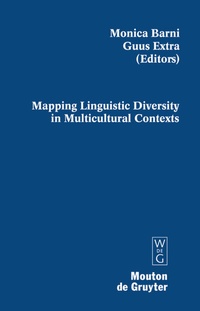
Mapping Linguistic Diversity in Multicultural Contexts
Description

Within the European context, linguistic diversity can be studied at the level of both official state languages and non-national languages. This comprehensive overview offers insightful crossnational and crosscontinental perspectives on non-national languages in terms of both regional and immigrant languages. The book focuses on mapping linguistic diversity in both the private and public domain. Methodological issues and empirical outcomes are explored for a variety of European and non-European countries and languages.
The book consists of four parts. Part 1 provides an introduction to the subject, as well as an overview and discussion of migration statistics and language use. Part 2 deals with the mapping of regional languages in Europe, exemplified by case studies on Welsh, Basque, and Frisian. Part 3 focuses on immigrant languages in Europe and includes case studies from both national (Switzerland, Italy, France) and crossnational (Multilingual Cities Project) perspectives. Part 4 turns to mapping linguistic diversity abroad with case studies on Australia, South Africa, Turkey, and Japan.
Reviews / Votes
"[...] the collection is a good tool (well organized and printed) to understand the present academic research on this matter, mainly in Europe and especially in the metropolitan areas."Lorenzo Zanasi in: Linguist List 20.1934More details
Other editions
Additional editions
Persons
Content
2 - Contents [Seite 9]
3 - Mapping linguistic diversity in multicultural contexts: Cross-national and cross-linguistic perspectives [Seite 13]
4 - European migration statistics: Definitions, data and challenges [Seite 53]
5 - TheWelsh language in the United Kingdom: Beyond cartography [Seite 79]
6 - The status of Basque in the Basque country [Seite 103]
7 - Language surveys on Frisian in the Netherlands [Seite 125]
8 - Mapping immigrant minority languages in multicultural cities [Seite 149]
9 - Immigrant languages and languages of France [Seite 173]
10 - Mapping immigrant languages in Switzerland [Seite 205]
11 - Mapping immigrant languages in Italy [Seite 227]
12 - Mapping linguistic diversity in an emigration and immigration context: Case studies on Turkey and Austria [Seite 255]
13 - The Linguistic Atlas of South Africa: Mapping diversity in space and time [Seite 275]
14 - Community languages in Australia [Seite 303]
15 - The linguistic landscape of Tokyo [Seite 321]
16 - Backmatter [Seite 345]
