

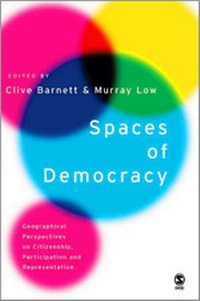
Spaces of Democracy
Geographical Perspectives on Citizenship, Participation and Representation
1st Edition
Published on 3. August 2004
264 pages
978-1-4129-3139-7 (ISBN)
Description

'This volume successfully exposes the "ghostly presence" of democracy in the field of geography and shows the value of thinking about democracy geographically. It is a major contribution to serious examination of a normative political issue from a geographical perspective. This is welcome above all because geography is a field whose cultural and economic branches, though often claiming the appellation "critical", are currently dominated by unexamined radical political fantasies' - John Agnew, University of California, Los Angeles
In an historically unprecedented way, democracy is now increasingly seen as a universal model of legitimate rule.This work addresses the key question: How can democracy be understood in theory and in practise?
In three thematically organised sections, Spaces of Democracy uses a critical geographical imagination (informed by thinking on space, place, and scale) to interrogate the latest work in democratic theory. Key ideas and concepts discussed include globalization and transnationalism; representation; citizenship; liberalism; the city and public space; and the media.
This volume comprises commissioned work by leading academics investigating democracy. Historical and comparative, animated by wider debates on globalization, it will facilitate the critical discussion of core questions on citizenship, the state, and democracy. Spaces of Democracy is essential reading for students of human geography, political science/international relations, and political sociology.
In an historically unprecedented way, democracy is now increasingly seen as a universal model of legitimate rule.This work addresses the key question: How can democracy be understood in theory and in practise?
In three thematically organised sections, Spaces of Democracy uses a critical geographical imagination (informed by thinking on space, place, and scale) to interrogate the latest work in democratic theory. Key ideas and concepts discussed include globalization and transnationalism; representation; citizenship; liberalism; the city and public space; and the media.
This volume comprises commissioned work by leading academics investigating democracy. Historical and comparative, animated by wider debates on globalization, it will facilitate the critical discussion of core questions on citizenship, the state, and democracy. Spaces of Democracy is essential reading for students of human geography, political science/international relations, and political sociology.
Reviews / Votes
'This volume successfully exposes the "ghostly presence" of democracy in the field of geography and shows the value of thinking about democracy geographically. It is a major contribution to serious examination of a normative political issue from a geographical perspective. This is welcome above all because geography is a field whose cultural and economic branches, though often claiming the appellation "critical", are currently dominated by unexamined radical political fantasies' - John Agnew, University of California, Los Angeles "This book is a welcome contribution to geographic studies of democracy for two reasons. Geographic interpretation has much to contribute to our understanding of political change subsumed under the term "democratization," and this book will serve as a solid addition to that body of literature. Second, this collection brings together a proven group of scholars from geography. Overall, this is a highly recommended collection." -- Brennan Kraxberger * Newport News *All prices
More details
Edition
First Edition
Language
English
Place of publication
London
United Kingdom
Publishing group
Sage Publications Ltd (Digital)
Target group
College/higher education
Professional and scholarly
ISBN-13
978-1-4129-3139-7 (9781412931397)
Copyright in bibliographic data and cover images is held by Nielsen Book Services Limited or by the publishers or by their respective licensors: all rights reserved.
Schweitzer Classification
Other editions
Additional editions
Clive Barnett | Murray Low
Spaces of Democracy
Geographical Perspectives on Citizenship, Participation and Representation
Book
08/2004
1st Edition
SAGE Publications Inc
€120.60
Shipment within 15-20 days
Clive Barnett | Murray Low
Spaces of Democracy
Geographical Perspectives on Citizenship, Participation and Representation
Book
08/2004
1st Edition
SAGE Publications Inc
€264.80
Shipment within 15-20 days
Persons
Clive Barnett works on the geographies of democracy and public life. He is author and editor of books and scholarly articles on colonial and postcolonial discourses, critical theory and the public sphere, political philosophy, popular media cultures, poststructuralism, and social movements. This includes empirical research on the UK, South Africa, USA, and Europe. His current research focuses on emergent forms of public action and their implications for understandings of democracy. Clive is a member of the OpenSpace Research Centre, and is Co-Director of the Publics Research Programme in the Centre for Citizenship, Identities and Governance (CCIG) in the Faculty of Social Sciences at the OU. He is also a Member of the Open University's Ethics Centre. Murray Low's research focuses on relationships between geography and democracy including institutional and spatial aspects of elections, changing practices of accountability and legitimacy in cities, and the geography of political party organisations and social movements. His work has dealt with the relationships between global networks and democracy, constructions of globalization and states in geography, and geographical aspects of political representation. He has recently completed research funded by the Leverhulme Foundation into city democratisation in South Africa. He is co-editor of Spaces of Democracy: Geographical Perspectives on Citizenship, Participation and Representation (Sage, 2004), and of The Sage Handbook of Political Geography (Sage, 2008)
Content
Geography and Democracy - Clive Barnett and Murray Low
An Introduction
PART ONE: ELECTIONS, VOTING AND REPRESENTATION
Global Democratization - John O'Loughlin
Measuring and Explaining the Diffusion of Democracy
Electoral Geography in Electoral Studies - Ron Johnston and Charles Pattie
Putting Voters in Their Place
Representation, Law and Redistricting in the United States - Richard L Morrill
PART TWO: DEMOCRACY, CITIZENSHIP AND SCALE
Citizens and the State - Sallie A Marston and Katharyne Mitchell
Citizenship Formations in Space and Time
Open Borders and Free Population Movement - David M Smith
A Challenge for Liberalism
Cities as Spaces of Democracy - Murray Low
Complexity, Scale and Governance
PART THREE: MAKING DEMOCRATIC SPACES
Spaces of Public and Private - Lynn A Staeheli and Don Mitchell
Locating Politics
The Geopolitics of Democracy and Citizenship in Latin America - Gareth A Jones
Media, Democracy and Representation - Clive Barnett
Disembodying the Public
Cultures of Democracy - Sophie Watson
Spaces of Democratic Possibility
Spaces of Mobilization - Byron Miller
Transnational Social Movements
An Introduction
PART ONE: ELECTIONS, VOTING AND REPRESENTATION
Global Democratization - John O'Loughlin
Measuring and Explaining the Diffusion of Democracy
Electoral Geography in Electoral Studies - Ron Johnston and Charles Pattie
Putting Voters in Their Place
Representation, Law and Redistricting in the United States - Richard L Morrill
PART TWO: DEMOCRACY, CITIZENSHIP AND SCALE
Citizens and the State - Sallie A Marston and Katharyne Mitchell
Citizenship Formations in Space and Time
Open Borders and Free Population Movement - David M Smith
A Challenge for Liberalism
Cities as Spaces of Democracy - Murray Low
Complexity, Scale and Governance
PART THREE: MAKING DEMOCRATIC SPACES
Spaces of Public and Private - Lynn A Staeheli and Don Mitchell
Locating Politics
The Geopolitics of Democracy and Citizenship in Latin America - Gareth A Jones
Media, Democracy and Representation - Clive Barnett
Disembodying the Public
Cultures of Democracy - Sophie Watson
Spaces of Democratic Possibility
Spaces of Mobilization - Byron Miller
Transnational Social Movements
