

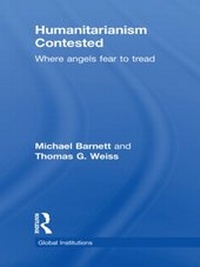
Humanitarianism Contested
Where Angels Fear to Tread
1st Edition
Published on 1. March 2013
192 pages
978-1-136-81439-6 (ISBN)
Description

This book provides a succinct but sophisticated understanding of humanitarianism and insight into the on-going dilemmas and tensions that have accompanied it since its origins in the early nineteenth century. Combining theoretical and historical exposition with a broad range of contemporary case studies, the book:
provides a brief survey of the history of humanitarianism, beginning with the anti-slavery movement in the early nineteenth century and continuing to today's challenge of post-conflict reconstruction and saving failed states
explains the evolution of humanitarianism. Not only has it evolved over the decades, but since the end of the Cold War, humanitarianism has exploded in scope, scale, and significance
presents an overview of the contemporary humanitarian sector, including briefly who the key actors are, how they are funded and what they do with their money
analyses the ethical dilemmas confronted by humanitarian organization, not only in the abstract but also, and most importantly, in real situations and when lives are at stake
examines how humanitarianism poses fundamental ethical questions regarding the kind of world we want to live in, what kind of world is possible, and how we might get there.
An accessible and engaging work by two of the leading scholars in the field, Humanitarianism Contested is essential reading for all those concerned with the future of human rights and international relations.
provides a brief survey of the history of humanitarianism, beginning with the anti-slavery movement in the early nineteenth century and continuing to today's challenge of post-conflict reconstruction and saving failed states
explains the evolution of humanitarianism. Not only has it evolved over the decades, but since the end of the Cold War, humanitarianism has exploded in scope, scale, and significance
presents an overview of the contemporary humanitarian sector, including briefly who the key actors are, how they are funded and what they do with their money
analyses the ethical dilemmas confronted by humanitarian organization, not only in the abstract but also, and most importantly, in real situations and when lives are at stake
examines how humanitarianism poses fundamental ethical questions regarding the kind of world we want to live in, what kind of world is possible, and how we might get there.
An accessible and engaging work by two of the leading scholars in the field, Humanitarianism Contested is essential reading for all those concerned with the future of human rights and international relations.
Reviews / Votes
'Short, penetrating and accessibly written. Apart from the open dialogue between the authors, the answers they give to 'ten guiding questions' provides important intellectual and normative puzzles that will engage both practitioners and students alike.' - Tim Dunne, International Affairs, Vol. 87, 6, November 2011More details
Series
Language
English
Place of publication
London
United Kingdom
Publishing group
Taylor & Francis Ltd
Target group
College/higher education
Illustrations
5 s/w Tabellen
5 Tables, black and white
File size
2,44 MB
ISBN-13
978-1-136-81439-6 (9781136814396)
Copyright in bibliographic data and cover images is held by Nielsen Book Services Limited or by the publishers or by their respective licensors: all rights reserved.
Schweitzer Classification
Other editions
Additional editions
Book
02/2011
1st Edition
Routledge
€231.10
Shipment within 15-20 days
Book
02/2011
1st Edition
Routledge
€67.60
Shipment within 15-20 days
Persons
Michael Barnett is University Professor of International Affairs and Political Science at the George Washington University. Among his recent books are Eyewitness to a Genocide: The United Nations and Rwanda (Cornell University Press, 2002); Rules for the World: International Organizations and World Politics (with Martha Finnemore, Cornell University Press, 2004); Power in Global Governance (co-edited with Raymond Duvall, Cambridge University Press, 2004); Humanitarianism in Question: Politics, Power, Ethics (co-edited with Thomas G. Weiss, Cornell University Press, 2008); and In a World of Hurt: Humanitarianism Through the Ages (Cornell University Press, 2011).
Thomas G. Weiss is Presidential Professor of Political Science at The Graduate Center of the City University of New York and Director of the Ralph Bunche Institute for International Studies, where he is Co-director of the United Nations Intellectual History Project. He was President of the International Studies Association (2009-2010) and Chair of the Academic Council on the UN System (2006-2009); editor of Global Governance; Research Director of the International Commission on Intervention and State Sovereignty; Research Professor at Brown University's Watson Institute for International Studies; Executive Director of the Academic Council on the UN System and of the International Peace Academy; a member of the UN secretariat; and a consultant to several public and private agencies. His latest authored books include Global Governance and the UN: An Unfinished Journey (with Ramesh Thakur, Indiana University Press, 2010); What's Wrong with the United Nations and How to Fix It (Polity, 2009); UN Ideas That Changed the World (with Richard Jolly and Louis Emmerij, Indiana University Press, 2009); and Humanitarian Intervention: Ideas in Action (Polity, 2007).
Thomas G. Weiss is Presidential Professor of Political Science at The Graduate Center of the City University of New York and Director of the Ralph Bunche Institute for International Studies, where he is Co-director of the United Nations Intellectual History Project. He was President of the International Studies Association (2009-2010) and Chair of the Academic Council on the UN System (2006-2009); editor of Global Governance; Research Director of the International Commission on Intervention and State Sovereignty; Research Professor at Brown University's Watson Institute for International Studies; Executive Director of the Academic Council on the UN System and of the International Peace Academy; a member of the UN secretariat; and a consultant to several public and private agencies. His latest authored books include Global Governance and the UN: An Unfinished Journey (with Ramesh Thakur, Indiana University Press, 2010); What's Wrong with the United Nations and How to Fix It (Polity, 2009); UN Ideas That Changed the World (with Richard Jolly and Louis Emmerij, Indiana University Press, 2009); and Humanitarian Intervention: Ideas in Action (Polity, 2007).
Content
Introduction 1. Humanitarianism: The Essentials 2. 'Birth' and Maturation, 1864-1945 3. The Traditional Enterprise, 1945 - 1989 4. The Turbulent Post-Cold War Era: The New Humanitarianism? 5. Turbulent Humanitarianism Since 1989: Rhetoric Meets Reality 6. Humanitarianism's Past and Possible Futures: Ten Guiding Questions
