

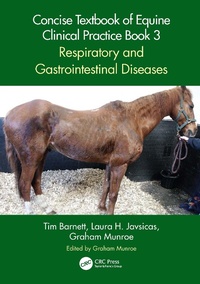
Concise Textbook of Equine Clinical Practice Book 3
Respiratory and Gastrointestinal Diseases
1st Edition
Published on 8. February 2024
296 pages
978-1-000-92398-8 (ISBN)
Description

This concise, practical text covers the essential information veterinary students and nurses, new graduates, and practitioners need to succeed in equine medicine, focussing on respiratory and gastrointestinal diseases. Written for an international readership, the book conveys the core information in an easily digestible, precise form with extensive use of bullet points, lists, diagrams, protocols, and extensive illustrations (over 300 full-colour, high-quality photographs).
Part of a five-book series that extracts and updates key information from Munroe's Equine Surgery, Reproduction and Medicine, Second Edition, the book distils best practice in a logical straightforward clinically based approach. It details relevant clinical anatomy, physical clinical examination techniques and findings, normal parameters, aetiology/pathophysiology, differential diagnoses, diagnostic techniques, management and treatment, and prognosis. The emphasis is on information tailored to general equine clinicians with just enough on advanced techniques to make the practitioner aware of what is available elsewhere.
The respiratory system is split into sections on surgical and medical conditions of the upper and lower respiratory tracts.
The gastrointestinal system is divided into the upper tract, including the oral cavity and dentistry, and the lower tract and peritoneal cavity.
Ideal for veterinary students and nurses on clinical placements with horses as well as practitioners needing a quick reference 'on the ground'.
Part of a five-book series that extracts and updates key information from Munroe's Equine Surgery, Reproduction and Medicine, Second Edition, the book distils best practice in a logical straightforward clinically based approach. It details relevant clinical anatomy, physical clinical examination techniques and findings, normal parameters, aetiology/pathophysiology, differential diagnoses, diagnostic techniques, management and treatment, and prognosis. The emphasis is on information tailored to general equine clinicians with just enough on advanced techniques to make the practitioner aware of what is available elsewhere.
The respiratory system is split into sections on surgical and medical conditions of the upper and lower respiratory tracts.
The gastrointestinal system is divided into the upper tract, including the oral cavity and dentistry, and the lower tract and peritoneal cavity.
Ideal for veterinary students and nurses on clinical placements with horses as well as practitioners needing a quick reference 'on the ground'.
Reviews / Votes
"Veterinary students will love this! I have seen the success of similar books in small animal medicine and how useful they can be on rotations when a quick reference is needed. I think it would equally be of benefit to residents and practitioners needing quick refreshers."Carla Lusi, University of Melbourne, Australia, author of Fascial Anatomy of the Equine Forelimb (CRC Press)
"I think this Equine textbook will be exceptionally well received. Although the original book Equine Clinical Medicine, Surgery and Reproduction really helped me personally through university, I could only ever use it at my desk or at the library. More concise books allow students and new grads to have them at hand all the time, especially during rotations for quick reference. Leave the 1500 page book at home and take just what they need for the day! Each disease or syndrome has the same layout, allowing a vey quick reference, and the images are amazing. They are good quality and allow very immersive learning."
Sophie Neasham, Veterinary surgeon, UK
"While the volume Equine Clinical Medicine, Surgery and Reproduction, Second Edition is a great resource for reference, say, when wanting to research differential diagnoses for a case or brush up on a disease, it is not practical to be used out in the field. This smaller, more focused reference guide is more amenable to practical day-to-day veterinary use. For example, when out on a call and you need a quick reference on how to treat a specific presentation, having a resource which is concise and targeted is more user friendly than a large volume."
Rachael Harmer, Veterinary Medicine student at the University of Surrey (2016-2021), UK "Veterinary students would love this! I have seen the success of similar books in small animal medicine and how useful they can be on rotations when a quick reference is needed. I think it would equally be of benefit to residents and practitioners needing quick refreshers."
Carla Lusi, University of Melbourne, Australia, author of Fascial Anatomy of the Equine Forelimb (CRC Press)
"I think this Equine textbook will be exceptionally well received. Although the original book Equine Clinical Medicine, Surgery and Reproduction really helped me personally through university, I could only ever use it at my desk or at the library. More concise books allow students and new grads to have them at hand all the time, especially during rotations for quick reference. Leave the 1500 page book at home and take just what they need for the day! Each disease or syndrome has the same layout, allowing a vey quick reference, and the images are amazing. They are good quality and allow very immersive learning."
Sophie Neasham, Veterinary surgeon, UK
"While the volume Equine Clinical Medicine, Surgery and Reproduction, Second Edition is a great resource for reference, say, when wanting to research differential diagnoses for a case or brush up on a disease, it is not practical to be used out in the field. This smaller, more focused reference guide is more amenable to practical day-to-day veterinary use. For example, when out on a call and you need a quick reference on how to treat a specific presentation, having a resource which is concise and targeted is more user friendly than a large volume."
Rachael Harmer, Veterinary Medicine student at the University of Surrey (2016-2021), UK
More details
Edition
1. Auflage
Language
English
Place of publication
London
United Kingdom
Publishing group
Taylor & Francis Ltd
Target group
College/higher education
Professional and scholarly
Product notice
Reflowable
Illustrations
16 Tables, color; 6 Line drawings, color; 307 Halftones, color; 307 Illustrations, color
ISBN-13
978-1-000-92398-8 (9781000923988)
Copyright in bibliographic data and cover images is held by Nielsen Book Services Limited or by the publishers or by their respective licensors: all rights reserved.
Schweitzer Classification
Other editions
Additional editions
Tim Barnett | Laura H. Javsicas | Graham Munroe
Concise Textbook of Equine Clinical Practice Book 3
Respiratory and Gastrointestinal Diseases
Book
02/2024
1st Edition
CRC Press
€245.35
Shipment within 10-20 days
Tim Barnett | Laura H. Javsicas | Graham Munroe
Concise Textbook of Equine Clinical Practice Book 3
Respiratory and Gastrointestinal Diseases
Book
02/2024
1st Edition
CRC Press
€93.50
Shipment within 10-20 days
Persons
Timothy P. Barnett BSc(Hons), BVM&S, MSc, CertAVP, DipECVS, DipEVDC-Eq, MRCVS qualified from the University of Edinburgh in 2005. After a period in general practice, he joined Rossdales in Newmarket, working as an orthopaedic assistant and then an 18-month internship in the hospital and diagnostic centre. He undertook a surgical residency at the University of Edinburgh before re-joining Rossdales in 2014. He worked in general practice and then part of the horses in training team before moving into the surgical and dental referral group. He became clinical director of Rossdales in 2021. He was awarded an MSc with Distinction from the University of Edinburgh 2014 for his work on post-operative findings in horses undergoing laryngoplasty and attained the RCVS Certificate in Advanced Veterinary Practice and became a Diplomate of the European College of Veterinary Surgeons (EVCS) in 2015. He became a Diplomate of the European Veterinary Dental College (EVDC) in 2018. He holds RCVS specialist status in both equine surgery and dentistry.
Erin Beasley, DVM, DACVIM, PhD, is a Clinical Associate Professor in Large Animal
Internal Medicine at the University of Georgia in Athens, GA USA. Her doctoral research was in cardiovascular function in horses with gastrointestinal disease. Equine cardiology remains a special interest, although all things internal medicine related make each day in this profession exciting and challenging.
Laura Javsicas is board certified by the American College of Veterinary Internal Medicine in Large Animal Medicine and has special interests in neonatology, ultrasonography, cardiology, gastrointestinal diseases and emergency/critical care medicine. She graduated from the University of Pennsylvania before completing an internship at the Hagyard Equine Medical Institute in Lexington, KY. She then completed in equine internal medicine residency at the University of Florida following which she became a member of the faculty. She joined Rhinebeck Equine, a full-service ambulatory and referral hospital in 2013 where she provides emergency and elective internal medicine services within the hospital and out in the field.
Graham Munroe qualified from the University of Bristol with honours in 1979. He spent 9 years in equine practice in Wendover, Newmarket, Arundel, and Oxfordshire, and a stud season in New Zealand. He gained a certificate in equine orthopaedics and a diploma in equine stud medicine from the RCVS whilst in practice. Joined Glasgow University Veterinary School in 1988 as a lecturer and then moved to Edinburgh Veterinary School as a senior lecturer in large animal surgery from 1994 to 1997. Obtained FRCVS in 1994 and Dip ECVS in 1997 by examination. Awarded a PhD in 1994 for a study in neonatal ophthalmology. He has been visiting equine surgeon at the University of Cambridge Veterinary School, University of Bristol Veterinary School and Helsingborg Hospital, Sweden. Team veterinary surgeon for British Driving Teams 1994-2001, British Dressage Team 2001-2002 and British Vaulting Team 2002. FEI veterinary delegate at Athens 2004 Olympics. He currently works in private referral surgical practice, mainly in orthopaedics. He has published over 60 papers and book chapters.
Erin Beasley, DVM, DACVIM, PhD, is a Clinical Associate Professor in Large Animal
Internal Medicine at the University of Georgia in Athens, GA USA. Her doctoral research was in cardiovascular function in horses with gastrointestinal disease. Equine cardiology remains a special interest, although all things internal medicine related make each day in this profession exciting and challenging.
Laura Javsicas is board certified by the American College of Veterinary Internal Medicine in Large Animal Medicine and has special interests in neonatology, ultrasonography, cardiology, gastrointestinal diseases and emergency/critical care medicine. She graduated from the University of Pennsylvania before completing an internship at the Hagyard Equine Medical Institute in Lexington, KY. She then completed in equine internal medicine residency at the University of Florida following which she became a member of the faculty. She joined Rhinebeck Equine, a full-service ambulatory and referral hospital in 2013 where she provides emergency and elective internal medicine services within the hospital and out in the field.
Graham Munroe qualified from the University of Bristol with honours in 1979. He spent 9 years in equine practice in Wendover, Newmarket, Arundel, and Oxfordshire, and a stud season in New Zealand. He gained a certificate in equine orthopaedics and a diploma in equine stud medicine from the RCVS whilst in practice. Joined Glasgow University Veterinary School in 1988 as a lecturer and then moved to Edinburgh Veterinary School as a senior lecturer in large animal surgery from 1994 to 1997. Obtained FRCVS in 1994 and Dip ECVS in 1997 by examination. Awarded a PhD in 1994 for a study in neonatal ophthalmology. He has been visiting equine surgeon at the University of Cambridge Veterinary School, University of Bristol Veterinary School and Helsingborg Hospital, Sweden. Team veterinary surgeon for British Driving Teams 1994-2001, British Dressage Team 2001-2002 and British Vaulting Team 2002. FEI veterinary delegate at Athens 2004 Olympics. He currently works in private referral surgical practice, mainly in orthopaedics. He has published over 60 papers and book chapters.
Content
Preface. Author Bios. Respiratory System. Introduction. Clinical examination of the respiratory tract. Physical examination of the respiratory tract. Diagnostic tests. Surgical conditions of the respiratory tract. Nostril. Nasal passages and Paranasal sinuses. Pharynx and larynx. Trachea. Guttural Pouch. Medical conditions of the upper respiratory tract. Viral diseases. Bacterial disease. Medical conditions of the lower respiratory tract. Infectious conditions. Obstructive conditions. Parasitic conditions. Miscellaneous conditions. The Upper Gastrointestinal Tract. The oral cavity. Introduction. Age-related changes in the appearance of teeth with eruption and ageing. Dental examination of the horse. Dental imaging. Diseases of the teeth and oral cavity. Conditions associated with development and eruption of teeth. Acquired dental disease. Dental diseases associated with wear. Disease of canine teeth. Treatment of common pathologies. Non-dental disease of the oral cavity. Oral neoplasia. Diseases of the salivary glands. Diseases of the oesophagus. Congenital and developmental diseases of the equine oesophagus. Acquired oesophageal disorders. The Lower Gastrointestinal Tract. Physical examination. Diagnostic tests. Use of analgesics in colic. General disorders of the lower gastrointestinal tract. Disorders of the stomach. Disorders of the small intestine. Disorders of the caecum. Disorders of the large colon. Disorders of the small colon and rectum. Disorders of the peritoneal cavity.
