

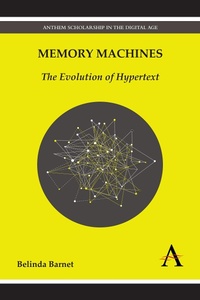
Memory Machines
The Evolution of Hypertext
Published on 15. July 2013
192 pages
978-0-85728-196-8 (ISBN)
Description

This book explores the history of hypertext, an influential concept that forms the underlying structure of the World Wide Web and innumerable software applications. Barnet tells both the human and the technological story by weaving together contemporary literature and her exclusive interviews with those at the forefront of hypertext innovation, tracing its evolutionary roots back to the analogue machine imagined by Vannevar Bush in 1945.
Reviews / Votes
'"Memory Machines" will appeal to anyone who is curious about the history of computing in general and hypertext in particular. This book is highly recommended for computer science students and for students of history of science and technology, as well as for computing and engineering enthusiasts.' -Stephanie Wical, Online Information Review '[A] richly layered account, focusing on oral histories as much as an analysis of documents. [...] This volume provides a sophisticated and vital history of early computing, usefully exploring conceptual ideas around hypertext, outlining the constraints on pioneering efforts to implement models of hypertext as technical prototypes, and ultimately demonstrating how these collectively shaped all subsequent efforts to develop computer-based prototypes for information structuring and retrieval.' -Craig Hight, 'Media International Australia'More details
Series
Language
English
Place of publication
London
United Kingdom
Target group
Professional and scholarly
Illustrations
18 b+w illustrations
ISBN-13
978-0-85728-196-8 (9780857281968)
Copyright in bibliographic data and cover images is held by Nielsen Book Services Limited or by the publishers or by their respective licensors: all rights reserved.
Schweitzer Classification
Other editions
Additional editions
Book
12/2014
Anthem Press
€48.30
Shipment within 10-15 days
Person
Belinda Barnet is a lecturer in media and communications at Swinburne University, Melbourne, Australia.
http://blog.arsmemoriae.com/
@Manjusrii
http://blog.arsmemoriae.com/
@Manjusrii
Content
Foreword: To Mandelbrot in Heaven - Stuart Moulthrop; Preface; Chapter 1: Technical Evolution; Chapter 2: Memex as an Image of Potentiality; Chapter 3: Augmenting the Intellect: NLS; Chapter 4. The Magical Place of Literary Memory: Xanadu; Chapter 5: Seeing and Making Connections: HES and FRESS; Chapter 6: Machine-Enhanced (Re)minding: The Development of Storyspace; Conclusion; Notes; Bibliography; Index
