

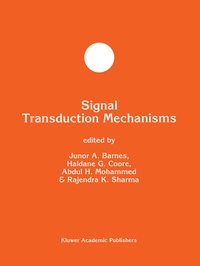
Signal Transduction Mechanisms
Published on 9. March 2013
VI, 325 pages
978-1-4615-2015-3 (ISBN)
Description

This volume contains the proceedings of an International Symposium on `Second Messenger Systems - Molecular, Cellular and Behavioural Aspects', which was held at Tobago on June 16-17, 1994.
The interaction of an extracellular agonist (First Messenger) with its plasma membrane receptor leads to the transmission of a signal across the cell membrane and results in the production and/or activation of other signalling molecules (Second Messengers). These Second Messengers control the action of many protein kinases and protein phosphatases and so lead to cellular responses. Although the biochemical basis of the transduction of signals in the main signalling systems in eukaryotic cells is probably largely known, intensified research is ongoing in the following areas: the discovery of specific substrates for many protein kinases, elucidation of the biological significance of the differential tissue expression and heterogeneity of many signalling proteins, and the unravelling of diverse interactions (such as signal potentiation, synergism, antagonism and neuronal co-transmission) between signalling systems. As knowledge from such studies accumulates, it is becoming clear that the `cross talk' interactions between signalling systems are important features of dynamic cell regulation.
This volume is designed to summarize some aspects of the current work on various Second Messenger Systems and the integration of signals with respect to plasma membrane receptors. Second Messenger generation and degradation, protein kinase and phosphatase, cell cycle control, and cellular learning and memory.
The interaction of an extracellular agonist (First Messenger) with its plasma membrane receptor leads to the transmission of a signal across the cell membrane and results in the production and/or activation of other signalling molecules (Second Messengers). These Second Messengers control the action of many protein kinases and protein phosphatases and so lead to cellular responses. Although the biochemical basis of the transduction of signals in the main signalling systems in eukaryotic cells is probably largely known, intensified research is ongoing in the following areas: the discovery of specific substrates for many protein kinases, elucidation of the biological significance of the differential tissue expression and heterogeneity of many signalling proteins, and the unravelling of diverse interactions (such as signal potentiation, synergism, antagonism and neuronal co-transmission) between signalling systems. As knowledge from such studies accumulates, it is becoming clear that the `cross talk' interactions between signalling systems are important features of dynamic cell regulation.
This volume is designed to summarize some aspects of the current work on various Second Messenger Systems and the integration of signals with respect to plasma membrane receptors. Second Messenger generation and degradation, protein kinase and phosphatase, cell cycle control, and cellular learning and memory.
More details
Other editions
Additional editions
J.A. Barnes | H.G. Coore | Abdul H. Mohammed
Signal Transduction Mechanisms
Book
11/2012
Springer
€320.99
Shipment within 7-9 days
J.A. Barnes | H.G. Coore | Abdul H. Mohammed
Signal Transduction Mechanisms
Book
09/1997
Kluwer Academic Publishers
€320.99
Shipment within 15-20 days
Content
Protein engineering and NMR studies of calmodulin.- PEST sequences in calmodulin-binding proteins.- High molecular weight calmodulin-binding protein is phosphorylated by calmodulin-dependent protein kinase VI from bovine cardiac muscle.- Regulatory properties of neuronal cdc2-like kinase.- Post-translationally modified 14-3-3 isoforms and inhibition of protein kinase C.- R.B. Marala and S.J. Mustafa: Modulation of protein kinase C by adenosine: Involvement of adenosine A1 receptor-pertussis toxin sensitive nucleotide binding protein system.- Phosphorylation and partial sequence of pregnant sheep myometrium myosin light chain kinase.- Effects of pyruvate on pyruvate dehydrogenase kinase of rat heart.- Tyrosine kinase-mediated signal transduction pathways and the actions of polypeptide growth factors and G-protein-coupled agonists in smooth muscle.- Protein tyrosine phosphorylation in cardiovascular system.- Regulation of glycogen synthase activation in isolated hepatocytes.- Regulation of phospholamban and troponin-I phosphorylation in the intact rat cardiomyocytes by adrenergic and cholinergic stimuli: Roles of cyclic nucleotides, calcium, protein kinases and phophatases and depolarization.- Preliminary crystallization studies of calmodulin- dependent protein phosphatase (calcineurin) from bovine brain.- Starvation reduces pyruvate dehydrogenase phosphate phosphatase activity in rat kidney.- Subcellular calcium oscillators and calcium influx support agonist- induced calcium waves in cultured astrocytes.- Activation and deactivation of sarcoplasmic reticulum calcium release channels: Molecular dissection of mechanisms via novel semi-synthetic ryanoids.- Inositol lipid-mediated signalling in response to endothelin and ATP in the mammalian testis.- Second messenger role ofmagnesium in pancreatic acinar cells of the rat.- Evidence for multisite ADP-ribosylation of neuronal phosphoprotein B-50/GAP-43.- Mammalian myristoyl CoA: Protein N-myristoyltransferase.- Towards the molecular basis for the regulation of mitochondrial dehydrogenases by calcium ions.- Regulation of cellular Gs? levels and basal adenylyl cyclase activity by expression of the ?2-adrenoceptor in neuroblastoma cell lines.- Membrane phospholipids and adrenergic receptor function.- Defective ANF-R2/ANP-C receptor-mediated signalling in hypertension.- Excitatory amino acid receptor-mediated neuronal signal transduction: Modulation by polyamines and calcium.- Signal transduction: Regulation of cAMP concentration in cardiac muscle by calmodulin-depend- ent cyclic nucleotide phosphodiesterase.- On the role of nitric oxide as a cellular messenger in brain.- Oxygen-radical/nitric oxide mediate calcium-dependent hormone action on cyclic GMP system: A novel concept in signal transduction mechanisms.- Interaction of heavy metal toxicants with brain constitutive nitric oxide synthase.- Mediation of H2O2-induced vascular relaxation by endothelium-derived relaxing factor.- The cyclic AMP system and Drosophila learning.- The biochemistry of learning and memory.- Disturbances in signal transduction mechanisms in Alzheimer' s disease.- Functional and genetic analysis of annexin VI.- Annexin II tetramer Structure and function.- Index to Volumes 149 and 150.
