

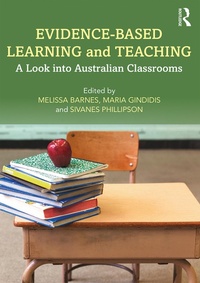
Evidence-Based Learning and Teaching
A Look into Australian Classrooms
1st Edition
Published on 8. May 2018
290 pages
978-1-351-12935-0 (ISBN)
Description

Education has become a political, economic and social priority for Australia, with the success of schools (and teachers) being an integral part of the economic and social future of the country. As a result, quality assurance for learning and teaching has become increasingly debated among policy-makers and the broader public, with a call for more evidence, data and standards to ensure that schools and teachers are held accountable for students' learning outcomes.
In response, this book provides a snapshot of the types of evidence and data relating to learning outcomes that are being collected in our classrooms within Australia. The chapters in this book seek to interrogate current views of learning and teaching, beyond what is measured in external assessments that only capture a limited view of student learning outcomes. The chapters explore a range of fundamental topics within education, including positive learning environments, student voice and assessment. They explore and articulate the vital knowledge and skills needed for current and future teachers. In addition, these chapters make clear links between teaching, learning and the theories that frame, shape and inform these learning and teaching processes.
The research presented in this book provides practical and theoretical insights into learning and teaching in early years, primary, secondary and tertiary education.
In response, this book provides a snapshot of the types of evidence and data relating to learning outcomes that are being collected in our classrooms within Australia. The chapters in this book seek to interrogate current views of learning and teaching, beyond what is measured in external assessments that only capture a limited view of student learning outcomes. The chapters explore a range of fundamental topics within education, including positive learning environments, student voice and assessment. They explore and articulate the vital knowledge and skills needed for current and future teachers. In addition, these chapters make clear links between teaching, learning and the theories that frame, shape and inform these learning and teaching processes.
The research presented in this book provides practical and theoretical insights into learning and teaching in early years, primary, secondary and tertiary education.
More details
Edition
1. Auflage
Language
English
Place of publication
London
United Kingdom
Publishing group
Taylor & Francis Ltd
Target group
College/higher education
Illustrations
25 s/w Zeichnungen, 20 s/w Photographien bzw. Rasterbilder, 9 s/w Tabellen, 45 s/w Abbildungen
9 Tables, black and white; 25 Line drawings, black and white; 20 Halftones, black and white; 45 Illustrations, black and white
ISBN-13
978-1-351-12935-0 (9781351129350)
Copyright in bibliographic data and cover images is held by Nielsen Book Services Limited or by the publishers or by their respective licensors: all rights reserved.
Schweitzer Classification
Other editions
Additional editions
Melissa Barnes | Maria Gindidis | Sivanes Phillipson
Evidence-Based Learning and Teaching
A Look into Australian Classrooms
Book
05/2018
1st Edition
Routledge
€206.70
Shipment within 15-20 days
Melissa Barnes | Maria Gindidis | Sivanes Phillipson
Evidence-Based Learning and Teaching
A Look into Australian Classrooms
Book
05/2018
1st Edition
Routledge
€58.90
Shipment within 15-20 days
Persons
Dr Melissa Barnes is a Lecturer in the Faculty of Education, Monash University, Australia. While her teaching career began in the United States, it is her teaching experiences in Germany, Vietnam, Australia and Brunei that have collectively shaped her understanding of language, literacy, assessment and teacher education in diverse educational contexts.
Dr Maria Gindidis is a Lecturer in the Faculty of Education, Monash University, Australia. Her teaching career began in Australian high schools. Her work as State coordinator of Bilingual Schools and leadership roles in the Department of Education influenced her current research in education leadership within culturally diverse and marginalised contexts.
Professor Sivanes Phillipson is Professor of Education and Associate Dean International at the Faculty of Health, Arts and Design, Swinburne University of Technology, Australia. She is also the Routledge Series Editor for Evolving Families. Her research interest and experience focus on family studies in particular parental involvement and expectations of culturally and linguistically diverse and disadvantaged young children and their educational outcomes.
Dr Maria Gindidis is a Lecturer in the Faculty of Education, Monash University, Australia. Her teaching career began in Australian high schools. Her work as State coordinator of Bilingual Schools and leadership roles in the Department of Education influenced her current research in education leadership within culturally diverse and marginalised contexts.
Professor Sivanes Phillipson is Professor of Education and Associate Dean International at the Faculty of Health, Arts and Design, Swinburne University of Technology, Australia. She is also the Routledge Series Editor for Evolving Families. Her research interest and experience focus on family studies in particular parental involvement and expectations of culturally and linguistically diverse and disadvantaged young children and their educational outcomes.
Content
1. Australian classrooms: Linking theory and practice Melissa Barnes, Sivanes Phillipson, and Maria Gindidis
Section I: Understanding Learning Learners
2. Creating a learning environment that encourages mathematical thinking Jill Cheeseman
3. "Why do we have to do addition? I already know addition": A cultural-historical perspective of collaborative learning, teaching and assessment in early years mathematics Megan Adams
4. Encouraging language development through an online community: Lessons learnt from an action research project Melissa Barnes
5. Neuroscepticism: Investigating teachers' experiences using a Whole Brain Teaching method Maria Gindidis
6. Literacy in and for the 21st century: Considering the pedagogical place of social media within 21st-century Australia literacy classrooms through the lens of childhood Damien Lyons
7. Listening to the voices of young children in educational settings Deborah Moore
8. Student experiences of career counselling process in secondary subject choices in Australia: A case for parent-school partnership Sarika Kewalramani, Sivanes Phillipson and Nish Belford
Section II: Encouraging Learning through Pedagogy
9. Hundreds of messages on a leaf: Inspiration from Reggio Emilia Julie Rimes, David Gilkes, and Lou Thorpe
10. Assessing student-generated representations to explore theory-practice connections Peter Sellings
11. Assessment to develop students' strategies and competence as learners Anna Fletcher
12. Groups in action: A closer look at how students respond to group work Kitty Janssen, Justen O'Connor, and Sivanes Phillipson
13. The Australian curriculum, creativity and narrative accounts of the classroom Narelle Wood
14. Digital technology and learning Amber McLeod
Section III: Navigating Structures and Tools
15. Education for Sustainability (EfS): A priority or an "add on?" Melissa Barnes, Deborah Moore and Sylvia Almeida
16. The changing landscape of early childhood curriculum: Empowering pre-service educators to engage in curriculum reform Lauren Armstrong, Corine Rivalland and Hilary Monk
17. Rights-based Indigenous education in Australia: Evidence-based policy to pedagogy Peter Joseph Anderson and Zane Ma Rhea
18. Collaboration in the classroom Jane McCormack and Michelle Smith-Tamaray
19. Action research: A reflective tool for teaching Louise Jenkins and Renee Crawford
20. Personal practical knowledge: Artists/researchers/teachers reflecting on their engagement in an art practice and professional work Nish Belford
21. Conclusion: Evidence-based learning and teaching: Unlocking successful pedagogy Melissa Barnes, Sivanes Phillipson and Maria Gindidis
Section I: Understanding Learning Learners
2. Creating a learning environment that encourages mathematical thinking Jill Cheeseman
3. "Why do we have to do addition? I already know addition": A cultural-historical perspective of collaborative learning, teaching and assessment in early years mathematics Megan Adams
4. Encouraging language development through an online community: Lessons learnt from an action research project Melissa Barnes
5. Neuroscepticism: Investigating teachers' experiences using a Whole Brain Teaching method Maria Gindidis
6. Literacy in and for the 21st century: Considering the pedagogical place of social media within 21st-century Australia literacy classrooms through the lens of childhood Damien Lyons
7. Listening to the voices of young children in educational settings Deborah Moore
8. Student experiences of career counselling process in secondary subject choices in Australia: A case for parent-school partnership Sarika Kewalramani, Sivanes Phillipson and Nish Belford
Section II: Encouraging Learning through Pedagogy
9. Hundreds of messages on a leaf: Inspiration from Reggio Emilia Julie Rimes, David Gilkes, and Lou Thorpe
10. Assessing student-generated representations to explore theory-practice connections Peter Sellings
11. Assessment to develop students' strategies and competence as learners Anna Fletcher
12. Groups in action: A closer look at how students respond to group work Kitty Janssen, Justen O'Connor, and Sivanes Phillipson
13. The Australian curriculum, creativity and narrative accounts of the classroom Narelle Wood
14. Digital technology and learning Amber McLeod
Section III: Navigating Structures and Tools
15. Education for Sustainability (EfS): A priority or an "add on?" Melissa Barnes, Deborah Moore and Sylvia Almeida
16. The changing landscape of early childhood curriculum: Empowering pre-service educators to engage in curriculum reform Lauren Armstrong, Corine Rivalland and Hilary Monk
17. Rights-based Indigenous education in Australia: Evidence-based policy to pedagogy Peter Joseph Anderson and Zane Ma Rhea
18. Collaboration in the classroom Jane McCormack and Michelle Smith-Tamaray
19. Action research: A reflective tool for teaching Louise Jenkins and Renee Crawford
20. Personal practical knowledge: Artists/researchers/teachers reflecting on their engagement in an art practice and professional work Nish Belford
21. Conclusion: Evidence-based learning and teaching: Unlocking successful pedagogy Melissa Barnes, Sivanes Phillipson and Maria Gindidis
