

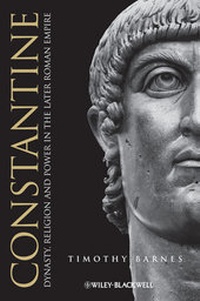
Constantine
Description

Reviews / Votes
"This fine book is a significant achievement in a fertileera of Constantinian studies." (EcclesiasticalHistory, 1 July 2013) "I would recommend a careful reading of this book toanyone who wants to discover what we really know aboutConstantine." (Open House, 1 April 2012) "Summing Up: Essential. Upper-division undergraduates andabove." (Choice, 1 January 2012) "Barnes' hypothesis, that Constantine pursued aggressivelyChristian policies, is sustained through a point-by-point summationof four decades of scholarship, and vindicated by the latestinnovative research. This is a powerful, polemical, and persuasivebook." Paul Stephenson, University of Durham "Thirty years after Constantine and Eusebius, TimBarnes has rejoined the fray of Constantinian studies. Armed withfresh evidence and characteristic vigor, blending biography,politics, and religion, Barnes has once again set the agenda fordebate on topics central to the history of the later Romanworld." Dennis Trout, University of MissouriMore details
Other editions
Additional editions

Person
Content
1
INTRODUCTION
In the preface to his novel about Helena, the mother of Constantine, Evelyn Waugh proclaimed that ‘the Age of Constantine is strangely obscure’ and that ‘most of the dates and hard facts, confidently given in the encyclopedias, soften and dissolve on examination.’ Similarly, Michael Grant began the preface to his book on Constantine by observing that ‘the problem of finding out about Constantine is an acute one’, then quoted these words of Evelyn Waugh before characterizing his own work as ‘another endeavor to walk over the same treacherous quicksands’ (Grant 1998: xi). In their assessment of the ancient evidence for Constantine, which Grant pronounced ‘wholly inadequate’ (Grant 1998: 13), both Waugh and Grant showed far superior judgement to professional historians of the Later Roman Empire who have recently written about the emperor and his place in history.
One such historian goes so far as to make the palpably false claim that ‘Constantine is one of the best documented of the Roman emperors, and a political narrative of his life and reign is straightforward enough’ (Van Dam 2007: 15), while another asserts that, if Constantine remains a problematical figure, it is not ‘because the events of his reign are obscured by a lack of relevant material’ (Lenski 2006b: 2). But the last period of Constantine’s reign from the surrender of the defeated Licinius on 19 September 324 to his own death on 22 May 337 is a truly dark period, in which the course of events is often obscure, except for the emperor’s movements, which can be reconstructed in detail (Barnes 1982: 76–80), and certain aspects of ecclesiastical politics, for which many original documents are preserved (Barnes 1981: 208–244; 1993a: 1–33). For the last third of Constantine’s reign, therefore, it is simply impossible to construct any sort of detailed military or political narrative. Nevertheless, it is possible to write a coherent and connected political and military narrative of the first third of Constantine’s reign (Chapters 4 and 5). Moreover, even if we know far less about Constantine than we do about other periods of Roman history such as the last decades of the Roman Republic, we can understand the basic outlines of his life and career before he became emperor, his political and military achievements as emperor, and his religious policies and attitudes – provided that we allow ourselves to be guided by the ancient evidence and do not seek to impose our own antecedent assumptions on its interpretation.
OFFICIAL LIES AND THE ‘CONSTANTINIAN QUESTION’
Constantine himself is in no small way responsible for creating many of the uncertainties about his religious convictions and religious policies which have been the subject of scholarly controversy since the sixteenth century. He was a highly skilful politician who, like all others of his breed, appreciated the necessity of using deceit in achieving his aims, and he had no compunction about eliminating those who obstructed his dynastic plans (Chapter 5). Moreover, he consistently employed propaganda in order to perpetuate deliberate falsehoods about both himself and important political and dynastic matters. Constantine’s subjects perforce accepted official falsehoods and reiterated them in public – and many no doubt genuinely believed them, as so often happens even in our modern world. Gross falsehoods put out by what may aptly be described as Constantine’s propaganda machine for contemporary consumption have also deceived many recent historians of Constantine and the Later Roman Empire – even those who prided themselves most on their critical acumen.
The prime (and most important) example of modern willingness to acquiesce in Constantine’s misrepresentation of basic facts without proper critical scrutiny is what ought to be the uncontroversial matter of his date of birth. Without exception, ancient authors who offer a figure state that Constantine was in his sixties when he died: according to Eusebius, for example, Constantine began to reign at the age when Alexander the Great died, lived twice as long as Alexander lived and twice as long as he himself reigned (VC 1.8, 4.53).1 The explicit ancient evidence, therefore, unanimously and unambiguously places Constantine’s birth in the early 270s (Barnes 1982: 39–40), and the indirect evidence indicates that he was in fact born on 27 February 273 (Chapter 2). Otto Seeck, however, rejected this date and contended that 288 was almost certainly (‘ziemlich sicher’) the year of Constantine’s birth (1895: 407; 1922: 435–436), adducing five specific items of evidence, namely (i) the mosaic in the palace of Aquileia invoked in the Gallic panegyric of 307 (Pan. Lat. 7[6].6.2i5); (ii) Eusebius’ report that he saw Constantine accompanying Diocletian in 301 or 302 when he was an adolescent (VC 1.19, cf. Chapter 3); (iii) Constantine’s own statement that he was a mere boy in 303 (Eusebius, VC 2.51); and retrospective statements that the emperor was young when he came to power in 306, especially those of (iv) Nazarius in 321 (Pan. Lat. 4[10].16.4: adhuc aevi immaturus sed iam maturus imperio) and (v) Firmicus Maternus in 337 (Mathesis 1.10.16). But the mosaic at Aquileia (i) probably depicted Constantine as a young man in 293, which is perfectly compatible with his being twenty at the time (Chapter 3), while Nazarius (iv), Firmicus Maternus (v) and Eusebius (ii) are merely repeating Constantine’s own deliberate misrepresentation for political reasons of how old he was in 303 and 306. In other words, it cannot be denied that contemporary writers presented Constantine in the last two decades of his life as being younger than he really was. Why? It is naive and simple-minded in the extreme to argue that ‘his precise age was apparently unknown,’ then to deduce from what Eusebius says that Constantine was ‘about thirteen or fourteen’ in 296 or 297 ( Jones in Jones & Skeat 1954: 196–197, slavishly repeated by Winkelmann 1962b: 203). That is not only to date the occasion when Eusebius saw Constantine at the side of Diocletian five years too early (Chapter 3), but to allow undue credence to an official untruth. Constantine himself deliberately lied about his age for political reasons.
Writing to ‘the provincials of the East’ shortly after his defeat of Licinius in 324, Constantine subtly combined two lies about his situation when Diocletian consulted the oracles of Apollo immediately before launching the ‘Great Persecution.’ He claimed that ‘I heard <about it> as a mere youth2 at the time’ (VC 2.51.1: ἠκροώμην τότε κομιδη̑ παι̑ς ἔτι ὑπάρχων). That is doubly false: in the winter of 302–303 Constantine was a mature adult at the court of Diocletian waiting for promotion into the imperial college (Chapter 3). Constantine undoubtedly knew how old he was. His claim that he was a mere boy or youth in 303 is not a simple and straightforward statement of fact from an impartial witness. He was in Nicomedia when the ‘Great Persecution’ started in that city, as he told a different audience at Easter 325 (Chapter 6 at nn. 13–15) and he stayed silent in order not to compromise his position as a crown prince or damage his prospects of being co-opted into the imperial college. More than twenty years later and over a decade after his very public conversion to Christianity, Constantine reminded his new subjects in the East that in 303 his father had protected the Christians of his territories at a time when his three imperial colleagues were not only savage persecutors intent exclusively on their own advantage, but also mentally deranged (VC 2.29). Political animal as he was, the Constantine of 324 avoided the embarrassing question of why he had failed to protest when his Christian friends were being hauled off to execution for their religious beliefs (Vogt 1943a: 194). He simply claimed that, so far from being a grown man of thirty with a prominent position at court in 303, he was in fact in 303 ‘still just a boy.’ For what could a mere boy have done to stop the persecution?
Historians who wrote about Constantine in the nineteenth century or most of the twentieth found it hard to believe that Constantine lied about his age and hence either allowed themselves to be taken in like Seeck or, like Jones, invented an excuse to palliate the misrepresentation. I write as one whose political awareness began in October 1956 with the invasion of Egypt by British, French and Israeli troops acting in concert at the same time as Russian tanks attacked Hungarian civilians on the streets of Budapest. Hence I have long been familiar with official stories designed to deceive. Indeed in 2003 I watched both the American Secretary of State and the British Prime Minister on television as they misled the Security Council of the United Nations and the House of Commons in Westminster about the necessity of invading a small country which they falsely claimed to possess ‘weapons of mass...
