

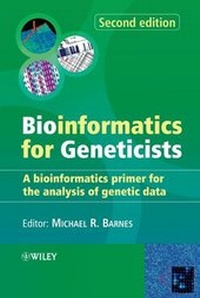
Bioinformatics for Geneticists
A Bioinformatics Primer for the Analysis of Genetic Data
2nd Edition
Published on 13. March 2007
576 pages
978-0-470-05917-3 (ISBN)
Description

Praise from the reviews:
"Without reservation, I endorse this text as the bestresource I've encountered that neatly introduces and summarizesmany points I've learned through years of experience. Thegems of truth found in this book will serve well those who wish toapply bioinformatics in their daily work, as well as help themadvise others in this capacity." CIRCGENETICS
"This book may really help to get geneticists andbioinformaticians on 'speaking-terms'... contains someessential reading for almost any person working in the field ofmolecular genetics." EUROPEAN JOURNAL OF HUMANGENETICS
"... an excellent resource... this book should ensure thatany researcher's skill base is maintained." GENETICALRESEARCH
"... one of the best available and most accessibletexts on bioinformatics and genetics in the postgenome age...The writing is clear, with succinct subsections within eachchapter....Without reservation, I endorse this text as the bestresource I've encountered that neatly introduces andsummarizes many points I've learned through years ofexperience. The gems of truth found in this book will serve wellthose who wish to apply bioinformatics in their daily work, as wellas help them advise others in this capacity." CIRCULATION: CARDIOVASCULAR GENETICS
A fully revised version of the successful First Edition, thisone-stop reference book enables all geneticists to improve theefficiency of their research.
The study of human genetics is moving into a challenging newera. New technologies and data resources such as the HapMap areenabling genome-wide studies, which could potentially identify mostcommon genetic determinants of human health, disease and drugresponse. With these tremendous new data resources at hand, morethan ever care is required in their use. Faced with the sheervolume of genetics and genomic data, bioinformatics is essential toavoid drowning true signal in noise. Considering these challenges,Bioinformatics for Geneticists, Second Edition works atmultiple levels: firstly, for the occasional user who simply wantsto extract or analyse specific data; secondly, at the level of theadvanced user providing explanations of how and why a tool worksand how it can be used to greatest effect. Finally experts fromfields allied to genetics give insight into the best genomics toolsand data to enhance a genetic experiment.
Hallmark Features of the Second Edition:
* Illustrates the value of bioinformatics as a constantlyevolving avenue into novel approaches to study genetics
* The only book specifically addressing the bioinformatics needsof geneticists
* More than 50% of chapters are completely new contributions
* Dramatically revised content in core areas of gene and genomiccharacterisation, pathway analysis, SNP functional analysis andstatistical genetics
* Focused on freely available tools and web-based approaches tobioinformatics analysis, suitable for novices and experiencedresearchers alike
Bioinformatics for Geneticists, SecondEdition describes the key bioinformatics and geneticanalysis processes that are needed to identify human geneticdeterminants. The book is based upon the combined practicalexperience of domain experts from academic and industrial researchenvironments and is of interest to a broad audience, includingstudents, researchers and clinicians working in the human geneticsdomain.
Reviews / Votes
" ...an excellent resource...this book should ensure thatany researcher's skill base is maintained" (GeneticalResearch, 2007) "...this book contains some essential reading for almost anyperson working in the field of molecular genetics." (EuropeanJournal Of Human Genetics, 2007) "Over 19 chapters, the authors cover an impressiveterrain. The focus is mainly on human genetics and genomics, withresearch in other species also presented, particularly where itsupports and advances our understanding of human genetics.Although a thoughtful discussion of the relevant literature andtechniques is found in each chapter, the book is not overlytechnical and does not present advanced mathematical, statistical,or genetic concepts in great depth. Instead, focus is on practicalapplications, available tools, software, and databases, and thepresentation supporting real world research examples. The endresult is one of the best available and most accessible texts onbioinformatics and genetics in the postgenome age...this bookin its current edition still serves as one of the best resourcesavailable, particularly in chapters on noncoding RNAs,pharmacogenetics, and drug discovery, microarrays/gene expression,regulatory polymorphisms, and the potential impacts of amino acidchanges. The writing is clear, with succinct subsections withineach chapter....Without reservation, I endorse this text as thebest resource I've encountered that neatly introduces andsummarizes many points I've learned through years ofexperience. The gems of truth found in this book will serve wellthose who wish to apply bioinformatics in their daily work, as wellas help them advise others in thiscapacity." (Circulation: CardiovascularGenetics, 2008)More details
Other editions
Additional editions
MR Barnes
Bioinformatics for Geneticists - A Bioinformatics Primer for the Analysis of Genetic Data 2e
Software
03/2007
Wiley
€137.68
No shipping information available
Michael R. Barnes
Bioinformatics for Geneticists
A Bioinformatics Primer for the Analysis of Genetic Data
Book
03/2007
2nd Edition
Wiley
€123.50
Shipment within 10-20 days
Michael R. Barnes
Bioinformatics for Geneticists
A Bioinformatics Primer for the Analysis of Genetic Data
Book
03/2007
2nd Edition
Wiley
€212.00
Shipment within 10-20 days
Person
Michael R. Barnes: Bioinformatics, GlaxoSmithKline Pharmaceuticals, UK
Content
- Intro
- Bioinformatics for Geneticists
- Contents
- Foreword
- Preface
- Contributors
- Glossary
- Section I An Introduction to Bioinformatics for the Geneticist
- 1 Bioinformatics Challenges for the Geneticist
- 1.1 Introduction
- 1.2 The Role of Bioinformatics in Genetics Research
- 1.3 Genetics in the Post-Genome Era
- 1.4 Conclusions
- References
- 2 Managing and Manipulating Genetic Data 17
- 2.1 Introduction
- 2.2 Basic Principles
- 2.3 Data Entry and Storage
- 2.4 Data Manipulation
- 2.5 Examples of Code
- 2.6 Resources
- 2.7 Summary
- References
- Section II Mastering Genes, Genomes and Genetic Variation Data
- 3 The HapMap - A Haplotype Map of the Human Genome
- 3.1 Introduction
- 3.2 Accessing the Data
- 3.3 Application of HapMap Data in Association Studies
- 3.4 Future Perspectives
- References
- 4 Assembling a View of the Human Genome
- 4.1 Introduction
- 4.2 Genomic Sequence Assembly
- 4.3 Annotation from a Distance: The Generalities
- 4.4 Annotation up close and Personal: The Specifics
- 4.5 Annotation: The next Generation
- References
- 5 Finding, Delineating and Analysing Genes
- 5.1 Introduction
- 5.2 Why Learn to Predict and Analyse Genes in the Complete Genome Era?
- 5.3 The Evidence Cascade for Gene Products
- 5.4 Dealing with the Complexities of Gene Models
- 5.5 Locating known Genes in the Human Genome
- 5.6 Genome Portal Inspection
- 5.7 Analysing Novel Genes
- 5.8 Conclusions and Prospects
- References
- 6 Comparative Genomics
- 6.1 Introduction
- 6.2 The Genomic Landscape
- 6.3 Concepts
- 6.4 Practicalities
- 6.5 Technology
- 6.6 Applications
- 6.7 Challenges and Future Directions
- 6.8 Conclusion
- References
- Section III Bioinformatics for Genetic Study Design and Analysis
- 7 Identifying Mutations in Single Gene Disorders
- 7.1 Introduction
- 7.2 Clinical Ascertainment
- 7.3 Genome-Wide Mapping of Monogenic Diseases
- 7.4 The Nature of Mutation in Monogenic Diseases
- 7.5 Considering Epigenetic Effects in Mendelian Traits
- 7.6 Summary
- References
- 8 From Genome Scan to Culprit Gene
- 8.1 Introduction
- 8.2 Theoretical and Practical Considerations
- 8.3 A Stepwise Approach to Locus Refinement and Candidate Gene Identification
- 8.4 Conclusion
- 8.5 A List of the Software Tools and Web LInks Mentioned in this Chapter
- References
- 9 Integrating Genetics, Genomics and Epigenomics to Identify Disease Genes
- 9.1 Introduction
- 9.2 Dealing with the (Draft) Human Genome Sequence
- 9.3 Progressing Loci of Interest with Genomic Information
- 9.4 In Silico Characterization of the IBD5 Locus - A Case Study
- 9.5 Drawing Together Biological Rationale - Hypothesis Building
- 9.6 Identification of Potentially Functional Polymorphisms
- 9.7 Conclusions
- References
- 10 Tools for statistical genetics
- 10.1 Introduction
- 10.2 Linkage Analysis
- 10.3 Association Analysis
- 10.4 Linkage disequilibrium
- 10.5 Quantitative Trait Locus (QTL) Rapping in Experimental Crosses
- 10.6 Closing Remarks
- References
- Section IV Moving from Associated Genes to Disease Alleles
- 11 Predictive Functional Analysis of Polymorphisms: An Overview
- 11.1 Introduction
- 11.2 Principles of Predictive Functional Analysis of Polymorphisms
- 11.3 The Anatomy of Promoter Regions and Regulatory Elements
- 11.4 The Anatomy of Genes
- 11.5 Pseudogenes and Regulatory mRNA
- 11.6 Analysis of Novel Regulatory Elements and Motifs in Nucleotide Sequences
- 11.7 Functional Analysis of Non-Synonymous Coding Polymorphisms
- 11.8 Integrated Tools for Functional Analysis of Genetic Variation
- 11.9 A Note of Caution on the Prioritization of in Silico Predictions for Further Laboratory Investigation
- 11.10 Conclusions
- References
- 12 Functional in Silico Analysis of Gene Regulatory Polymorphism
- 12.1 Introduction
- 12.2 Predicting Regulatory Regions
- 12.3 Modelling and Predicting Transcription Factor-Binding Sites
- 12.4 Predicting Regulatory Elements for Splicing Regulation
- 12.5 Evaluating the Functional Importance of Regulatory Polymorphisms
- References
- 13 Amino-Acid Properties and Consequences of Substitutions
- 13.1 Introduction
- 13.2 Protein Features Relevant to Amino-Acid Behaviour
- 13.3 Amino-Acid Classifications
- 13.4 Properties of the Amino Acids
- 13.5 Amino-Acid Quick Reference
- 13.6 Studies of how Mutations Affect Function
- 13.7 A Summary of the Thought Process
- References
- 14 Non-Coding RNA Bioinformatics
- 14.1 Introduction
- 14.2 The Non-Coding (nc) RNA Universe
- 14.3 Computational Analysis of ncRNA
- 14.4 ncRNA Variation in Disease
- 14.5 Assessing the Impact of Variation in ncRNA
- 14.6 Data Resources to Support Small ncRNA Analysis
- 14.7 Conclusions
- References
- Section V Analysis at the Genetic and Genomic Data Interface
- 15 What are Microarrays?
- 15.1 Introduction
- 15.2 Principles of The Application of Microarray Technology
- 15.3 Complementary Approaches to Microarray Analysis
- 15.4 Differences between Data Repository and Research Database
- 15.5 Descriptions of Freely Available Research Database Packages
- References
- 16 Combining Quantitative Trait and Gene-Expression Data
- 16.1 Introduction: The Genetic Regulation of Endophenotypes
- 16.2 Transcript Abundance as a Complex Phenotype
- 16.3 Scaling up Genetic Analysis and Mapping Models for Microarrays
- 16.4 Genetic Correlation Analysis
- 16.5 Systems Genetic Analysis
- 16.6 Using Expression QTLs to Identify Candidate Genes for the Regulation of Complex Phenotypes
- 16.7 Conclusions
- References
- 17 Bioinformatics and Cancer Genetics
- 17.1 Introduction
- 17.2 Cancer Genomes
- 17.3 Approaches to Studying Cancer Genetics
- 17.4 General Resources for Cancer Genetics
- 17.5 Cancer Genes and Mutations
- 17.6 Copy Number Alterations in Cancer
- 17.7 Loss of Heterozygosity in Cancer
- 17.8 Gene-Expression Data in Cancer
- 17.9 Multiplatform Gene Target Identification
- 17.10 The Epigenetics of Cancer
- 17.11 Tumour Modelling
- 17.12 Conclusions
- References
- 18 Needle in a Haystack? Dealing with 500 000 SNP Genome Scans
- 18.1 Introduction
- 18.2 Genome Scan Analysis Issues
- 18.3 Ultra-High-Density Genome-Scanning Technologies
- 18.4 Bioinformatics for Genome Scan Analysis
- 18.5 Conclusions
- References
- 19 A Bioinformatics Perspective on Genetics in Drug Discovery and Development
- 19.1 Introduction
- 19.2 Target Genetics
- 19.3 Pharmacogenetics (PGx)
- 19.4 Conclusions: Toward 'Personalized Medicine'
- References
- Appendix I
- Appendix II
- Index
