

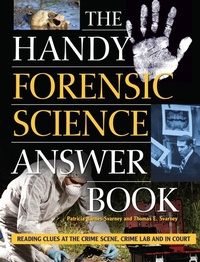
The Handy Forensic Science Answer Book
Description

A practical, accessible, and informative guide to the science of criminal investigations. Covering the fundamentals, science, history, and analysis of clues, The Handy Forensic Science Answer Book: Reading Clues at the Crime Scene, Crime Lab and in Court provides detailed information on crime scene investigations, techniques, laboratory finding, the latest research, and controversies. It looks at the science of law enforcement, how evidence is gathered, processed, analyzed, and viewed in the courtroom, and more. From the cause, manner, time of a death, and autopsies to blood, toxicology, DNA typing, fingerprints, ballistics, tool marks, tread impressions, and trace evidence, it takes the reader through the many sides of a death investigation. Arson, accidents, computer crimes, criminal profiling, and much, much more are also addressed. The Handy Forensic Science Answer Book gives real-world examples and looks at what Hollywood gets right and wrong. It provides the history of the science, and it introduces the scientists behind breakthroughs. An easy-to-use and informative reference, it brings the complexity of a criminal investigation into focus and provides well-researched answers to over 950 common questions, such as ...
- What is the difference between cause of death and manner of death?
- How did a person's skull fit into criminal evidence in the early 1800s?
- When were fingerprints first used to identify a criminal?
- How is the approximate time of death of a crime scene victim determined?
- What is forensic serology?
- What is the National Missing and Unidentified Persons System?
- Can a forensics expert look at skeletal remains and tell whether the person was obese?
- How can a simple knot analyzed in the crime lab be used as evidence?
- Can fingerprints be permanently changed or destroyed?
- How fast does a bullet travel?
- How was a chemical analysis of ink important in the conviction of Martha Stewart?
- What types of data are often retrieved from a crime scene cellphone?
- Can analyses similar to those used in forensics be used to uncover doping in athletics?
- What is the Personality Assessment Inventory?
- What are some motives that cause an arsonist to start a fire?
- What state no longer allows bite marks as admissible evidence in a trial?
- What is the Innocence Project?
- Why are eyewitness accounts not always reliable?
- Who was ?Jack the Ripper??
More details
Other editions
Additional editions
Persons
Content
Introduction 1. Overview 2. History of Forensic Science 3. The Crime Site and Investigation Teams 4. Looking for Biological Evidence 5. Looking for Physical Evidence 6. Analyzing a Body 7. Analyzing Older Remains 8. Trace Evidence 9. Patent, Latent, and Plastic Prints 10. DNA Analysis 11. Toolmarks, Firearms, and Ballistics 12. Examining Explosives 13. Questioned Documents and Cryptanalysis 14. Computer, Accounting, and Other Forensic Investigations 15. Forensic Psychology 16. The Legal Process 17. Controversies in Forensic Science 18. Famous (and Infamous) Crimes and Forensic Science 19. The Media and Forensic Science Glossary Resources Further Reading Index
