

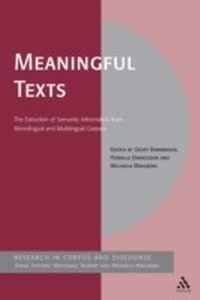
Meaningful Texts
The Extraction of Semantic Information from Monolingual and Multilingual Corpora
1st Edition
Published on 1. December 2004
242 pages
978-1-84714-232-0 (ISBN)
Description

This book reflects the growing influence of corpus linguistics in a variety of areas such as lexicography, translation studies, genre analysis, and language teaching.
The book is divided into two sections, the first on monolingual corpora and the second addressing multilingual corpora. The range of languages covered includes English, French and German, but also Chinese and some of the less widely known and less widely explored central and eastern European language. The chapters discuss:
- the relationship between methodology and theory
- the importance of computers for linking textual segments, providing teaching tools, or translating texts
- the significance of training corpora and human annotation
- how corpus linguistic investigations can shed light on social and cultural aspects of language
Presenting fascinating research in the field, this book will be of interest to academics researching the applications of corpus linguistics in modern linguistic studies and the applications of corpus linguistics.
More details
Series
Edition
1. Auflage
Language
English
Place of publication
London
United Kingdom
Publishing group
Bloomsbury Publishing PLC
Target group
Professional and scholarly
ISBN-13
978-1-84714-232-0 (9781847142320)
Copyright in bibliographic data and cover images is held by Nielsen Book Services Limited or by the publishers or by their respective licensors: all rights reserved.
Schweitzer Classification
Other editions
Additional editions
Geoff Barnbrook | Pernilla Danielsson | Michaela Mahlberg
Meaningful Texts
The Extraction of Semantic Information from Monolingual and Multilingual Corpora
Book
09/2006
Continuum International Publishing Group Ltd.
€113.80
Shipment within 15-20 days
Persons
Content
Part One Monolingual Corpora
1. Extracting concepts from dynamic legislative text collections
Gael Dias, Sara Madeira and Jose Gabriel Pereira Lopes
2. A diachronic genre corpus: problems and findings from the DIALAYMED-Corpus (DIAchronic Multilingual Corpus of LAYman-oriented MEDical Texts)
Eva Martha Eckkrammer
3. Word meaning in dictionaries, corpora and the speaker's mind
Christiane Fellbaum, Lauren Delfs, Susanne Wolff and Martha Palmer
4. Extracting meaning from text
Gregory Grefenstette
5. Translators at work: a case study of electronic tools used by translators in industry
Riitta Jaaskelainen and Anna Mauranen
6. Extracting meteorological contexts from the newspaper corpus of Slovenian
Primoz Jakopin
7. The Hungarian possibility suffix - hat/ het as a dictionary entry
Frenc Kiefer
8. Dictionaries, corpora and word-formation
Simon Krek, Vojko Gorjanc and Marko Stabej
9. Hidden culture: using the British National Corpus with language learners to investigate collocational behaviour, wordplay and culture-specific references
Dominic Stewart
10. Language as an economic factor: the importance of terminology
Wolfgang Teubert
11. Lemmatisation and collocational analysis of Lithuanian nouns
Andrius Utka
12. Challenging the native speaker norm: a corpus driven analysis of scientific usage
Geoffrey Williams
Part Two: Multilingual Corpora
13. Chinese-English translation database: extracting units of translation from parallel texts
Chang Baobao, Pernilla Danielsson and Wolfgang Teubert
14. Abstract nouns collocations: their nature in a parallel English-Czech corpus
Frantisek Cermak
15. Parallel corpora and translation studies: old questions, new perspectives? Reporting that in Gepcolt. A case study
Dorothy Kenny
16. Structural derivation and meaning extraction: a comparative study of French-Serbo-Croatian parallel texts
Cvetana Krstev and Dusko Vitas
17. Noun collocations from a multilingual perspective
Ruta Marcinkeviciene
18. Studies of English-Latvian legal texts for Machine Translation
Inguna Skadina
19. The applicability of lemmatization in translation equivalents detection
Marko Tadic, Sanja Fulgosi and Kresimir Sojat
20. Cognates: free rides, false friends or stylistic devices? A corpus based comparative study
Spela Vintar and Silvia Hansen
21. Trilingual corpus and its use for the teaching of reading comprehension in French
Xu Xunfeng and Regis Kawecki
1. Extracting concepts from dynamic legislative text collections
Gael Dias, Sara Madeira and Jose Gabriel Pereira Lopes
2. A diachronic genre corpus: problems and findings from the DIALAYMED-Corpus (DIAchronic Multilingual Corpus of LAYman-oriented MEDical Texts)
Eva Martha Eckkrammer
3. Word meaning in dictionaries, corpora and the speaker's mind
Christiane Fellbaum, Lauren Delfs, Susanne Wolff and Martha Palmer
4. Extracting meaning from text
Gregory Grefenstette
5. Translators at work: a case study of electronic tools used by translators in industry
Riitta Jaaskelainen and Anna Mauranen
6. Extracting meteorological contexts from the newspaper corpus of Slovenian
Primoz Jakopin
7. The Hungarian possibility suffix - hat/ het as a dictionary entry
Frenc Kiefer
8. Dictionaries, corpora and word-formation
Simon Krek, Vojko Gorjanc and Marko Stabej
9. Hidden culture: using the British National Corpus with language learners to investigate collocational behaviour, wordplay and culture-specific references
Dominic Stewart
10. Language as an economic factor: the importance of terminology
Wolfgang Teubert
11. Lemmatisation and collocational analysis of Lithuanian nouns
Andrius Utka
12. Challenging the native speaker norm: a corpus driven analysis of scientific usage
Geoffrey Williams
Part Two: Multilingual Corpora
13. Chinese-English translation database: extracting units of translation from parallel texts
Chang Baobao, Pernilla Danielsson and Wolfgang Teubert
14. Abstract nouns collocations: their nature in a parallel English-Czech corpus
Frantisek Cermak
15. Parallel corpora and translation studies: old questions, new perspectives? Reporting that in Gepcolt. A case study
Dorothy Kenny
16. Structural derivation and meaning extraction: a comparative study of French-Serbo-Croatian parallel texts
Cvetana Krstev and Dusko Vitas
17. Noun collocations from a multilingual perspective
Ruta Marcinkeviciene
18. Studies of English-Latvian legal texts for Machine Translation
Inguna Skadina
19. The applicability of lemmatization in translation equivalents detection
Marko Tadic, Sanja Fulgosi and Kresimir Sojat
20. Cognates: free rides, false friends or stylistic devices? A corpus based comparative study
Spela Vintar and Silvia Hansen
21. Trilingual corpus and its use for the teaching of reading comprehension in French
Xu Xunfeng and Regis Kawecki
