

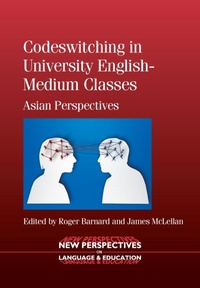
Codeswitching in University English-Medium Classes
Asian Perspectives
Published on 20. December 2013
248 pages
978-1-78309-092-1 (ISBN)
Description

In the complex, multilingual societies of the 21st century, codeswitching is an everyday occurrence, and yet the use of students' first language in the English language classroom has been consistently discouraged by teachers and educational policy-makers. This volume begins by examining current theoretical work on codeswitching and then proceeds to examine the convergence and divergence between university language teachers' beliefs about codeswitching and their classroom practice. Each chapter investigates the extent of, and motivations for, codeswitching in one or two particular contexts, and the interactive and pedagogical functions for which alternative languages are used. Many teachers, and policy-makers, in schools as well as universities, may rethink existing 'English-only' policies in the light of the findings reported in this book.
Reviews / Votes
Barnard and McLellan have brought together a group of rigorous empirical investigations of one of the most overlooked and undertheorized aspects of second-language classrooms, namely the use of the first language and the practice of codeswitching in the second-language classroom. This collection of studies done across Asia should be read by applied linguists, language teachers at all levels, and particularly educational policy-makers who currently assert that there is no place in the classroom for codeswitching and the students' first language. -- Glenn Levine, University of California, Irvine, USA Barnard and McLellan's co-edited book is not only timely but also highly relevant. As the English language becomes a medium of instruction across many more campus classrooms in Asia, this book - with its many careful analyses of rich data and evidence - will turn readers towards reshaping their beliefs and practices regarding instructional strategies in multilingual settings. The book begs the question: can bilingual code-switching become an immense tool for teaching and learning in the Asian context and the 21st century? -- Anne Pakir, National University of Singapore, Singapore This book makes an important contribution in providing interesting examples from a variety of contexts including some that are vastly under-reported in the literature. This volume will appeal to teachers and researchers in EFL who want to understand more about the role of codeswitching in Asian university contexts as well as to language policymakers within those contexts. The book will also serve as a useful resource for students of applied linguistics, particularly those with an interest in codeswitching but also those interested more widely in comparing the impact of native and non-native speaking teachers of EFL, the implementation of English as a lingua franca and possibly also bilingual education. -- Althea Ha, The University of Hong Kong * The Asian Journal of Applied Linguistics Vol. 2 No. 1, 2015 * This volume has much to offer those teaching in English-only policy environments and for those researching classroom codeswitching in higher education. Its unique case-study/commentator format is interesting to read and facilitates cross-case comparison. Overall, Codeweitching in University English-Medium Classes: Asian Perspectives is a must-read for anyone interested in classroom codeswitching across diverse contexts.-- Catherine M. Mazak, University of Puerto Rico, Mayagueez, Puerto Rico * Journal of Immersion and Content-Based Language Education, 3:1 (2015), 161-163. * We should celebrate the wealth of fresh data that is presented, material that certainly adds to our knowledge about the extent of codeswitching practices in a wide range of English-medium classes in Asia, some of the reasons why this codeswitching occurs, and the attitudes of various teachers and their students towards the practice of codeswitching. Indeed, all the chapters in the book are packed full of data, many offering numerical analysis of the extent of codeswitching and the reasons for it occurring, and most chapters include detailed examples of actual codeswitching occurring in the classroom. -- David Deterding, Universiti Brunei Darussalam, Brunei * Southeast Asia: A Multidisciplinary Journal, Vol 14, 2014, pp 36-38 *
More details
Series
Language
English
Place of publication
Bristol
United Kingdom
Publishing group
Channel View Publications Ltd
Target group
Professional and scholarly
ISBN-13
978-1-78309-092-1 (9781783090921)
Copyright in bibliographic data and cover images is held by Nielsen Book Services Limited or by the publishers or by their respective licensors: all rights reserved.
Schweitzer Classification
Other editions
Additional editions
Book
12/2013
Multilingual Matters
€47.90
Shipment within 10-20 days
Persons
Roger Barnard is an Associate Professor in Applied Linguistics at the University of Waikato, New Zealand. His recent publications include Researching Language Teacher Cognition and Practice (2012, edited with Anne Burns) and Creating Classroom Communities of Learning (2009, edited with Maria Torres-Guzman).
James McLellan is a Senior Lecturer in English Language and Linguistics at Universiti Brunei Darussalam. His recent publications include Code Switching in Malaysia (2009, edited with M.K. David, S. Rafik-Galea and Ain Nadzimah Abdullah ).
James McLellan is a Senior Lecturer in English Language and Linguistics at Universiti Brunei Darussalam. His recent publications include Code Switching in Malaysia (2009, edited with M.K. David, S. Rafik-Galea and Ain Nadzimah Abdullah ).
Content
Contributors
Transcription conventions
Roger Barnard and James McLellan: Introduction
Ernesto Macaro: Overview: Where Should we be Going with Classroom Codeswitching Research?
1. Ching-yi Tien and David C.S. Li: Codeswitching in a University in Taiwan
2. Lili Tian and Claudia Kunschak: Codeswitching in two Chinese Universities
3. Simon Humphries and Richmond Stroupe: Codeswitching in two Japanese Contexts
4. Chamaipak Tayjasanant and Matthew G. Robinson: Codeswitching in Universities in Thailand and Bhutan
5. Le Van Canh and Fuad Abdul Hamied: Codeswitching in Universities in Vietnam and Indonesia
6. Noor Azam Haji-Othman, Hajah Zurinah Haji Ya'akub, Liyana Ghani, Hajah Suciyati Haji Sulaiman, Saidai Haji Hitam Ain Nadzimah Abdullah and Chan Swee Heng: Codeswitching in Universities in Brunei Darussalam and Malaysia
7. Kenneth Ong Keng Wee, Lawrence Jun Zhang and Isabel Pefianco Martin: Codeswitching in Universities in Singapore and the Philippines
8. Moyra Sweetnam Evans, Ha Rim Lee and Hyun-Ju Kim: Codeswitching by Korean Students in New Zealand and Lecturers in Korea
9. Andy Kirkpatrick: Afterword
Transcription conventions
Roger Barnard and James McLellan: Introduction
Ernesto Macaro: Overview: Where Should we be Going with Classroom Codeswitching Research?
1. Ching-yi Tien and David C.S. Li: Codeswitching in a University in Taiwan
2. Lili Tian and Claudia Kunschak: Codeswitching in two Chinese Universities
3. Simon Humphries and Richmond Stroupe: Codeswitching in two Japanese Contexts
4. Chamaipak Tayjasanant and Matthew G. Robinson: Codeswitching in Universities in Thailand and Bhutan
5. Le Van Canh and Fuad Abdul Hamied: Codeswitching in Universities in Vietnam and Indonesia
6. Noor Azam Haji-Othman, Hajah Zurinah Haji Ya'akub, Liyana Ghani, Hajah Suciyati Haji Sulaiman, Saidai Haji Hitam Ain Nadzimah Abdullah and Chan Swee Heng: Codeswitching in Universities in Brunei Darussalam and Malaysia
7. Kenneth Ong Keng Wee, Lawrence Jun Zhang and Isabel Pefianco Martin: Codeswitching in Universities in Singapore and the Philippines
8. Moyra Sweetnam Evans, Ha Rim Lee and Hyun-Ju Kim: Codeswitching by Korean Students in New Zealand and Lecturers in Korea
9. Andy Kirkpatrick: Afterword
