

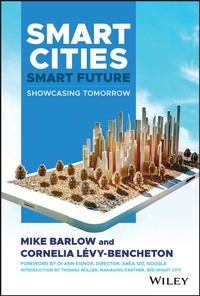
Smart Cities, Smart Future
Description

More details
Other editions
Additional editions
Content
- Cover
- Title Page
- Copyright
- Contents
- Foreword
- Acknowledgments
- Introduction
- Collaboration Engines
- Focused on People
- Dealing with Obstacles
- Will Government Help or Hinder?
- Connected Ecosystems
- Setting the Stage for Long-Term Success
- Platforms for Continuous Innovation
- Endnotes
- Chapter 1 Cities of Our Dreams
- What Makes a City Smart?
- Cities on a Hill
- A New Approach to City Planning
- Thinking beyond Technology
- Looking Backward
- Smart by Necessity
- Public-Private Partnerships
- Open Data
- Skin in the Game
- Follow the Dream
- Endnotes
- Chapter 2 Data Cities
- Open Is Smarter
- Hacking in Berlin
- Thousands of Layers
- The Rise of Data Science
- A Web of Information
- Saving Water and Protecting Children
- Cops, Firefighters, and Data Scientists
- Endnotes
- Chapter 3 Cities in Motion
- Congestion Pricing
- Expanding Opportunities
- Car Culture Remains Strong
- Will the Car Find a Parking Spot?
- Learning to Love Big Data
- Multimodal Mobility
- Battling Complacency
- Moving Goods and People
- Jobs and Access to Transit
- The Bottleneck at Morrill's Corner
- Endnotes
- Chapter 4 Forces of Attraction
- Racing to Quality
- Punching a Featherbed
- A Billion Saved Is a Billion Earned
- Big Brother and the Nanny State
- Flatter Organizations and Circular Economies
- The Future of Work Is the Future of Cities
- Workforce Transformation
- Endnotes
- Chapter 5 Human-Centered Design
- Targeting Hard Problems
- Blending in Behavioral Science
- Bringing Together Data and Design
- Plain Language
- Back to the Drawing Board
- Invisible Heroes
- Keeping It Simple
- Single Purpose, Many Hats
- Designing for Usability
- Endnotes
- Chapter 6 Citizens in the Loop
- Weaving a Stronger Social Fabric
- Knowledge Champions
- Start-Up Government
- Following Instincts, Not Tech Trends
- Endnote
- Chapter 7 We Decide
- Updating Democracy
- Ditch the Status Quo
- Technopolitics
- Collaborative Government
- Strengthening Social Ties
- Narrowing the Focus to Specific Segments
- Works in Progress
- It's the Journey, Not the Destination
- Endnotes
- Chapter 8 Smart Nation
- Tabula Rasa
- Fortune Plays a Hand
- X-Road
- Building Trust through Practice
- Once Only
- Turning an Attack into a Challenge
- In the Know
- The Shape of Things to Come
- Endnotes
- Chapter 9 Paint a Bull's-Eye on Them
- The Bored
- The Desperate
- The Villainous
- Small Disruptions Can Have Large Consequences
- Data in Motion
- People Are Worth More Than Data
- Cybersecurity by Design
- The Smart-City CISO
- Hierarchies and Networks
- A Universe of Connected People and Devices
- Endnotes
- Chapter 10 Finding a Balance
- Data for Good
- Location, Location, Location
- Hard Questions
- Algorithmic Bias
- Can We Prevent Crime Before It Happens?
- Red Flags
- Will Smart Cities Respect Privacy?
- Pushing Back
- Endnote
- Chapter 11 Deceptive Complexity
- Progressive Development
- Evolving Strategies
- Enter the Smartivist
- Defining the Smart-City Process
- Six Fields of Action
- Smart Economy
- Smart Environment
- Smart Government
- Smart Living
- Smart Mobility
- Smart People
- Toward the Fourth Generation of Smart Cities
- Endnotes
- Appendix A Organizations and Councils
- Endnote
- Appendix B Conferences and Events
- Glossary
- Endnotes
- Recommended Reading
- Nonfiction
- Fiction
- Meet Our Expert Sources
- About the Authors
- Index
- EULA
FOREWORD
Authors Mike Barlow and Cornelia Lévy-Bencheton have distilled hundreds of ideas, sources, technologies, and dreams into a thoughtful showcase of tomorrow. Much of the information is widely available, but their analysis, synthesis, and narrative make this a foundational guide for all of us.
And we need it.
Within the next 20 years, 70 percent of the world's population will be living in cities. The exponential change will be staggering. Designing and operating smarter cities is not just a movement-it is the inevitable shape of our future and the culture we are capable of building together. It will take an ecosystem-government, citizens, companies, and academics-to make sure that we do this right and hold each other accountable.
We have an opportunity to reimagine our cities and our lives in a way that is more equitable, more just, more sustainable, and just plain happier. But we need to do it now and make sure that new exponential technologies and governing bodies are of service and enhance the quality of life of our citizens.
As with all change, it will be uncomfortable. Citizens will demand transparency, higher levels of service, and quality of life. And they will be able to compare their services to their neighbors and to residents of other cities across the globe.
Today, lack of trust is one of the largest barriers to massive collaboration. We assume that each person and entity has an agenda. We've learned that it is hard to trust across borders or outside of our groups.
But one of the most exciting aspects of transformative technologies is the ability to delegate trust across decentralized networks. It will become much harder to incentivize people for actions that are not in the common interest. When we don't have to worry about trust, we can focus on what we can achieve. That level of collaboration has never been seen before and will be a powerful force in design and co-creation.
We are seeing an emerging cultural shift in which technology is the supportive tool set. The key questions are: How do we make tools that allow all of these cities and citizens to improve quality of life, and how do we scale citizen engagement and participation, so we can define and measure quality of life? That's what really matters.
Governments, private companies, and citizens will all need to work together to design these platforms, and to provide knowledge, outreach, and tools that are distributed, decentralized, and available to all. The work that lies ahead is hard and it requires radical adaptability.
As an entrepreneur, urbanist, and investor, I'm inspired by the seeds of the platforms outlined in this book. They speak to supporting citizens, citizen experience, and human-centered design. DigiTel, Tel Aviv's innovative citizen information platform, is a good example of the kind of people-focused technology we need. The goal of DigiTel is helping people to become more engaged with their city and its services. It helps residents form deeper and stronger emotional connections with the urban environment around them.
As a dreamer, I knew from the opening page that I would love this book. I don't think Blade Runner, I think Shambhala. If we imagine it, we can build it. And I nodded vigorously at every chapter, especially the book's opener.
El Dorado, Atlantis, Shambhala, Avalon, Xanadu, and Shangri-La. Those fabled places inspire our dreams. They are fantasies that nourish our imagination, spark our curiosity and embolden us to envision what could be. This book approaches the smart city from the perspective of the human spirit . This is a book for dreamers and visionaries. We invite you to dream along with us and to imagine the world your children and grandchildren will inhabit.
As a technologist, I know that our future urban systems will bridge data, provide insights, and be more efficient and transparent, but I feel a heavy responsibility to be a wise steward of these technologies and ensure that they are working for the people and designed with the people.
I started the US office of Waze nine years ago, underestimating the impact we would have on mobility and ultimately on city operations. One Friday night in 2012, I got a call from the White House during Superstorm Sandy. There was a fuel shortage on Staten Island, N.Y. Motorists were waiting in lines for three to four hours. The government asked for our help in collecting citizen data. For the first time ever, we sent a push notification to all Wazers in the area asking for information on which gas stations had power, which had fuel, and how long the lines were.
By the next day, we had thousands of responses that the Federal Emergency Management Agency (FEMA) could use to figure out where to send fuel trucks. That fundamentally changed my perception of what we were creating. It inspired the launch of the Waze Connected Citizens program to share data on incidents, traffic, events, and construction between Waze and city partners.
Since then, we've worked with over 650 cities, trying to help them use data as infrastructure. Our data has been used to improve emergency response times (e.g., in the United States, 70 percent of crashes are reported through Waze before they're reported through 911), close the loop on citizen problems, such as potholes and speed limit changes, redefine waste management and snowplow routes, and reduce congestion. In harnessing the insights of millions of Wazers, we have evolved from a traffic app to a change agent in traffic and mobility innovation.
One of our biggest successes came during the 2016 Summer Olympics in Rio de Janeiro. The city needed to accommodate a million visitors in an area that was already famously congested. We created an ad hoc team of Waze employees, Waze on-the-ground map editor volunteers, city officials, and citizens-all working together to collect and share the information as quickly as possible. The ad hoc partnerships performed marvelously, and case studies from Rio have now been shared with other cities, which can learn from these tests.
But we didn't stop there. We formed our Connected Citizens program with hundreds of global partners, including city, state, and national government agencies; nonprofits; and first responders. Software code from the program is now on GitHub and other open platforms, where it can be shared and adapted by cities and states all over the world.
Experiments are a start, but ongoing learning, iteration, operational tools, and transparency allow cities to become living laboratories in the best sense.
Based on this work, I'm now currently incubating new urban systems at Google's Area 120. Here are a few guiding motivations:
- Technology can enable cultures to flourish in their own unique ways.
- Technology should remove unwanted friction and allow people to focus on quality of life.
- Technology must evolve hand in hand with ethics, philosophy, and society.
- Technology is the best opportunity we have to discover the needs, ideas, and voices of every citizen.
I look at this as a move toward the self-awareness of cities. Self-awareness describes a process of learning, reflecting, acting on what we've learned, and constant adaptation to become better. A city is a living organism that adapts with every new citizen, event, visitor, and policy.
A city can have its own self-awareness, powered by technology in service of society. Self-awareness is also a cornerstone of a life well lived for individuals within a community. We will screw things up, we will scrap ideas that sounded good and were voted in. We will iterate and learn.
Self-awareness is the most human of goals. We want to improve, see things clearly, and understand our place in the world. This is what the right urban technology platform and planning can enable.
Existential technologies, including robots, artificial intelligence (AI), blockchains, and even self-driving cars, can fundamentally alter society and must be deployed thoughtfully and responsibly as part of an entire intelligent system. We will need to deal with issues, such as privacy in blockchain, bias in AI, fair economic development in robotics, and just use of space, as well as other important policy decisions.
The goal of this effort is the wise stewardship of technology to support culture and society through a new urban system that is dynamic, adaptive, and supportive.
I read this manuscript while in Barcelona, Spain, a city that was referenced multiple times for its quality of support and civic engagement. I was inspired to visit projects and places mentioned by authors Mike and Cornelia, such as the Institute of Advanced Architecture of Catalonia, where they are 3D printing algorithmic "bricks" of local soil and crafting citizen sensor kits.
I see technology being used to make tools to be used by all. Developed at Barcelona's Laboratory for Democratic Innovation, Decidim is a joint effort of 17 organizations, including software companies, industry consortiums, research institutions, and civic associations. Decidim allows citizens to propose ideas, conduct surveys, call public meetings, and join the debate on whether proposals are good solutions to identified needs. Decidim is currently used by municipalities in other parts of Spain, and by local governments in Finland and France.
For me, this book is a call to action. As they say in Catalonia: Decidem. We decide. Let's get on it!
Di-Ann Eisnor
Director Area 120,...
