

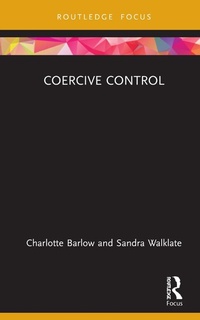
Coercive Control
1st Edition
Published on 18. January 2022
122 pages
978-1-000-55502-8 (ISBN)
Description

This book offers a critical appreciation of the nature and impact of coercive control in interpersonal relationships. It examines what this concept means, who is impacted by the behaviours it captures, and how academics, policymakers, and policy advocates have responded to the increasing recognition of the deleterious effects that coercive control has on especially women's lives.
The book discusses the historical emergence of this concept, who its main proponents have been, and how its effects have been understood. It considers the role of coercive control in making sense of women's pathway into crime as well as their experiences of it as victims. Coercive control has been presented predominantly as a gendered process, and consideration is given in this book to the efficacy of this assumption as well as the extent to which the concept makes sense for a wide constituency of marginalized women. In recent years, much energy has been given to efforts to criminalize coercive control, and the concerns that these efforts generate are discussed in detail, alongside what the limitations to such initiatives might be. In conclusion, the book situates the rising pre-occupation with coercive control within the broader concerns with policy transfer, ways of taking account of victim-survivor voices, alongside the importance of working towards more holistic policy responses to violence(s) against women.
The book will be of particular interest to academics, policymakers, and practitioners working in criminal justice who wish to understand both the nature and extent of coercive control and the importance of appreciating the role of nuance in translating that understanding into practice.
The book discusses the historical emergence of this concept, who its main proponents have been, and how its effects have been understood. It considers the role of coercive control in making sense of women's pathway into crime as well as their experiences of it as victims. Coercive control has been presented predominantly as a gendered process, and consideration is given in this book to the efficacy of this assumption as well as the extent to which the concept makes sense for a wide constituency of marginalized women. In recent years, much energy has been given to efforts to criminalize coercive control, and the concerns that these efforts generate are discussed in detail, alongside what the limitations to such initiatives might be. In conclusion, the book situates the rising pre-occupation with coercive control within the broader concerns with policy transfer, ways of taking account of victim-survivor voices, alongside the importance of working towards more holistic policy responses to violence(s) against women.
The book will be of particular interest to academics, policymakers, and practitioners working in criminal justice who wish to understand both the nature and extent of coercive control and the importance of appreciating the role of nuance in translating that understanding into practice.
Reviews / Votes
Ask any survivor of male violence about her abusive experiences and you will undoubtedly discover that she will call for a definition that includes many harmful nonphysical and nonsexual behaviors like those described in this book. It is a vital resource for anyone seeking a richer social scientific understanding of one of the most significant threats to the health and well-being of women today.Walter DeKeseredy, Director of the Research Center on Violence and Professor of Sociology, West Virginia University
While many countries have criminalised coercive control in order to combat violence against women, fewer have appraised whether such laws will work as promised. In this thoroughgoing critique, Barlow and Walklate offer a radically new perspective that explores how professional responses to victimized women expose them to further jeopardy in the criminal and family courts, child protection systems and from perpetrators themselves. Essential reading that cautions against quick fixes while advising on what needs to be done to best support those facing multiple forms of discrimination and abuse.
David Gadd, Professor of Criminology, University of Manchester
This book is a clear and lucid explanation of the concept of coercive control, as well as some of the central debates and issues thrown up by the research grappling with intimate partner violence in the law and policy context. It is essential reading for academics and policy makers working on improving our responses to intimate partner violence.
Julia Tolmie, Professor of Law, University of Auckland
Coercive control has become a buzzword in policy discussions about domestic violence in select countries. However, the term is used in ways that bear little resemblance to its empirically derived theoretical roots. Coercive Control contributes a valuable critical discussion of the development of divergent understandings of the concept and debates about the implications of transferring a theory based on research about heterosexual men's violence against women into criminal legal frameworks that are largely gender-blind.
Molly Dragiewicz, Associate Professor, Griffith University Ask any survivor of male violence about her abusive experiences and you will undoubtedly discover that she will call for a definition that includes many harmful nonphysical and nonsexual behaviors like those described in this book. It is a vital resource for anyone seeking a richer social scientific understanding of one of the most significant threats to the health and well-being of women today.
Walter DeKeseredy, Director of the Research Center on Violence and Professor of Sociology, West Virginia University
While many countries have criminalised coercive control in order to combat violence against women, fewer have appraised whether such laws will work as promised. In this thoroughgoing critique, Barlow and Walklate offer a radically new perspective that explores how professional responses to victimized women expose them to further jeopardy in the criminal and family courts, child protection systems and from perpetrators themselves. Essential reading that cautions against quick fixes while advising on what needs to be done to best support those facing multiple forms of discrimination and abuse.
David Gadd, Professor of Criminology, University of Manchester
This book is a clear and lucid explanation of the concept of coercive control, as well as some of the central debates and issues thrown up by the research grappling with intimate partner violence in the law and policy context. It is essential reading for academics and policy makers working on improving our responses to intimate partner violence.
Julia Tolmie, Professor of Law, University of Auckland
Coercive control has become a buzzword in policy discussions about domestic violence in select countries. However, the term is used in ways that bear little resemblance to its empirically derived theoretical roots. Coercive Control contributes a valuable critical discussion of the development of divergent understandings of the concept and debates about the implications of transferring a theory based on research about heterosexual men's violence against women into criminal legal frameworks that are largely gender-blind.
Molly Dragiewicz, Associate Professor, Griffith University
This fascinating edited collection explores the development of victim policies internationally and historically. It extends our gaze from current victims' rights in adversarial systems to social welfare systems and to victims who have historically been ignored and badly treated within the system. Importantly, many chapters delve into the available empirical data to see whether victims' experiences in practice mirror their rights as set out in legislation and policy.'
Joanna Shapland, Edward Bramley Professor of Criminal Justice, The University of Sheffield
More details
Series
Edition
1. Auflage
Language
English
Place of publication
London
United Kingdom
Publishing group
Taylor & Francis Ltd
Target group
College/higher education
Professional and scholarly
ISBN-13
978-1-000-55502-8 (9781000555028)
Copyright in bibliographic data and cover images is held by Nielsen Book Services Limited or by the publishers or by their respective licensors: all rights reserved.
Schweitzer Classification
Other editions
Additional editions
Charlotte Barlow | Sandra Walklate
Coercive Control
Book
11/2023
1st Edition
Routledge
€32.80
Shipment within 10-20 days
Charlotte Barlow | Sandra Walklate
Coercive Control
Book
01/2022
1st Edition
Routledge
€76.70
Shipment within 15-20 days
Persons
Charlotte Barlow is a Reader in Criminal Justice and Policing at UCLAN. She has led various research projects in the field of domestic abuse, including police responses to coercive control, responding to domestic abuse in rural communities, and victim-survivor experiences of Clare's Law/ Domestic Violence Disclosure Schemes.
Sandra Walklate is Eleanor Rathbone Chair of Sociology at the University of Liverpool, UK, conjoint Chair of Criminology, Monash University, Australia. Internationally recognized for her work in victimology, gender and violence, she is currently President of the British Society of Criminology.
Sandra Walklate is Eleanor Rathbone Chair of Sociology at the University of Liverpool, UK, conjoint Chair of Criminology, Monash University, Australia. Internationally recognized for her work in victimology, gender and violence, she is currently President of the British Society of Criminology.
Content
1. What is 'coercive control'? 2. Coercion into crime: the role of coercive control 3. Coercive control and victimization 4. Criminalizing coercive control 5. Coercive control, the man of law, and the role of the state 6. Concluding thoughts: coercive control, victim-survivors, and the policy process
