

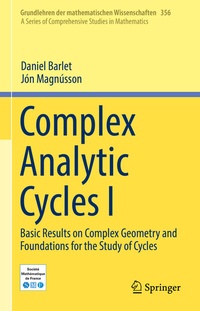
Complex Analytic Cycles I
Description

The book consists of a presentation from scratch of cycle space methodology in complex geometry. Applications in various contexts are given. A significant portion of the book is devoted to material which is important in the general area of complex analysis. In this regard, a geometric approach is used to obtain fundamental results such as the local parameterization theorem, Lelong' s Theorem and Remmert's direct image theorem. Methods involving cycle spaces have been used in complex geometry for some forty years. The purpose of the book is to systematically explain these methods in a way which is accessible to graduate students in mathematics as well as to research mathematicians. After the background material which is presented in the initial chapters, families of cycles are treated in the last most important part of the book. Their topological aspects are developed in a systematic way and some basic, important applications of analytic families of cycles are given. The construction of the cycle space as a complex space, along with numerous important applications, is given in the second volume. The present book is a translation of the French version that was published in 2014 by the French Mathematical Society.
More details
Other editions
Additional editions
Persons
Daniel Barlet was born and educated in Paris, where he was a student at the Ecole Normale Superieure (Ulm) from 1966 to 1970. After becoming Assistant and then Maitre-Assistant in Paris VII, he defended his State Thesis at the end of 1974 and became Professor at the University Nancy I in 1976. In 1998 he was awarded a senior chair for Complex Analysis and Complex Geometry in the Institut Universitaire de France. Since 2011 he has been Professor Emeritus at the Institut Elie Cartan of the University of Lorraine. In addition to cycle space theory and its applications, he has contributed to the areas of singularity theory and D-modules.
