

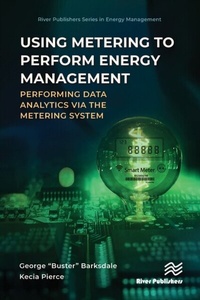
Using Metering to Perform Energy Management
Performing Data Analytics via the Metering System
1st Edition
Published on 12. April 2024
424 pages
978-1-040-01089-1 (ISBN)
Description

This book covers many helpful analysis tools and processes to assist energy managers (EMs) administer their energy program through their meter management system (MMS). These tools and the corresponding techniques offer opportunities for the EM to optimize their time. If fully utilized, the MMS will allow an EM to reduce field time significantly, as they can perform most of the energy management pre-analysis, benchmarking, data analysis and, in many cases, complete the task of performing a virtual audit remotely from their office.
The book covers many instructional areas that are, for the most part, only offered by consulting groups and software vendors as services. Those two groups offer their services for fees and therefore do not publish their ideas or best practices for commercial use. Software vendors provide software analytics whose functional aspects are addressed by our descriptions of the essential tasks in each chapter. This book allows EMs to expand their knowledge of software capabilities by viewing other best practices. Consulting groups offer services in a few areas: basic benchmarking and monitoring-based commissioning (MBCx). These services are considered essential to energy management but are generally implemented as on-site services, which, due to their nature, are much more expensive than a monitoring commissioning (MCx) solution. Monitoring commissioning, in contrast to MBCx, is purely done at the monitoring level and allows you to manage the critical energy measures that comprise the majority of the savings, but without getting into the field testing.
Benchmarking is covered much deeper in the book as we show how to benchmark each system within a building. The benchmarking sections show how to automatically analyze each system's usage into a separate benchmark for baseload, lighting, AC, and fan/pump systems. These systems produce benchmarks so EMs can compare by site, category type, climate zone, etc. We also introduce benchmarks that enable the EM to utilize tools to determine the performance of each system and which are their most significant energy users. These analytics functions are covered to produce results that identify potential energy savings for each energy system.
The book covers many instructional areas that are, for the most part, only offered by consulting groups and software vendors as services. Those two groups offer their services for fees and therefore do not publish their ideas or best practices for commercial use. Software vendors provide software analytics whose functional aspects are addressed by our descriptions of the essential tasks in each chapter. This book allows EMs to expand their knowledge of software capabilities by viewing other best practices. Consulting groups offer services in a few areas: basic benchmarking and monitoring-based commissioning (MBCx). These services are considered essential to energy management but are generally implemented as on-site services, which, due to their nature, are much more expensive than a monitoring commissioning (MCx) solution. Monitoring commissioning, in contrast to MBCx, is purely done at the monitoring level and allows you to manage the critical energy measures that comprise the majority of the savings, but without getting into the field testing.
Benchmarking is covered much deeper in the book as we show how to benchmark each system within a building. The benchmarking sections show how to automatically analyze each system's usage into a separate benchmark for baseload, lighting, AC, and fan/pump systems. These systems produce benchmarks so EMs can compare by site, category type, climate zone, etc. We also introduce benchmarks that enable the EM to utilize tools to determine the performance of each system and which are their most significant energy users. These analytics functions are covered to produce results that identify potential energy savings for each energy system.
More details
Series
Edition
1. Auflage
Language
English
Place of publication
London
United Kingdom
Target group
College/higher education
Professional and scholarly
Illustrations
138 Tables, black and white; 184 Line drawings, color; 15 Halftones, color; 1 Halftones, black and white; 199 Illustrations, color; 1 Illustrations, black and white
ISBN-13
978-1-040-01089-1 (9781040010891)
Copyright in bibliographic data and cover images is held by Nielsen Book Services Limited or by the publishers or by their respective licensors: all rights reserved.
Schweitzer Classification
Other editions
Additional editions
George "Buster" Barksdale | Kecia Pierce
Using Metering to Perform Energy Management
Performing Data Analytics via the Metering System
Book
04/2024
1st Edition
River Publishers
€190.40
Article not available for order
Persons
Buster Barksdale is a Mechanical Engineer who is a Certified Energy Manager with over 44 years of energy management experience and has served at all organizational and functional levels. His service started in 1978 as an Energy Manager for the US Air Force. Since then, he has performed engineering, energy management, construction management, performance contracts, facility operations and consulted on government energy policy and procurement procedures. His experiences in the Air Force led him to evaluate and inspect maintenance for 20 installations, which developed into a study that revised how the Air Force performed maintenance. Upon retiring from the Air Force, he continued in all aspects of energy management with a specific emphasis on control systems and the development of analysis techniques. For 25 years, he has applied the techniques he learned in the Air Force to incorporate best maintenance practices into a monitoring commission with meters and control systems. This experience has been poured into the Army metering program, which has developed analysis tools that the energy managers could use to do their job easier and better. Over 45 tools have been developed, with five additional in development. The professional development program led by Buster and Kecia Pierce received the International Energy Professional Develop Award for the Association of Energy Engineers in 2019. Buster is a CEM, CSDP, CDSM, Fellow Society of American Military Engineers, Fellow Association of Energy Engineers (AEE), Hall of Fame AEE, Past President of AEE, Board of Directors AEE.
Kecia Pierce is a Software Scientist and Project Manager who has over 33 years of requirements analysis, structured design, product/project management, and implementation leadership experience, thus giving her a strong technical background and a solid understanding of geospatial energy infrastructure management systems, including Outage and Incident Management. Kecia has worked with over 170 utilities and communications companies worldwide, leading to an in-depth knowledge of requirements and supporting technology in the energy geospatial software industry. Kecia has been published in various industry magazines and publications, such as Transmission and Distribution World, GeoWorld, and Geospatial Today. Kecia is a Project Management Institute Certified Project Management Professional, and has served with Energy Huntsville, GEO Huntsville, the GITA conference committee, and the GITA Board of Directors. Kecia has served as the Outreach Strategist for the US Army's Meter Data Management System (MDMS) since October 2016. She provides the services of a communications strategist, technical writer, and trainer for educating US Army Energy Managers in using the MDMS to prioritize their energy conservation actions, and verify energy savings. Kecia prepares and leads the MDMS training webinars, tutorials, and the MDMS Update newsletter that notifies the Army end-user community of advancements, changes, and other pertinent facts about the Army Meter Program.
Kecia Pierce is a Software Scientist and Project Manager who has over 33 years of requirements analysis, structured design, product/project management, and implementation leadership experience, thus giving her a strong technical background and a solid understanding of geospatial energy infrastructure management systems, including Outage and Incident Management. Kecia has worked with over 170 utilities and communications companies worldwide, leading to an in-depth knowledge of requirements and supporting technology in the energy geospatial software industry. Kecia has been published in various industry magazines and publications, such as Transmission and Distribution World, GeoWorld, and Geospatial Today. Kecia is a Project Management Institute Certified Project Management Professional, and has served with Energy Huntsville, GEO Huntsville, the GITA conference committee, and the GITA Board of Directors. Kecia has served as the Outreach Strategist for the US Army's Meter Data Management System (MDMS) since October 2016. She provides the services of a communications strategist, technical writer, and trainer for educating US Army Energy Managers in using the MDMS to prioritize their energy conservation actions, and verify energy savings. Kecia prepares and leads the MDMS training webinars, tutorials, and the MDMS Update newsletter that notifies the Army end-user community of advancements, changes, and other pertinent facts about the Army Meter Program.
Content
1. Introduction
2. What is Important about Managing Meter Systems?
3. Fault Detection
4. Comprehensive Building Analytics (HVAC Systems)
5. Setting up Billing
6. Meter Data Connectivity
7. Data Quality
8. Auditing Template
9. Using Metering for Measurement & Verification (M&V)
10. Basic Benchmarking (1st level)
11. Second Level Benchmarking (Baseload with Plug load)
12. Third Level Benchmarking (Lights and Scatter Plot Modeling)
13. Fourth Level of Benchmarking (Fan/Pump and AC Systems)
14. Understanding and Troubleshooting System Overrides
15. Monitoring Commissioning (MCx) Process
16. Evaluating the Energy Use Intensity (EUI) Value to the Energy Manager
17. Comparing EUI to Other Metrics
18. Setting Up for Energy Projects
19. Comparing Campus Consumption to Individual Building Statistics
20. Cross-referencing 3 Metrics for Evaluating Buildings
Appendixes
1. The Transition of HDD and CDD Over the Last 70 Years
2. Determine the Impact of Variance on Calculating Various Degree Day Base Temperatures
3. Determine the Variance of Each Energy System in the Scatter Plot and the Overall Impact
2. What is Important about Managing Meter Systems?
3. Fault Detection
4. Comprehensive Building Analytics (HVAC Systems)
5. Setting up Billing
6. Meter Data Connectivity
7. Data Quality
8. Auditing Template
9. Using Metering for Measurement & Verification (M&V)
10. Basic Benchmarking (1st level)
11. Second Level Benchmarking (Baseload with Plug load)
12. Third Level Benchmarking (Lights and Scatter Plot Modeling)
13. Fourth Level of Benchmarking (Fan/Pump and AC Systems)
14. Understanding and Troubleshooting System Overrides
15. Monitoring Commissioning (MCx) Process
16. Evaluating the Energy Use Intensity (EUI) Value to the Energy Manager
17. Comparing EUI to Other Metrics
18. Setting Up for Energy Projects
19. Comparing Campus Consumption to Individual Building Statistics
20. Cross-referencing 3 Metrics for Evaluating Buildings
Appendixes
1. The Transition of HDD and CDD Over the Last 70 Years
2. Determine the Impact of Variance on Calculating Various Degree Day Base Temperatures
3. Determine the Variance of Each Energy System in the Scatter Plot and the Overall Impact
