

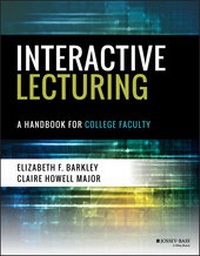
Interactive Lecturing
Description

Tips and techniques to build interactive learning into lecture classes
Have you ever looked out across your students only to find them staring at their computers or smartphones rather than listening attentively to you? Have you ever wondered what you could do to encourage students to resist distractions and focus on the information you are presenting? Have you ever wished you could help students become active learners as they listen to you lecture?
Interactive Lecturing is designed to help faculty members more effectively lecture. This practical resource addresses such pertinent questions as, "How can lecture presentations be more engaging?" "How can we help students learn actively during lecture instead of just sitting and passively listening the entire time?" Renowned authors Elizabeth F. Barkley and Claire H. Major provide practical tips on creating and delivering engaging lectures as well as concrete techniques to help teachers ensure students are active and fully engaged participants in the learning process before, during, and after lecture presentations.
Research shows that most college faculty still rely predominantly on traditional lectures as their preferred teaching technique. However, research also underscores the fact that more students fail lecture-based courses than classes with active learning components. Interactive Lecturing combines engaging presentation tips with active learning techniques specifically chosen to help students learn as they listen to a lecture. It is a proven teaching and learning strategy that can be readily incorporated into every teacher's methods.
In addition to providing a synthesis of relevant, contemporary research and theory on lecturing as it relates to teaching and learning, this book features 53 tips on how to deliver engaging presentations and 32 techniques you can assign students to do to support their learning during your lecture. The tips and techniques can be used across instructional methods and academic disciplines both onsite (including small lectures and large lecture halls) as well as in online courses.
This book is a focused, up-to-date resource that draws on collective wisdom from scholarship and practice. It will become a well-used and welcome addition for everyone dedicated to effective teaching in higher education.
More details
Other editions
Additional editions
Persons
ELIZABETH F. BARKLEY is professor of music history at Foothill College, Los Altos, California. She is a scholar, educator, and consultant with over 40 years of experience as an innovative and reflective college instructor.
CLAIRE HOWELL MAJOR is professor of higher education at the University of Alabama in Tuscaloosa, Alabama. Her expertise is in teaching and learning in higher education and in qualitative research methods.
Content
Acknowledgments xi
About the Authors xiii
Part One: A Conceptual Framework for Interactive Lecturing
1 Lecture versus Active Learning: Reframing the Debate 3
The Lecture 4
Active Learning 5
The Debate: Lecture versus Active Learning 7
Reconsidering the Debate: How We Frame It Matters 12
Conclusion 13
Notes 14
2 Integrating Lectures and Active Learning 15
The Interactive Lecturing Model 16
Engaging Presentations 17
Active Learning 21
Conclusion 28
Part Two: Engaging Presentation Tips
3 Setting Goals 33
References 34
TIP 1 Big Why, Little Why 35
TIP 2 SMART Lecture-Learning Goals 38
TIP 3 Student Characteristics Analysis 42
TIP 4 Presentation Persona 48
4 Creating Content 51
TIP 5 Sticky Note Diagrams 52
TIP 6 Brainstorming 55
TIP 7 Logical Patterns 58
TIP 8 Rule of Three 62
5 Structuring the Session 65
TIP 9 Linked Lecturettes 66
TIP 10 Select-a-Structure 68
TIP 11 Bookends, Interleaves, and Overlays 71
TIP 12 Lecture Plan 73
TIP 13 Double Planning 76
6 Leveraging the Language 79
TIP 14 Aristotelian Triptych 80
TIP 15 Signposts 82
TIP 16 Internal Previews and Summaries 87
TIP 17 High-Impact Language 89
7 Designing Effective Audiovisuals 92
TIP 18 Template Temperance 94
TIP 19 Less Is More 97
TIP 20 Context Keeper 101
TIP 21 Invisible Slide 103
TIP 22 Slide Replacements 106
8 Crafting Handouts and Supplements 108
TIP 23 Lecture Map 109
TIP 24 Content-Rich Handout 114
TIP 25 Infodeck 118
TIP 26 Annotated Reference Page 121
9 Demonstrating Readiness 124
TIP 27 Out Loud 125
TIP 28 Lecture Supply Kit 127
TIP 29 Dress for Success 129
TIP 30 Book and Check 131
10 Generating Enthusiasm and Interest 133
TIP 31 Lecture Preview 135
TIP 32 Meet and Greet 138
TIP 33 Icebreakers 140
TIP 34 Keep the Lights On 142
TIP 35 The Hook 144
TIP 36 Value Display 147
11 Managing the Session 149
TIP 37 Terms of Engagement 150
TIP 38 Classroom Technology Policy 153
TIP 39 Silent Signals 156
TIP 40 Every Minute Matters 158
TIP 41 Extensions 160
12 Presenting Like a Professional 163
TIP 42 To Script, or Not to Script? 164
TIP 43 Weatherperson 167
TIP 44 Pedagogical Moves 169
TIP 45 Voice Modulation 172
13 Asking and Answering Questions 174
TIP 46 Write a Question 176
TIP 47 Echo Chamber 178
TIP 48 Wait Time 180
TIP 49 Right Means Right 182
14 Signaling the Takeaways 184
TIP 50 The Synthesis 185
TIP 51 The Connector 187
TIP 52 The Power Close 189
TIP 53 The Graceful Goodbye 191
Part Three: Active Learning Techniques
15 Actively Preparing 198
ALT 1 Active Reading Documents 200
ALT 2 Know-Wonder-Learned 204
ALT 3 Two-Minute Question-Development Talks 209
ALT 4 Individual Readiness Assurance Tests 212
16 Anticipating and Predicting New Information 216
ALT 5 Update Your Classmate 217
ALT 6 Sentence Stem Predictions 221
ALT 7 Guess and Confirm 227
ALT 8 Preview Guide 232
17 Listening for Information 237
ALT 9 Advance Organizers 238
ALT 10 Lecture Bingo 245
ALT 11 Listening Teams 249
ALT 12 Live-Tweet Lecture 253
18 Taking Notes 258
ALT 13 Guided Notes 260
ALT 14 Cued Notes 264
ALT 15 Coded Notes 269
ALT 16 Note-Taking Pairs 274
ALT 17 Sketch Notes 278
19 Rehearsing Information 288
ALT 18 Translate That! 289
ALT 19 Think-Pair-Share 293
ALT 20 Snap Shots 297
20 Applying Information 302
ALT 21 Thick and Thin Questions 304
ALT 22 Support a Statement 309
ALT 23 Intrigue Journal 313
ALT 24 Real-World Applications 317
21 Checking Understanding 320
ALT 25 Pre-Post Freewrite 322
ALT 26 One-Sentence Summary 327
Alt 27 3-2-1 331
Alt 28 Rsqc2 336
22 Reflecting and Metacognition 341
ALT 29 Punctuated Lecture 343
ALT 30 Post-Lecture Knowledge Survey 347
ALT 31 Lecture Wrapper 352
ALT 32 Lecture Engagement Logs 356
References 363
Name Index 379
Subject Index 383
CHAPTER 1
Lecture versus Active Learning: Reframing the Debate
Educators today would be hard-pressed to identify a teaching technique more heartily maligned than the lecture. Lectures are boring: "Some people talk in their sleep. Lecturers talk while other people sleep" (Albert Camus1). Lectures are ineffective: "A lecture is a process in which information passes from the notes of the lecturer into the notes of the student without passing through the minds of either" (Mark Twain2). Lectures are pointless: "Lectures were once useful; but now, when all can read and books are so numerous, lectures are unnecessary" (Samuel Johnson). Lecturing is currently considered to be so bad that one author imagines a future when universities are required to issue a warning to students that "lectures may stunt your academic performance and increase risk of failure" (Dawson, 2016). The list of criticisms continues and includes charges such as old-fashioned, overused, obsolete, and even unfair (see, for example, Abrams, 2012; Jensen & Davidson, 1997; Lambert, 2012; Paul, 2015; Segesten, 2012; Wieman, 2014).
Most of us have experienced listening to a lecture in which the speaker droned on and on; our minds wandered, our bodies fidgeted, and we would have dashed for the door had that been an option. One student expressed a similar sentiment: "I was so bored, I feared all the blood had left my head and I would pass out in the aisle" (El-Shamy, 2004, p. 24). Despite the surfeit of disparagements, research indicates that most college and university faculty members still lecture.3 Lectures have remained popular for many reasons, including that they serve several important instructional purposes. Furthermore, lectures don't have to be dreary and mind-numbing. We-and students-have encountered situations in which we sat transfixed as we listened to a particularly captivating lecture. Indeed, a colleague recently shared that these kinds of lectures were the transformative events of his undergraduate education.
Although most college professors continue to lecture, researchers have also found that few today rely on the lecture entirely;4 instead, they use lecture in combination with a variety of other teaching techniques, such as small-group work, case studies, discussion, and problem-solving-strategies that fall under the banner of "active learning." Active learning is a pedagogical approach that puts into practice over a half-century of research that demonstrates that, to truly learn, we need to make new information our own by working it into our personal knowledge and experience. As attractive as active learning is conceptually, however, many college teachers struggle with promoting it in practice. For example, assigning students to group work is a popular active learning pedagogy, yet teachers know that it is not safe to assume that students who are talking to each other are learning and that it is equally risky to conclude that students are learning when they are listening to other students talking. Furthermore, although lectures can leave some students disengaged, active learning strategies can engender full-blown resistance. We once overhead a student passionately protest, "Today was awful! My teacher . . ." [with our curiosity piqued, we waited for her to complete her complaint so that we could hear what terrible thing the professor had done] "assigned us to group work!"
Thus lecturing and active learning strategies have potential pitfalls, and although neither method is perfect, neither is despicable. Yet currently there is a fierce debate that sometimes intimates otherwise. This either-or dispute sets educators against each other in ways that we propose are unproductive. In this book, we aim to move past the premise that instructors must choose one or the other approach and suggest instead that faculty members can combine lectures with active learning to create a vibrant instructional environment that capitalizes on the benefits while minimizing the constraints of each. Our approach, a form of interactive lecturing, helps professors navigate the process of integrating lectures and active learning into a seamless whole that promotes deep learning.
We begin in Part 1 of this book by establishing our conceptual framework, which is grounded in research evidence. In this chapter, we answer the following questions:
- What is a lecture, and what is it good for?
- What is active learning, and what purposes does it serve?
- What are the main points of contention in the lectures versus active learning debate?
- Why is this debate problematic? And how can we reframe the basic proposition?
The Lecture
The word lecture comes from the Latin word lectare, which translates roughly into "to read" aloud, whereas the term lecture means "that which is read." To ancient Greeks, a lecture was the primary method of transmitting knowledge and information (Brown & Atkins, 1988), and this understanding served as the foundation for later developments. About the sixth century CE, scholars traveled hundreds of miles to European monasteries to hear monks read a book aloud from a lectern; as the monk read, scholars copied down the book verbatim (Exley & Dennick, 2004). With the establishment of universities in the Middle Ages, lectures persisted. Lecturing continued to be a core pedagogy as European higher education expanded during the subsequent centuries, and these traditions were transplanted to the colonies. By the mid-nineteenth century, lecturing was firmly established as the primary method of instruction in the American college classroom (Garside, 1996). But what exactly is a lecture?
Definitions of the Lecture
Bligh (1999) suggests a working definition of a lecture as "a more or less continuous exposition by a speaker who wants the audience to learn something" (p. 4). The literature is replete with similar definitions, such as the following:
- A lecture is an educational talk to an audience, especially to students in a university or college (Oxford Dictionary, n.d.).
- Lecture is a method of teaching in which the instructor gives an oral presentation of facts or principles to learners, who are responsible for note-taking (Good & Merkel, 1959).
- [A lecture is when] a teacher is talking and students are listening (Singh, 2006).
These definitions rely on a view of the lecture as a method of transmitting information. This model of lecturing became the prevalent pedagogy because it provided an essential method for conveying and spreading knowledge, especially in the centuries before the printing press facilitated widespread publication of books.
Purposes of the Lecture
Lectures have remained popular because they serve several important purposes. We summarize those purposes in Exhibit 1.1.
Exhibit 1.1 The Purposes of Lecture
Teachers use lectures to . . .
- Present information otherwise unavailable to students
- Present a synthesis of information from across multiple sources
- Organize information into a logical structure
- Share important background and contextual information and ideas
- Highlight similarities and differences
- Clarify confusing concepts, principles, and ideas
- Help learners consolidate information
- Model higher-order thinking strategies and skills
- Convey enthusiasm for the content
- Communicate why content is worth learning
Active Learning
Despite the trend of describing it as modern, active learning-similar to the lecture-has a long history in education. In 1852, John Henry Newman proposed that true learning consists "not merely in the passive reception into the mind of a number of ideas" but rather "in the mind's energetic and simultaneous action upon and towards those new ideas . . . and making the objects of our knowledge subjectively our own" (from Idea of a University). Page (1990) traces the origins of active learning back to the eighteenth and nineteenth centuries as found in the work of Rousseau, Pestalozzi, Dewey, Kilpatrick, and Piaget. She describes four common themes associated with active learning, including rejection of traditional teaching methods, belief in the cognitive learning paradigm, faith in the ability of the student, and belief in the importance of the relationship of school to society. Although active learning's roots run deep, the actual term active learning wasn't popularized until the late twentieth century with the publication of Bonwell and Eison's (1991) ASHE-ERIC Report titled Active Learning: Creating Excitement in the Classroom. But what exactly is active learning?
Definitions of Active Learning
Whereas definitions for the lecture seem relatively focused and straightforward, descriptions of active learning are broad and imprecise:
- Anything that involves students in doing things and thinking about the things they are doing (Bonwell & Eison, 1991)
- A process whereby students engage in activities, such as reading, writing, discussion, or problem-solving, which promote analysis, synthesis, and evaluation of class content (University of Michigan, Center for Research on Learning...
