

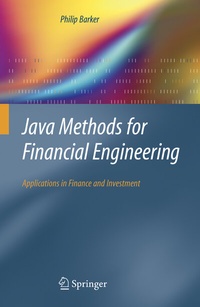
Java Methods for Financial Engineering
Description

In order to build a successful, Java-based application it is important to have a clear understanding of the principles underlying the various financial models. Those models guide the application designer in choosing the most appropriate Java data structures and implementation strategy. This book describes the principles of model building in financial engineering and explains those models as designs and working implementations for Java-based applications.
Throughout the book a series of packaged classes are developed to address a wide range of financial applications. Java methods are designed and implemented based on the most widely used models in financial engineering and investment practice. The classes and methods are explained and designed in a way which allows the financial engineer complete flexibility. The classes can be used as off-the-shelf working solutions or the innovative developer can re-arrange and modify methods to create new products
Reviews / Votes
From the reviews:
"This is a book that aims to provide software professionals with an accessible source of numerical methods and/or a 'ready-to-use' code for use in business applications. Anyone working in management sciences, in modeling or software development will want to peruse this text. . 'it is the first book to cover the topic of Java implementations for finance investment applications.' The book sets out to describe the principles of model building in financial engineering and to explain those models as designs for Java-based applications." (C.J.H. Mann, Kybernetes, Vol. 37 (1), 2008)
More details
Other editions
Additional editions
Person
Phil Barker has considerable experience in both software engineering and in finance and investment having taught courses at the National Alvey HCI centre, a government funded organisation transferring university based research into commercial applications. Prior to this he lectured at Heriot-Watt University where he taught undergraduate and postgraduate courses in computer science and accountancy. His research focused on neural networks and cognitive modelling involving the use of software simulations. He is currently an independent consultant to the financial and investment sector.
