

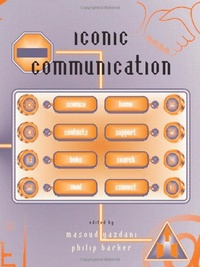
Iconic Communication
1st Edition
Published on 1. January 2000
210 pages
978-1-84150-818-4 (ISBN)
Description

Our society is becoming a more visual culture day-by-day. This book offers detailed analyses of how to combine words with pictures to communicate clearly across cultural barriers. While some information is better communicated by one kind of media than another, some information is communicated most effectively through a combination of media. This book presents a critical framework within which iconic communication systems can be developed to truly bridge linguistic and cultural gaps and to provide effective computer-based systems for conveying information on a global scale. With valuable insights for the Information and Communication industries, this book draws on the work presented at several conferences on the subject and is designed primarily for graphic designers and human-computer interface developers as well as supplementary reading on degree courses in Information Technology.
More details
Edition
1. Auflage
Language
English
Place of publication
Bristol
United Kingdom
Publishing group
Intellect
Target group
Professional and scholarly
ISBN-13
978-1-84150-818-4 (9781841508184)
Copyright in bibliographic data and cover images is held by Nielsen Book Services Limited or by the publishers or by their respective licensors: all rights reserved.
Schweitzer Classification
Other editions
Additional editions
Philip Barker | Masoud Yazdani
Iconic Communication
Book
05/2000
Intellect Books
€26.50
Article not available at the moment
Content
- Front Cover
- Preliminaries
- Contents
- Preface
- PART 1: Foundations
- 1. Human Communication Processes - Philip Barker
- Introduction
- Foundation Models
- The Role Of Mental Models
- The Evolution Of Iconic Communication
- What Next?
- Conclusion
- References
- 2. On the Possibility and Impossibility of a Universal Iconic Communication System - Andrew J King
- Impossibilities
- Possibilities
- 'Epistemology of the Body'
- Conclusions
- Notes
- Illustration acknowledgements
- 3. The Limits Of Iconic Communication - John Roscoe
- Communication
- Marks
- Iconic Communication
- Recipes for Making Pictures
- Titles
- Saying 'that'
- Modality
- Conclusion
- Reference
- Notes
- PART 2: Background
- 4. Some Pictorial Symbol Systems for Public Places - Ian McLaren
- Otto Neurath and the 'Isotype Movement'
- Otl Aicher
- ISO / BSI
- Personal Experience
- Conclusion
- Notes
- 5. Double Vision - Michelle Gausman and Clive Chizlett
- Shared Concerns
- Tunnel Vision Part One: the Problem
- Tunnel Vision Part Two: the Proposal
- Boundaries and Barriers
- Confused States
- If it Looks Like a Duck. . .
- A Little Knowledge. . .
- Signs of Meaning
- What Next?
- References
- 6. Communication through Icons - Masoud Yazdani
- References
- PART 3: Proposals
- 7. Do You See What I'm Saying? - Stuart Mealing
- Introduction
- On Being Understood
- Semiotics and Syntax
- Presentation of Text
- Units of Mapping
- Visual Signifiers
- Mapping Options
- Dimensions of Mapping
- Emotional Elements
- Comprehension, Control and Context
- Conclusion
- References
- 8. IconText: An Exploration of the Limitations of Iconic Languages - Colin Beardon
- Introduction
- Form and Content
- Referring to Objects
- Propositions that Refer
- Issues
- References
- 9. Visualisation of Textual Structures[1] - Graziella Tonfoni
- Introduction
- Multiple Viewing and Complex Textual Visualisation
- A New Framework for Viewing Natural Language and for Visualizing Text
- Text Visual Processing and Context and Style Sensitive Parsing
- Textual Visual Processing
- Static vs Dynamic Visualisation.
- Conclusions
- Notes
- Acknowledgements
- References
- PART 4: Development of Prototypes
- 10. The Augmentation of Textual Communication with User-created Icons - Leon Cruickshank and Lon Barfield
- Introduction
- Text Augmentation
- The Icon Project - A User-Led Approach
- The Icon Project Prototype
- Paper Prototyping
- The Digital Prototype
- Conclusions
- Notes
- Appendix 1: Work Sheet Proforma for Iconic Conversation Workshop 1
- 11. VIL: A Visual Inter Lingua - Lee Becker and Paul Leemans
- Introduction
- Criteria for a New Language
- Simplified Speech
- VIL
- Composing a Message in VIL
- Evaluating the Design of the Language and Icons
- Summary
- Notes
- References
- PART 5: Research Outcomes
- 12. Icons in the Mind - Philip Barker and Paul van Schaik
- Introduction
- Knowledge Representation
- Iconic Representation In Mental Models
- Case Study - Results Of A Teach-Back Study
- Conclusion
- References
- 13. Designing and Evaluating Icons - Philip Barker and Paul van Schaik
- Introduction
- Rationale
- The Icon Classification Hypothesis
- Experimental Methods
- Results
- Discussion
- Conclusions
- References
- 14. Evaluating Appropriate Interface Metaphors - Paul Honeywill
- Overview
- Introduction
- The ARC Interface
- The ARC Evaluation
- Returned Data from the Report Logs
- User Goals and Sub-Goals
- The Program Interface
- World Wide Web Interfaces
- Computer Interface Compound Icons from around the World
- Africa 114 ISPs
- Asia 1004 ISPs
- Australasia 886 ISPs
- Europe 1325 ISPs
- North America excluding USA 1590 ISPs
- North America - United States of America 15,419 ISPs
- South America 537 ISPs
- Conclusion
- References
- Back Cover - Book Description
