

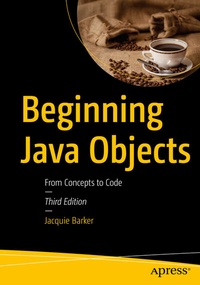
Beginning Java Objects
Description

As a programming language, Java's object-oriented nature is key to creating powerful, reusable code and applications that are easy to maintain and extend. That being said, many people learn Java syntax without truly understanding its object-oriented roots, setting them up to fail to harness all of the power of Java. This book is your key to learning both!
This new third edition of Beginning Java Objects: From Concepts to Code discusses Java syntax, object principles, and how to properly structure the requirements of an application around an object architecture. It is unique in that it uses a single case study of a Student Registration System throughout the book, carrying the reader from object concepts, to object modeling, to building actual code for a full-blown application. A new chapter covers a technology-neutral discussion of the principles of building a three-tier architecture using Java, introducing the notion of model layer - presentation layer - data layer separation.
Coding examples used throughout the book are Java version-neutral. The core object-oriented principles that you will learn from this book are timeless, and are relevant to all versions of the Java language, as well as to many other object-oriented languages.
The book can be used for individual self-study or as a university-level textbook.
What You Will Learn
- Know basic object-oriented principles, from the simplest notion of classes and objects through the power of encapsulation, abstract classes, and polymorphism
- Approach the requirements for an application to structure it properly around objects
- Render the resultant object model into Java code, building a complete functioning model layer for the Student Registration System case study
- Conceptually round out an object layer by adding presentation and data layers
Who This Book Is For
Software developers who have never tackled Java as a programming language, as well as those who have already used Java but want to ensure that they are taking full advantage of the object-oriented nature of the language
More details
Other editions
Additional editions
Previous edition
Person
Jacquie earned a bachelor of science degree in computer engineering with highest honors from Case Institute of Technology/Case Western Reserve University in Cleveland, Ohio, and a master of science degree in computer science, emphasizing software systems engineering, from the University of California, Los Angeles. She has subsequently pursued postgraduate studies in information technology at George Mason University in Fairfax, VA. Jacquie's winning formula for teaching object fundamentals continues to receive praise from readers around the world, and her Apress book Beginning Java Objects: From Concepts to Code has been adopted by many universities as a key textbook in their core IT curricula.
On a personal note, Jacquie's passions include her husband Steve and their three cats Walter, Rocky, and Tanner; serving as founder and executive director of Pets Bring Joy, a 501(c)(3) non-profit animal rescue organization (pbj.org); and her recent launch of a pro bono IT consulting service for start-up non profits (probonoit.org).
