

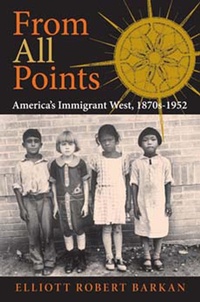
From All Points
America's Immigrant West, 1870s-1952
Published on 11. May 2007
624 pages
978-0-253-02796-2 (ISBN)
Description

At a time when immigration policy is the subject of heated debate, this book makes clear that the true wealth of America is in the diversity of its peoples. By the end of the 20th century the American West was home to nearly half of America's immigrant population, including Asians and Armenians, Germans and Greeks, Mexicans, Italians, Swedes, Basques, and others. This book tells their rich and complex story-of adaptation and isolation, maintaining and mixing traditions, and an ongoing ebb and flow of movement, assimilation, and replenishment. These immigrants and their children built communities, added to the region's culture, and contended with discrimination and the lure of Americanization. The mark of the outsider, the alien, the nonwhite passed from group to group, even as the complexion of the region changed. The region welcomed, then excluded, immigrants, in restless waves of need and nativism that continue to this day.
Reviews / Votes
An engaging and complex work, From All Points makes a persuasive case for the centrality of immigrants to the growth of the West.Autumn 2008 -- Frank Van Nuys * Western Historical Quarterly 39 * This book is a cleary written, hefty synthesis of American immigration literature.Fall 2008 -- Lissa Wadewitz * Journal of American Ethnic History * From All Points is a remarkable synthesis of the West as a region of immigrants. It tells the story of how vital immigrants were to economic growth and modernization. This will be the prime reference for 21st century scholars of immigration and ethnicity in the American West. Spring 2010 * Annals of Wyoming * Written in the fashion of Oscar Handlin, this study makes a convincing case that immigration history comprises an essential part of the history of the American West, and that appreciation of the former and the roles played by myriad alien arrivals is essential for understanding the latter. . . . Barkan (emer., California State Univ.) combines vignettes based on immigrant reminiscences with keen analysis to explore four related themes: various groups' arrivals, their economic influences, their effects on public policy, and their adaptation and assimilation. The resulting narrative is readable and informative. . . . Recommended. * Choice * Within this handsome volume, Barkan has set a benchmark for further research in the varied histories of immigrants from all pointsFall 2008 -- Frederick C. Luebke * New Mexico Historical Review * From All Points deserves high praise for a number of good things, including meticulous research, expert synthesizing, keen conceptualization, and rich narrative. More important, Barkan's ambitious project does a great service to western historians who have longed for an overview of immigration. Spring 2009 * MONTANA: MAG OF WESTERN HIST * . . . important demographic profiles, and on a meticulous reading of the vast secondary literature that is so masterfully synthesized here.Summer 2007 -- Arnoldo De Leon * Register of Kentucky Historical Society * Elliott Robert Barkan comes ideally equipped for the task of this book . . . By including vignettes of individual life stories, he manages to capture both the forest and the trees of the immigrant experience, and puts a human face on many of the general tendencies and developments he describes.October, 2009 * H-Net Reviews *More details
Language
English
Place of publication
Bloomington, IN
United States
Target group
Professional and scholarly
US School Grade: College Graduate Student and over
Illustrations
50 b&w photos, 2 maps
File size
8,78 MB
ISBN-13
978-0-253-02796-2 (9780253027962)
Copyright in bibliographic data and cover images is held by Nielsen Book Services Limited or by the publishers or by their respective licensors: all rights reserved.
Schweitzer Classification
Other editions
Additional editions
Book
05/2007
Indiana University Press
€42.50
Shipment within 10-20 days
Person
Elliott Robert Barkan is Professor Emeritus of History and Ethnic Studies at California State University. He is author of Our Multicultural Heritage: A Guide to America's Principal Ethnic Groups and And Still They Come: The Immigrant in American Society, 1920s-1990s. He lives in Corona, California.
Content
Preface
Acknowledgments
Note on Translation and Transliteration
Introduction: Defining Themes-The West, Westerners, and Whiteness
Prelude: Western Immigrant Experiences
Part 1. Laying the Groundwork: Immigrants and Immigration Laws, Old and New, 1870s - 1903
1. Immigrant Stories from the West
2. The Draw of the Late-Nineteenth-Century West
3. Where in the West Were They?
4. Targets of Racism: Chinese and Others on the Mainland and Hawaii
5. The Scandinavians and Step Migration
6. The German Presence
7. Proximity of Homeland: The Mexicans
8. In the Year 1903
9. Foreshadowing Twentieth-Century Patterns
Part 2. Opening and Closing Doors, 1903 - 1923
10. Immigrant Stories and the West in the 1900s
11. Who Came?
12. The Dillingham Commission and the West
13. The Continuing Evolution of Immigration and Naturalization Issues and Policies (Asians)
14. Miners, Merchants, and Entrepreneurs: Europeans Compete with Europeans (Greeks and Others)
15. Land, Labor, and Immigrant Communities: Hawaii and the Mainland (Asians, Portuguese, Armenians, and Scandinavians)
16. Newcomers, Old and New (Italians, Basques, French, and Mexicans)
17. The First World War and Americanization
18. State and Federal Laws and Decisions, 1917 - 1920
19. The Early 1920s: Threshold of Momentous Changes
Part 3. "Give me a bug, please": Restriction and Repatriation, Accommodation and Americanization, 1923 - 1941
20. A World of Peoples: The 1920s and 1930s
21. Demographic Trends: A Changing West and Changing Westerners
22. Institutionalizing the Quota System: 1924
23. Divided Yet Interlinked: The Rural West
24. Filipinos: The Newer Immigrant Wave Bridging the Rural and Urban West
25. Divided Yet Interlinked: The Urban West in the Interwar Years
26. Urban Landscapes and Ethnic Encounters
27. From "Reoccupation" to Repatriation: Mexicans in the Southwest between the Wars
28. Darker Turns during the Interwar Years: Workers and Refugees
29. Aliens and Race Issues on the Eve of the Second World War
30. Interwar or Interlude? Twilight and Dawn in the West
Part 4. America's Dilemma: Races, Refugees, and Reforms in an Age of World War and Cold War, 1942 - 1952
31. Voices from America on the Eve of War
32. War: Against All Those of Japanese Descent
33. The Second World War's Other Enemy Aliens: Italians and Germans
34. The Homefront in Wartime: Preface to an Era of Change
35. Wartime and Postwar Agricultural Issues: Land, Labor, Growers, and Unions
36. Immigrants and Ethnics in the Postwar Years
37. The Cold War Heats Up: The Politics of Immigration, 1950 - 1952
38. Dora and the Harbinger of Coming Events
39. Looking Back on America's Immigrant West
Appendix
Notes
Select Bibliography
Index
Acknowledgments
Note on Translation and Transliteration
Introduction: Defining Themes-The West, Westerners, and Whiteness
Prelude: Western Immigrant Experiences
Part 1. Laying the Groundwork: Immigrants and Immigration Laws, Old and New, 1870s - 1903
1. Immigrant Stories from the West
2. The Draw of the Late-Nineteenth-Century West
3. Where in the West Were They?
4. Targets of Racism: Chinese and Others on the Mainland and Hawaii
5. The Scandinavians and Step Migration
6. The German Presence
7. Proximity of Homeland: The Mexicans
8. In the Year 1903
9. Foreshadowing Twentieth-Century Patterns
Part 2. Opening and Closing Doors, 1903 - 1923
10. Immigrant Stories and the West in the 1900s
11. Who Came?
12. The Dillingham Commission and the West
13. The Continuing Evolution of Immigration and Naturalization Issues and Policies (Asians)
14. Miners, Merchants, and Entrepreneurs: Europeans Compete with Europeans (Greeks and Others)
15. Land, Labor, and Immigrant Communities: Hawaii and the Mainland (Asians, Portuguese, Armenians, and Scandinavians)
16. Newcomers, Old and New (Italians, Basques, French, and Mexicans)
17. The First World War and Americanization
18. State and Federal Laws and Decisions, 1917 - 1920
19. The Early 1920s: Threshold of Momentous Changes
Part 3. "Give me a bug, please": Restriction and Repatriation, Accommodation and Americanization, 1923 - 1941
20. A World of Peoples: The 1920s and 1930s
21. Demographic Trends: A Changing West and Changing Westerners
22. Institutionalizing the Quota System: 1924
23. Divided Yet Interlinked: The Rural West
24. Filipinos: The Newer Immigrant Wave Bridging the Rural and Urban West
25. Divided Yet Interlinked: The Urban West in the Interwar Years
26. Urban Landscapes and Ethnic Encounters
27. From "Reoccupation" to Repatriation: Mexicans in the Southwest between the Wars
28. Darker Turns during the Interwar Years: Workers and Refugees
29. Aliens and Race Issues on the Eve of the Second World War
30. Interwar or Interlude? Twilight and Dawn in the West
Part 4. America's Dilemma: Races, Refugees, and Reforms in an Age of World War and Cold War, 1942 - 1952
31. Voices from America on the Eve of War
32. War: Against All Those of Japanese Descent
33. The Second World War's Other Enemy Aliens: Italians and Germans
34. The Homefront in Wartime: Preface to an Era of Change
35. Wartime and Postwar Agricultural Issues: Land, Labor, Growers, and Unions
36. Immigrants and Ethnics in the Postwar Years
37. The Cold War Heats Up: The Politics of Immigration, 1950 - 1952
38. Dora and the Harbinger of Coming Events
39. Looking Back on America's Immigrant West
Appendix
Notes
Select Bibliography
Index
