

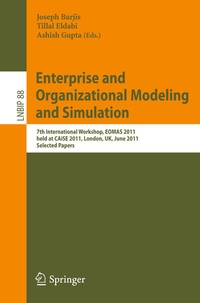
Enterprise and Organizational Modeling and Simulation
Description

This book constitutes the post conference proceedings of the 7th International Workshop on Enterprise and Organizational Modeling and Simulation, EOMAS 2011, held in conjunction with CAiSE 2011 in London, UK, in June 2011.
Enterprises are purposefully designed systems used to fulfill certain functions. An extended enterprise and organizational study involves both analysis and design activities, in which modeling and simulation play prominent roles.
The related techniques and methods are effective, efficient, economic, and widely used in enterprise engineering, organizational study, and business process management. The 14 contributions in this volume were carefully reviewed and selected from 29 submissions, and they explore these topics, address the underlying challenges, find and improve on solutions, and demonstrate the application of modeling and simulation in the domains of enterprises, their organizations and underlying business processes.
More details
Other editions
Additional editions
Content
- Title
- Preface
- Organization
- Table of Contents
- Efficient Routing of Mobile Agents for Agent-Based Integrated Enterprise Management: A General Acceleration Technique
- Introduction
- An Example of the Mobile Agent Routing Problem
- Problem Set-Up
- Outline of the Camponogara-Shima Algorithm
- Description of the Acceleration Technique
- Accelerating FPTAS for P1
- Accelerating FPTAS for P2
- FPTAS for P3 and P4
- Discussion and Computational Experiments
- Conclusions
- References
- A Framework of Views on Service Networks Models
- Introduction
- Related Work
- Running Example
- Service Network Modeling
- Views on Service Network Models
- Offering-Centric Views on Service Networks
- Participant Views on Service Networks
- Multilateral Views on Service Networks
- Aggregation and Projection of Service Network Views
- Aggregating Service Network Views
- Projecting Service Network Views
- Conclusions
- References
- System Dynamics in Integration of Supply Chain Management
- Introduction
- Supply Chain Integration
- Supply Chain Characteristics
- Supply Chain Modelling
- System Dynamics
- Conclusion and Future Direction
- References
- Modeling and Simulating Organisations
- Introduction
- Computational Organisation Methodologies - Modeling and Simulation Approaches
- Ontological Analysis of Organisations
- Extending the AOR Simulation Language with Organisational Constructs
- AOR Organisational Metamodel
- Organisation Case Study - Modeling an Academic Environment
- Conclusion and Future Works
- References
- Simulation, Games and Challenges: From Schools to Enterprises
- Introduction
- Simulation
- Simulation, Games and Challenges
- From Schools to Enterprises
- Military
- Medical
- Management
- Choosing the Product's Name
- Conclusion
- References
- Using a Controlled Vocabulary to Support Business Process Design
- Introduction
- Related Work
- Core Concepts
- Taxonomy
- Business Process
- Information Entity
- Organizational Unit
- Actor
- Business Schedule
- Business Goal
- Relationships between Concepts
- Ontology
- Conclusions
- References
- A Quality-Oriented Business Process Meta-Model
- Introduction
- Related Works
- A Meta-Model of Business Process
- Business Processes Quality Factors
- Performance
- Efficiency
- Reliability
- Security
- Availability
- Quality-Oriented Meta-Model
- Conclusion and Future Work
- References
- Can BPMN Be Used for Making Simulation Models?
- Introduction
- Related Work
- UFO and ABDESO
- Substance Individuals, Attributions, Relationships and References
- Events
- Universals
- DESO - A Foundational Ontology for Basic DES
- ABDESO - A Foundational Ontology for ABS
- Soundness and Completeness of Simulation Languages
- BPMN
- Evaluation of BPMN
- Evaluating Soundness and Lucidity
- Evaluating Completeness and Laconicity
- Conclusions
- References
- Performance Improvement in Healthcare Processes
- Introduction
- Theoretical Background
- The Current Process
- The New Business Process
- Simulation
- Conclusion
- References
- Supporting Enterprise IS Modelling Using Ontological Analysis
- Goal
- Methodology
- Motivation
- Definition of Terms
- Ontology
- Concept Map
- Semantics of the Concept Map
- CMoD: The Method
- Vocabulary Method
- Complete Ontological Analysis
- Discussion and Conclusions
- Related Work
- Future Work
- References
- Instance-Level Modeling and Simulation Using Lambda-Calculus and Object-Oriented Environments
- Introduction
- Instance-Level Modeling and Simulation
- Formal Background
- Tools for Object-Level Modeling and Testing
- BlueJ
- .NET Object Test Bench
- Our Approach: Data Modeling and Simulation Using Lambda-Calculus
- Algorithm Examples
- Objects, Messages and Object Interface
- Object Interface and Methods
- Manipulations with Objects Using Lambda-Calculus
- EyeDB and the Standard ODMG
- Daskalos
- Smalltalk as the Appropriate Programming Language for Modeling and Simulation
- Language Examples
- Daskalos Application
- Conclusion
- References
- Conceptual Normalisation Formalised
- Introduction
- Motivation and Problem Statement
- Presumptions and Our Approach
- Conceptual Model
- Uniqueness and Identity
- The Conceptual Object and Its Features
- Property, Object and Class
- The Base for Conceptual Normalisation
- Definition of Redundancy
- Results: Proposals of Conceptual Normal Forms (CNFs)
- CNFs in Relation to Relational Normal Forms (RNFs)
- CNFs in Relation to Object Normal Forms (ONFs)
- Conclusion and Future Works
- References
- Modelling and Prototyping of Business Applications Based on Multilevel Domain-Specific Language
- Introduction
- Data Abstraction Concept
- Behaviour Abstraction Concept: Functional Paradigm
- Functional Model
- Architecture and Decomposition
- Decomposition Based on Fundamental Concepts
- Motivation for a Domain-Specific Language Approach
- Multilevel Domain-Specific Language Approach
- Rapid Prototyping of Functional Models
- ML-DSL Prototyping Demonstration
- Level 0
- Level -1
- Level -2
- Level -3
- Level -3.5
- Level -4
- Level -5
- Discussion
- Summary and Conclusions
- References
- Building towards a Software Based Innovation Modelling Tool
- Introduction
- The Conceptual Foundation for the Tool
- A Conceptualisation of the Innovation Process
- An Ontology of the Innovation Process
- The Approach to Designing the Tool
- The Form of the Tool
- Guidelines for Use of the Canvas
- A Worked Example Based on the Canvas
- Why Should the Tool Work?
- The Role of Graphical Externalisations
- The Role of Talkback
- The Role of Constraints
- The Role of Collaboration
- The Role of Ease of Use and Ease of Modification
- A Concluding Remark on the Future of the Tool
- References
- Author Index
