

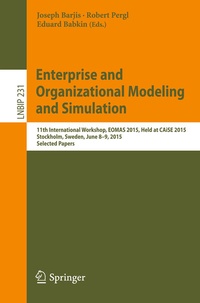
Enterprise and Organizational Modeling and Simulation
Description

This book constitutes the refereed proceedings of the 11 th International Workshop on Enterprise and Organizational Modeling and Simulation, EOMAS 2015, held at CAiSE 2015, in June 2015 in Stockholm, Sweden.
EOMAS was founded with the purpose to become a forum among researchers and practitioners to share their research and practical findings by encouraging the dissemination of research results under a more generic umbrella called enterprise engineering, which encompasses internal factors ranging from organizational complexity to intricacy of business processes and sophistication in workflows as well as external factors and uncertainties such as competition, politics, or the emergence of innovative technologies.
The 15 papers presented in this volume were carefully reviewed and selected from 28 submissions. They were organized in topical sections named: enterprise conceptual modeling and simulation; enterprise modeling formal foundation; and enterprise optimization.
More details
Other editions
Additional editions
Content
- Intro
- Preface
- Organization
- Contents
- Enterprise Conceptual Modelling and Simulation
- Natural Language Generation for Declarative Process Models
- 1 Introduction
- 2 Background and Preliminaries
- 3 Related Work and Challenges
- 3.1 Pipeline Model
- 3.2 Challenges
- 4 Natural Language Generation for DPIL Models
- 4.1 Generation Inputs
- 4.2 Document Planning
- 4.3 Microplanning
- 4.4 Surface Realization
- 5 Conclusion and Outlook
- References
- Generating Event Logs Through the Simulation of Declare Models
- 1 Introduction
- 2 Background
- 2.1 Event Logs
- 2.2 Declare
- 2.3 Regular Expressions
- 2.4 Finite State Automata
- 3 Approach
- 4 Evaluation
- 4.1 Efficiency
- 4.2 Effectiveness
- 5 Related Work
- 6 Conclusions and Future Work
- References
- Towards a Business Process Model Transformations Framework
- Abstract
- 1 Introduction
- 2 Business Process Modelling: An Overview
- 2.1 Process Modelling Languages
- 2.2 BPMN to BPEL Processes Transformation
- 3 Related Work
- 4 Process Transformation Framework
- 4.1 Collaborative Business Agreement Definition Phase
- 4.2 Collaborative Process Modelling Phase
- 4.3 Generation of Partner's Public Processes Phase
- 4.4 Definition of Partner's Private Processes Phase
- 4.5 Code Execution and User Interfaces Phase
- 5 Implementation
- 6 Conclusion and Future Research
- Acknowledgment
- References
- Object-Oriented Conceptual Modeling and Simulation of Health Care Processes
- Abstract
- 1 Introduction
- 2 Motivation
- 3 Borm Approach
- 3.1 Method Basics
- 3.2 Combination of the OOP and FSM
- 3.3 Modeling Cards
- 4 The Project
- 5 Conclusion
- 5.1 Future Work
- Acknowledgments
- References
- Big Data Analytics for Supply Chain Management: A Literature Review and Research Agenda
- Abstract
- 1 Introduction
- 2 BDA-Enabled Supply Chain
- 3 Methodology
- 4 Results and Discussion
- 5 Conclusion and Future Research Directions
- Appendix A. Summary of Articles
- References
- Enterprise Modelling Formal Foundation
- One Solution for Semantic Data Integration in Logistics
- Abstract
- 1 Introduction
- 2 Our Approach to Ontology Engineering
- 2.1 DEMO Theory and Methodology of Enterprise Ontology
- 2.2 BORO Object Paradigm for Data Modeling
- 2.3 Formal Enterprise Ontology (FEO)
- 3 Our Approach to Ontology Codification
- 4 The Logistics Ontology
- 5 Our Solution for Data Consolidation
- 6 Conclusions
- References
- A Wide-Spectrum Approach to Modelling and Analysis of Organisation for Machine-Assisted Decision-Making
- Abstract
- 1 Introduction
- 2 State of the Art
- 3 Our Approach
- 4 ESL
- 4.1 Decsion Making Using DSL
- 5 Case Study
- 5.1 Description and Implementation
- 5.2 Simulation & Results
- 6 Comparative Study
- 7 Analysis
- 8 Conclusion
- Acknowledgements
- References
- Revisiting the BORM OR Diagram Composition Pattern
- 1 Introduction
- 1.1 Motivation
- 1.2 The Goal
- 2 The BORM Method
- 2.1 The Formal Foundations
- 2.2 The Process Composition
- 2.3 New Composition in BOBA
- 3 Vertical Decomposition
- 3.1 Tasks
- 4 Horizontal Decomposition
- 5 The Challenge of Communication Decomposition
- 6 Summary and Discussion
- 7 Related Work
- 8 Conclusion and Future Work
- References
- Formal Grammar Approach to the Virtual Enterprise Synthesis as Web-Services Composition by Parsing Algorithm
- Abstract
- 1 Introduction
- 2 Web-Service Composition
- 3 Formal Grammar
- 4 Parsing Algorithm
- 5 Conclusion and Future Research
- References
- Formalising Responsibility Modelling for Automatic Analysis
- 1 Introduction
- 2 Modelling Socio-Technical Systems
- 3 Formalism
- 3.1 Notation
- 3.2 Properties and Relations
- 3.3 Applications
- 4 Modelling
- 4.1 The Surgical Team
- 4.2 Scrum
- 4.3 Observations
- 5 Prototype Tool Support
- 6 Conclusion
- References
- Multidimensional Modelling from Open Data for Precision Agriculture
- Abstract
- 1 Introduction
- 1.1 Open Data of Agricultural E-Government
- 1.2 Theoretical Principles of Multidimensional Databases
- 2 Methods
- 3 Results
- 3.1 Transforming Knowledge Rules
- 3.2 Creation of the Prototype
- 4 Conclusion
- Acknowledgments
- References
- Enterprise Optimisation
- Lessons Learned from Experimental Prototype Development for KPI Acquisition and Modeling from Legacy ...
- Abstract
- 1 Introduction
- 2 General Architecture of the Prototype
- 3 Key Performance Indicators
- 4 Acquiring KPIs from Business Process Simulation Tools
- 5 Data Import into KPI Analysis and Visualization Tools
- 6 Conclusions
- References
- Model Checking Web Services Choreography
- 1 Introduction
- 2 Preliminaries
- 2.1 WS-CDL Language
- 2.2 Petri Nets
- 2.3 Model Checking
- 3 Mapping WS-CDL Elements to oWF-net Constructs
- 4 Formal Verification Approach
- 4.1 Analysis of the WS-CDL Document
- 4.2 Generation of the oWF-nets Based Model
- 4.3 Formal Verification of the Model
- 5 Approach Evaluation
- 5.1 Complexity of Modeling Algorithm
- 5.2 Evaluation of Formal Verification
- 6 Related Work
- 7 Conclusion
- References
- ICNETS: Towards Designing Inter-Cloud Workflow Management Systems by Petri Nets
- 1 Introduction
- 2 Related Work
- 3 Motivating Example
- 4 Grid-Based Workflow Management Systems
- 5 Inter-Cloud NETS
- 6 Cloud-Based Workflow Management with ICNETS
- 6.1 Architecture
- 7 Conclusion
- References
- Interactive Transformation Path Generation Using Business Support Maps
- 1 Introduction
- 2 Related Work
- 2.1 IT Consolidation in the Context of Enterprise Architecture
- 2.2 Actions as Possible Transformations
- 2.3 Tool Supported Planning
- 3 Preliminaries
- 3.1 Enterprise Architecture Model
- 3.2 Meta Model for Business Support Maps
- 3.3 Definition of Transformation Actions
- 4 Interactive Transformation Path Generation
- 4.1 EA Models as Graph States
- 4.2 Transformation Actions as Graph Transitions
- 4.3 Initial and Goal State
- 4.4 Different Modes of Resource Allocation for Transformation Actions
- 4.5 Ranking Applicable Transformation Actions
- 4.6 Interactive Selection Process
- 5 Use Case
- 6 Discussion
- References
- Towards Detecting Misalignment Symptoms: An Alignment Perspective-Driven Architecture-Matching Framework
- Abstract
- 1 Introduction
- 2 Related Work
- 2.1 Strategic Alignment
- 2.2 Misalignment
- 2.3 Enterprise Architecture
- 2.4 Enterprise Architecture Analysis
- 2.5 Enterprise Architecture Alignment
- 3 EA-Based Misalignment Assessment Framework
- 3.1 Framework Building with Meta-Methodology Concept
- 3.2 Matching of Architecture Domains and Alignment Domains
- 3.3 Decomposition of Alignment Perspectives
- 3.4 Misalignment Symptom Collection
- 3.5 Enterprise Architecture Analysis Types
- 3.6 Enterprise Architecture-Based Misalignment Assessment
- 4 Operation of the Framework
- 4.1 Analysis of Strategy Execution Perspective
- 4.2 Analysis of Technology Transformation Perspective
- 4.3 Analysis of Competitive Potential Perspective
- 4.4 Analysis of Service Level Perspective
- 5 Discussion
- 6 Conclusion and Future Work
- References
- Author Index
