

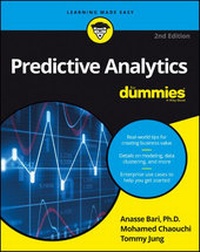
Predictive Analytics For Dummies
2nd Edition
Published on 16. September 2016
456 pages
978-1-119-26702-7 (ISBN)
Description

Use Big Data and technology to uncover real-world insights
You don't need a time machine to predict the future. All it takes is a little knowledge and know-how, and Predictive Analytics For Dummies gets you there fast. With the help of this friendly guide, you'll discover the core of predictive analytics and get started putting it to use with readily available tools to collect and analyze data. In no time, you'll learn how to incorporate algorithms through data models, identify similarities and relationships in your data, and predict the future through data classification. Along the way, you'll develop a roadmap by preparing your data, creating goals, processing your data, and building a predictive model that will get you stakeholder buy-in.
Big Data has taken the marketplace by storm, and companies are seeking qualified talent to quickly fill positions to analyze the massive amount of data that are being collected each day. If you want to get in on the action and either learn or deepen your understanding of how to use predictive analytics to find real relationships between what you know and what you want to know, everything you need is a page away!
* Offers common use cases to help you get started
* Covers details on modeling, k-means clustering, and more
* Includes information on structuring your data
* Provides tips on outlining business goals and approaches
The future starts today with the help of Predictive Analytics For Dummies.
More details
Other editions
Additional editions
Anasse Bari | Mohamed Chaouchi | Tommy Jung
Predictive Analytics For Dummies
Book
12/2016
2nd Edition
Wiley
€28.50
Shipment within 15-20 days
Persons
Anasse Bari, Ph.D. is data science expert and a university professor who has many years of predictive modeling and data analytics experience.
Mohamed Chaouchi is a veteran software engineer who has conducted extensive research using data mining methods.
Tommy Jung is a software engineer with expertise in enterprise web applications and analytics.
Content
1 - Title Page [Seite 3]
2 - Copyright Page [Seite 4]
3 - Table of Contents [Seite 5]
4 - Introduction [Seite 11]
5 - Part 1 Getting Started with Predictive Analytics [Seite 15]
5.1 - Chapter 1 Entering the Arena [Seite 17]
5.1.1 - Exploring Predictive Analytics [Seite 17]
5.1.1.1 - Mining data [Seite 18]
5.1.1.2 - Highlighting the model [Seite 19]
5.1.2 - Adding Business Value [Seite 20]
5.1.2.1 - Endless opportunities [Seite 21]
5.1.2.2 - Empowering your organization [Seite 22]
5.1.3 - Starting a Predictive Analytic Project [Seite 23]
5.1.3.1 - Business knowledge [Seite 24]
5.1.3.2 - Data-science team and technology [Seite 25]
5.1.3.3 - The Data [Seite 26]
5.1.4 - Ongoing Predictive Analytics [Seite 27]
5.1.5 - Forming Your Predictive Analytics Team [Seite 28]
5.1.5.1 - Hiring experienced practitioners [Seite 28]
5.1.5.2 - Demonstrating commitment and curiosity [Seite 29]
5.1.6 - Surveying the Marketplace [Seite 29]
5.1.6.1 - Responding to big data [Seite 30]
5.1.6.2 - Working with big data [Seite 30]
5.2 - Chapter 2 Predictive Analytics in the Wild [Seite 33]
5.2.1 - Online Marketing and Retail [Seite 35]
5.2.1.1 - Recommender systems [Seite 35]
5.2.1.2 - Personalized shopping on the Internet [Seite 36]
5.2.2 - Implementing a Recommender System [Seite 38]
5.2.2.1 - Collaborative filtering [Seite 38]
5.2.2.2 - Content-based filtering [Seite 46]
5.2.2.3 - Hybrid recommender systems [Seite 49]
5.2.3 - Target Marketing [Seite 51]
5.2.3.1 - Targeting using predictive modeling [Seite 52]
5.2.3.2 - Uplift modeling [Seite 53]
5.2.4 - Personalization [Seite 56]
5.2.4.1 - Online customer experience [Seite 56]
5.2.4.2 - Retargeting [Seite 57]
5.2.4.3 - Implementation [Seite 57]
5.2.4.4 - Optimizing using personalization [Seite 58]
5.2.4.5 - Similarities of Personalization and Recommendations [Seite 58]
5.2.5 - Content and Text Analytics [Seite 60]
5.3 - Chapter 3 Exploring Your Data Types and Associated Techniques [Seite 61]
5.3.1 - Recognizing Your Data Types [Seite 62]
5.3.1.1 - Structured and unstructured data [Seite 62]
5.3.1.2 - Static and streamed data [Seite 66]
5.3.2 - Identifying Data Categories [Seite 68]
5.3.2.1 - Attitudinal data [Seite 69]
5.3.2.2 - Behavioral data [Seite 70]
5.3.2.3 - Demographic data [Seite 71]
5.3.3 - Generating Predictive Analytics [Seite 71]
5.3.3.1 - Data-driven analytics [Seite 72]
5.3.3.2 - User-driven analytics [Seite 74]
5.3.4 - Connecting to Related Disciplines [Seite 75]
5.3.4.1 - Statistics [Seite 75]
5.3.4.2 - Data mining [Seite 76]
5.3.4.3 - Machine learning [Seite 77]
5.4 - Chapter 4 Complexities of Data [Seite 79]
5.4.1 - Finding Value in Your Data [Seite 80]
5.4.1.1 - Delving into your data [Seite 80]
5.4.1.2 - Data validity [Seite 80]
5.4.1.3 - Data variety [Seite 81]
5.4.2 - Constantly Changing Data [Seite 82]
5.4.2.1 - Data velocity [Seite 82]
5.4.2.2 - High volume of data [Seite 83]
5.4.3 - Complexities in Searching Your Data [Seite 83]
5.4.3.1 - Keyword-based search [Seite 84]
5.4.3.2 - Semantic-based search [Seite 84]
5.4.3.3 - Contextual search [Seite 86]
5.4.4 - Differentiating Business Intelligence from Big-Data Analytics [Seite 89]
5.4.5 - Exploration of Raw Data [Seite 90]
5.4.5.1 - Identifying data attributes [Seite 90]
5.4.5.2 - Exploring common data visualizations [Seite 91]
5.4.5.3 - Tabular visualizations [Seite 91]
5.4.5.4 - Word clouds [Seite 92]
5.4.5.5 - Flocking birds as a novel data representation [Seite 93]
5.4.5.6 - Graph charts [Seite 95]
5.4.5.7 - Common visualizations [Seite 97]
6 - Part 2 Incorporating Algorithms in Your Models [Seite 99]
6.1 - Chapter 5 Applying Models [Seite 101]
6.1.1 - Modeling Data [Seite 102]
6.1.1.1 - Models and simulation [Seite 102]
6.1.1.2 - Categorizing models [Seite 104]
6.1.1.3 - Describing and summarizing data [Seite 106]
6.1.1.4 - Making better business decisions [Seite 107]
6.1.2 - Healthcare Analytics Case Studies [Seite 107]
6.1.2.1 - Google Flu Trends [Seite 107]
6.1.2.2 - Cancer survivability predictors [Seite 109]
6.1.3 - Social and Marketing Analytics Case Studies [Seite 111]
6.1.3.1 - Target store predicts pregnant women [Seite 111]
6.1.3.2 - Twitter-based predictors of earthquakes [Seite 112]
6.1.3.3 - Twitter-based predictors of political campaign outcomes [Seite 113]
6.1.3.4 - Tweets as predictors for the stock market [Seite 115]
6.1.3.5 - Predicting variation of stock prices from news articles [Seite 116]
6.1.3.6 - Analyzing New York City's bicycle usage [Seite 117]
6.1.3.7 - Predictions and responses [Seite 120]
6.1.3.8 - Data compression [Seite 121]
6.1.4 - Prognostics and its Relation to Predictive Analytics [Seite 122]
6.1.5 - The Rise of Open Data [Seite 123]
6.2 - Chapter 6 Identifying Similarities in Data [Seite 125]
6.2.1 - Explaining Data Clustering [Seite 126]
6.2.2 - Converting Raw Data into a Matrix [Seite 130]
6.2.2.1 - Creating a matrix of terms in documents [Seite 130]
6.2.2.2 - Term selection [Seite 131]
6.2.3 - Identifying Groups in Your Data [Seite 132]
6.2.3.1 - K-means clustering algorithm [Seite 132]
6.2.3.2 - Clustering by nearest neighbors [Seite 136]
6.2.3.3 - Density-based algorithms [Seite 140]
6.2.4 - Finding Associations in Data Items [Seite 142]
6.2.5 - Applying Biologically Inspired Clustering Techniques [Seite 146]
6.2.5.1 - Birds flocking: Flock by Leader algorithm [Seite 146]
6.2.5.2 - Ant colonies [Seite 153]
6.3 - Chapter 7 Predicting the Future Using Data Classification [Seite 157]
6.3.1 - Explaining Data Classification [Seite 159]
6.3.2 - Introducing Data Classification to Your Business [Seite 162]
6.3.3 - Exploring the Data-Classification Process [Seite 164]
6.3.4 - Using Data Classification to Predict the Future [Seite 166]
6.3.4.1 - Decision trees [Seite 166]
6.3.4.2 - Algorithms for Generating Decision Trees [Seite 169]
6.3.4.3 - Support vector machine [Seite 173]
6.3.5 - Ensemble Methods to Boost Prediction Accuracy [Seite 175]
6.3.5.1 - Naïve Bayes classification algorithm [Seite 176]
6.3.5.2 - The Markov Model [Seite 182]
6.3.5.3 - Linear regression [Seite 187]
6.3.5.4 - Neural networks [Seite 187]
6.3.6 - Deep Learning [Seite 189]
7 - Part 3 Developing a Roadmap [Seite 195]
7.1 - Chapter 8 Convincing Your Management to Adopt Predictive Analytics [Seite 197]
7.1.1 - Making the Business Case [Seite 198]
7.1.2 - Gathering Support from Stakeholders [Seite 205]
7.1.3 - Presenting Your Proposal [Seite 216]
7.2 - Chapter 9 Preparing Data [Seite 219]
7.2.1 - Listing the Business Objectives [Seite 220]
7.2.2 - Processing Your Data [Seite 222]
7.2.2.1 - Identifying the data [Seite 222]
7.2.2.2 - Cleaning the data [Seite 223]
7.2.2.3 - Generating any derived data [Seite 225]
7.2.2.4 - Reducing the dimensionality of your data [Seite 225]
7.2.2.5 - Applying principal component analysis [Seite 226]
7.2.2.6 - Leveraging singular value decomposition [Seite 228]
7.2.3 - Working with Features [Seite 229]
7.2.4 - Structuring Your Data [Seite 234]
7.2.4.1 - Extracting, transforming and loading your data [Seite 235]
7.2.4.2 - Keeping the data up to date [Seite 236]
7.2.4.3 - Outlining testing and test data [Seite 236]
7.3 - Chapter 10 Building a Predictive Model [Seite 239]
7.3.1 - Getting Started [Seite 240]
7.3.1.1 - Defining your business objectives [Seite 242]
7.3.1.2 - Preparing your data [Seite 243]
7.3.1.3 - Choosing an algorithm [Seite 246]
7.3.2 - Developing and Testing the Model [Seite 247]
7.3.3 - Going Live with the Model [Seite 252]
7.4 - Chapter 11 Visualization of Analytical Results [Seite 255]
7.4.1 - Visualization as a Predictive Tool [Seite 256]
7.4.2 - Evaluating Your Visualization [Seite 259]
7.4.3 - Visualizing Your Model's Analytical Results [Seite 261]
7.4.3.1 - Visualizing hidden groupings in your data [Seite 261]
7.4.3.2 - Visualizing data classification results [Seite 262]
7.4.3.3 - Visualizing outliers in your data [Seite 264]
7.4.3.4 - Visualization of Decision Trees [Seite 264]
7.4.3.5 - Visualizing predictions [Seite 266]
7.4.4 - Novel Visualization in Predictive Analytics [Seite 268]
7.4.5 - Big Data Visualization Tools [Seite 272]
7.4.5.1 - Tableau [Seite 273]
7.4.5.2 - Google Charts [Seite 273]
7.4.5.3 - Plotly [Seite 273]
7.4.5.4 - Infogram [Seite 274]
8 - Part 4 Programming Predictive Analytics [Seite 275]
8.1 - Chapter 12 Creating Basic Prediction Examples [Seite 277]
8.1.1 - Installing the Software Packages [Seite 278]
8.1.1.1 - Installing Python [Seite 278]
8.1.1.2 - Installing the machine-learning module [Seite 280]
8.1.1.3 - Installing the dependencies [Seite 284]
8.1.2 - Preparing the Data [Seite 288]
8.1.3 - Making Predictions Using Classification Algorithms [Seite 290]
8.1.3.1 - Creating a supervised learning model with SVM [Seite 291]
8.1.3.2 - Creating a supervised learning model with logistic regression [Seite 298]
8.1.3.3 - Creating a supervised learning model with random forest [Seite 305]
8.1.3.4 - Comparing the classification models [Seite 307]
8.2 - Chapter 13 Creating Basic Examples of Unsupervised Predictions [Seite 309]
8.2.1 - Getting the Sample Dataset [Seite 310]
8.2.2 - Using Clustering Algorithms to Make Predictions [Seite 311]
8.2.2.1 - Comparing clustering models [Seite 311]
8.2.2.2 - Creating an unsupervised learning model with K-means [Seite 312]
8.2.2.3 - Creating an unsupervised learning model with DBSCAN [Seite 324]
8.2.2.4 - Creating an unsupervised learning model with mean shift [Seite 328]
8.3 - Chapter 14 Predictive Modeling with R [Seite 333]
8.3.1 - Programming in R [Seite 335]
8.3.1.1 - Installing R [Seite 335]
8.3.1.2 - Installing RStudio [Seite 336]
8.3.1.3 - Getting familiar with the environment [Seite 337]
8.3.1.4 - Learning just a bit of R [Seite 338]
8.3.2 - Making Predictions Using R [Seite 344]
8.3.2.1 - Predicting using regression [Seite 344]
8.3.2.2 - Using classification to predict [Seite 355]
8.3.2.3 - Classification by random forest [Seite 364]
8.4 - Chapter 15 Avoiding Analysis Traps [Seite 369]
8.4.1 - Data Challenges [Seite 370]
8.4.1.1 - Outlining the limitations of the data [Seite 371]
8.4.1.2 - Dealing with extreme cases (outliers) [Seite 374]
8.4.1.3 - Data smoothing [Seite 377]
8.4.1.4 - Curve fitting [Seite 381]
8.4.1.5 - Keeping the assumptions to a minimum [Seite 384]
8.4.2 - Analysis Challenges [Seite 385]
9 - Part 5 Executing Big Data [Seite 391]
9.1 - Chapter 16 Targeting Big Data [Seite 393]
9.1.1 - Major Technological Trends in Predictive Analytics [Seite 394]
9.1.1.1 - Exploring predictive analytics as a service [Seite 394]
9.1.1.2 - Aggregating distributed data for analysis [Seite 395]
9.1.1.3 - Real-time data-driven analytics [Seite 397]
9.1.2 - Applying Open-Source Tools to Big Data [Seite 398]
9.1.2.1 - Apache Hadoop [Seite 398]
9.1.2.2 - Apache Spark [Seite 404]
9.2 - Chapter 17 Getting Ready for Enterprise Analytics [Seite 409]
9.2.1 - Analytics as a Service [Seite 413]
9.2.1.1 - Google Analytics [Seite 413]
9.2.1.2 - IBM Watson [Seite 415]
9.2.1.3 - Microsoft Revolution R Enterprise [Seite 415]
9.2.2 - Preparing for a Proof-of-Value of Predictive Analytics Prototype [Seite 416]
9.2.2.1 - Prototyping for predictive analytics [Seite 416]
9.2.2.2 - Testing your predictive analytics model [Seite 419]
10 - Part 6 The Part of Tens [Seite 421]
10.1 - Chapter 18 Ten Reasons to Implement Predictive Analytics [Seite 423]
10.2 - Chapter 19 Ten Steps to Build a Predictive Analytic Model [Seite 433]
11 - Index [Seite 443]
12 - EULA [Seite 459]
2 - Copyright Page [Seite 4]
3 - Table of Contents [Seite 5]
4 - Introduction [Seite 11]
5 - Part 1 Getting Started with Predictive Analytics [Seite 15]
5.1 - Chapter 1 Entering the Arena [Seite 17]
5.1.1 - Exploring Predictive Analytics [Seite 17]
5.1.1.1 - Mining data [Seite 18]
5.1.1.2 - Highlighting the model [Seite 19]
5.1.2 - Adding Business Value [Seite 20]
5.1.2.1 - Endless opportunities [Seite 21]
5.1.2.2 - Empowering your organization [Seite 22]
5.1.3 - Starting a Predictive Analytic Project [Seite 23]
5.1.3.1 - Business knowledge [Seite 24]
5.1.3.2 - Data-science team and technology [Seite 25]
5.1.3.3 - The Data [Seite 26]
5.1.4 - Ongoing Predictive Analytics [Seite 27]
5.1.5 - Forming Your Predictive Analytics Team [Seite 28]
5.1.5.1 - Hiring experienced practitioners [Seite 28]
5.1.5.2 - Demonstrating commitment and curiosity [Seite 29]
5.1.6 - Surveying the Marketplace [Seite 29]
5.1.6.1 - Responding to big data [Seite 30]
5.1.6.2 - Working with big data [Seite 30]
5.2 - Chapter 2 Predictive Analytics in the Wild [Seite 33]
5.2.1 - Online Marketing and Retail [Seite 35]
5.2.1.1 - Recommender systems [Seite 35]
5.2.1.2 - Personalized shopping on the Internet [Seite 36]
5.2.2 - Implementing a Recommender System [Seite 38]
5.2.2.1 - Collaborative filtering [Seite 38]
5.2.2.2 - Content-based filtering [Seite 46]
5.2.2.3 - Hybrid recommender systems [Seite 49]
5.2.3 - Target Marketing [Seite 51]
5.2.3.1 - Targeting using predictive modeling [Seite 52]
5.2.3.2 - Uplift modeling [Seite 53]
5.2.4 - Personalization [Seite 56]
5.2.4.1 - Online customer experience [Seite 56]
5.2.4.2 - Retargeting [Seite 57]
5.2.4.3 - Implementation [Seite 57]
5.2.4.4 - Optimizing using personalization [Seite 58]
5.2.4.5 - Similarities of Personalization and Recommendations [Seite 58]
5.2.5 - Content and Text Analytics [Seite 60]
5.3 - Chapter 3 Exploring Your Data Types and Associated Techniques [Seite 61]
5.3.1 - Recognizing Your Data Types [Seite 62]
5.3.1.1 - Structured and unstructured data [Seite 62]
5.3.1.2 - Static and streamed data [Seite 66]
5.3.2 - Identifying Data Categories [Seite 68]
5.3.2.1 - Attitudinal data [Seite 69]
5.3.2.2 - Behavioral data [Seite 70]
5.3.2.3 - Demographic data [Seite 71]
5.3.3 - Generating Predictive Analytics [Seite 71]
5.3.3.1 - Data-driven analytics [Seite 72]
5.3.3.2 - User-driven analytics [Seite 74]
5.3.4 - Connecting to Related Disciplines [Seite 75]
5.3.4.1 - Statistics [Seite 75]
5.3.4.2 - Data mining [Seite 76]
5.3.4.3 - Machine learning [Seite 77]
5.4 - Chapter 4 Complexities of Data [Seite 79]
5.4.1 - Finding Value in Your Data [Seite 80]
5.4.1.1 - Delving into your data [Seite 80]
5.4.1.2 - Data validity [Seite 80]
5.4.1.3 - Data variety [Seite 81]
5.4.2 - Constantly Changing Data [Seite 82]
5.4.2.1 - Data velocity [Seite 82]
5.4.2.2 - High volume of data [Seite 83]
5.4.3 - Complexities in Searching Your Data [Seite 83]
5.4.3.1 - Keyword-based search [Seite 84]
5.4.3.2 - Semantic-based search [Seite 84]
5.4.3.3 - Contextual search [Seite 86]
5.4.4 - Differentiating Business Intelligence from Big-Data Analytics [Seite 89]
5.4.5 - Exploration of Raw Data [Seite 90]
5.4.5.1 - Identifying data attributes [Seite 90]
5.4.5.2 - Exploring common data visualizations [Seite 91]
5.4.5.3 - Tabular visualizations [Seite 91]
5.4.5.4 - Word clouds [Seite 92]
5.4.5.5 - Flocking birds as a novel data representation [Seite 93]
5.4.5.6 - Graph charts [Seite 95]
5.4.5.7 - Common visualizations [Seite 97]
6 - Part 2 Incorporating Algorithms in Your Models [Seite 99]
6.1 - Chapter 5 Applying Models [Seite 101]
6.1.1 - Modeling Data [Seite 102]
6.1.1.1 - Models and simulation [Seite 102]
6.1.1.2 - Categorizing models [Seite 104]
6.1.1.3 - Describing and summarizing data [Seite 106]
6.1.1.4 - Making better business decisions [Seite 107]
6.1.2 - Healthcare Analytics Case Studies [Seite 107]
6.1.2.1 - Google Flu Trends [Seite 107]
6.1.2.2 - Cancer survivability predictors [Seite 109]
6.1.3 - Social and Marketing Analytics Case Studies [Seite 111]
6.1.3.1 - Target store predicts pregnant women [Seite 111]
6.1.3.2 - Twitter-based predictors of earthquakes [Seite 112]
6.1.3.3 - Twitter-based predictors of political campaign outcomes [Seite 113]
6.1.3.4 - Tweets as predictors for the stock market [Seite 115]
6.1.3.5 - Predicting variation of stock prices from news articles [Seite 116]
6.1.3.6 - Analyzing New York City's bicycle usage [Seite 117]
6.1.3.7 - Predictions and responses [Seite 120]
6.1.3.8 - Data compression [Seite 121]
6.1.4 - Prognostics and its Relation to Predictive Analytics [Seite 122]
6.1.5 - The Rise of Open Data [Seite 123]
6.2 - Chapter 6 Identifying Similarities in Data [Seite 125]
6.2.1 - Explaining Data Clustering [Seite 126]
6.2.2 - Converting Raw Data into a Matrix [Seite 130]
6.2.2.1 - Creating a matrix of terms in documents [Seite 130]
6.2.2.2 - Term selection [Seite 131]
6.2.3 - Identifying Groups in Your Data [Seite 132]
6.2.3.1 - K-means clustering algorithm [Seite 132]
6.2.3.2 - Clustering by nearest neighbors [Seite 136]
6.2.3.3 - Density-based algorithms [Seite 140]
6.2.4 - Finding Associations in Data Items [Seite 142]
6.2.5 - Applying Biologically Inspired Clustering Techniques [Seite 146]
6.2.5.1 - Birds flocking: Flock by Leader algorithm [Seite 146]
6.2.5.2 - Ant colonies [Seite 153]
6.3 - Chapter 7 Predicting the Future Using Data Classification [Seite 157]
6.3.1 - Explaining Data Classification [Seite 159]
6.3.2 - Introducing Data Classification to Your Business [Seite 162]
6.3.3 - Exploring the Data-Classification Process [Seite 164]
6.3.4 - Using Data Classification to Predict the Future [Seite 166]
6.3.4.1 - Decision trees [Seite 166]
6.3.4.2 - Algorithms for Generating Decision Trees [Seite 169]
6.3.4.3 - Support vector machine [Seite 173]
6.3.5 - Ensemble Methods to Boost Prediction Accuracy [Seite 175]
6.3.5.1 - Naïve Bayes classification algorithm [Seite 176]
6.3.5.2 - The Markov Model [Seite 182]
6.3.5.3 - Linear regression [Seite 187]
6.3.5.4 - Neural networks [Seite 187]
6.3.6 - Deep Learning [Seite 189]
7 - Part 3 Developing a Roadmap [Seite 195]
7.1 - Chapter 8 Convincing Your Management to Adopt Predictive Analytics [Seite 197]
7.1.1 - Making the Business Case [Seite 198]
7.1.2 - Gathering Support from Stakeholders [Seite 205]
7.1.3 - Presenting Your Proposal [Seite 216]
7.2 - Chapter 9 Preparing Data [Seite 219]
7.2.1 - Listing the Business Objectives [Seite 220]
7.2.2 - Processing Your Data [Seite 222]
7.2.2.1 - Identifying the data [Seite 222]
7.2.2.2 - Cleaning the data [Seite 223]
7.2.2.3 - Generating any derived data [Seite 225]
7.2.2.4 - Reducing the dimensionality of your data [Seite 225]
7.2.2.5 - Applying principal component analysis [Seite 226]
7.2.2.6 - Leveraging singular value decomposition [Seite 228]
7.2.3 - Working with Features [Seite 229]
7.2.4 - Structuring Your Data [Seite 234]
7.2.4.1 - Extracting, transforming and loading your data [Seite 235]
7.2.4.2 - Keeping the data up to date [Seite 236]
7.2.4.3 - Outlining testing and test data [Seite 236]
7.3 - Chapter 10 Building a Predictive Model [Seite 239]
7.3.1 - Getting Started [Seite 240]
7.3.1.1 - Defining your business objectives [Seite 242]
7.3.1.2 - Preparing your data [Seite 243]
7.3.1.3 - Choosing an algorithm [Seite 246]
7.3.2 - Developing and Testing the Model [Seite 247]
7.3.3 - Going Live with the Model [Seite 252]
7.4 - Chapter 11 Visualization of Analytical Results [Seite 255]
7.4.1 - Visualization as a Predictive Tool [Seite 256]
7.4.2 - Evaluating Your Visualization [Seite 259]
7.4.3 - Visualizing Your Model's Analytical Results [Seite 261]
7.4.3.1 - Visualizing hidden groupings in your data [Seite 261]
7.4.3.2 - Visualizing data classification results [Seite 262]
7.4.3.3 - Visualizing outliers in your data [Seite 264]
7.4.3.4 - Visualization of Decision Trees [Seite 264]
7.4.3.5 - Visualizing predictions [Seite 266]
7.4.4 - Novel Visualization in Predictive Analytics [Seite 268]
7.4.5 - Big Data Visualization Tools [Seite 272]
7.4.5.1 - Tableau [Seite 273]
7.4.5.2 - Google Charts [Seite 273]
7.4.5.3 - Plotly [Seite 273]
7.4.5.4 - Infogram [Seite 274]
8 - Part 4 Programming Predictive Analytics [Seite 275]
8.1 - Chapter 12 Creating Basic Prediction Examples [Seite 277]
8.1.1 - Installing the Software Packages [Seite 278]
8.1.1.1 - Installing Python [Seite 278]
8.1.1.2 - Installing the machine-learning module [Seite 280]
8.1.1.3 - Installing the dependencies [Seite 284]
8.1.2 - Preparing the Data [Seite 288]
8.1.3 - Making Predictions Using Classification Algorithms [Seite 290]
8.1.3.1 - Creating a supervised learning model with SVM [Seite 291]
8.1.3.2 - Creating a supervised learning model with logistic regression [Seite 298]
8.1.3.3 - Creating a supervised learning model with random forest [Seite 305]
8.1.3.4 - Comparing the classification models [Seite 307]
8.2 - Chapter 13 Creating Basic Examples of Unsupervised Predictions [Seite 309]
8.2.1 - Getting the Sample Dataset [Seite 310]
8.2.2 - Using Clustering Algorithms to Make Predictions [Seite 311]
8.2.2.1 - Comparing clustering models [Seite 311]
8.2.2.2 - Creating an unsupervised learning model with K-means [Seite 312]
8.2.2.3 - Creating an unsupervised learning model with DBSCAN [Seite 324]
8.2.2.4 - Creating an unsupervised learning model with mean shift [Seite 328]
8.3 - Chapter 14 Predictive Modeling with R [Seite 333]
8.3.1 - Programming in R [Seite 335]
8.3.1.1 - Installing R [Seite 335]
8.3.1.2 - Installing RStudio [Seite 336]
8.3.1.3 - Getting familiar with the environment [Seite 337]
8.3.1.4 - Learning just a bit of R [Seite 338]
8.3.2 - Making Predictions Using R [Seite 344]
8.3.2.1 - Predicting using regression [Seite 344]
8.3.2.2 - Using classification to predict [Seite 355]
8.3.2.3 - Classification by random forest [Seite 364]
8.4 - Chapter 15 Avoiding Analysis Traps [Seite 369]
8.4.1 - Data Challenges [Seite 370]
8.4.1.1 - Outlining the limitations of the data [Seite 371]
8.4.1.2 - Dealing with extreme cases (outliers) [Seite 374]
8.4.1.3 - Data smoothing [Seite 377]
8.4.1.4 - Curve fitting [Seite 381]
8.4.1.5 - Keeping the assumptions to a minimum [Seite 384]
8.4.2 - Analysis Challenges [Seite 385]
9 - Part 5 Executing Big Data [Seite 391]
9.1 - Chapter 16 Targeting Big Data [Seite 393]
9.1.1 - Major Technological Trends in Predictive Analytics [Seite 394]
9.1.1.1 - Exploring predictive analytics as a service [Seite 394]
9.1.1.2 - Aggregating distributed data for analysis [Seite 395]
9.1.1.3 - Real-time data-driven analytics [Seite 397]
9.1.2 - Applying Open-Source Tools to Big Data [Seite 398]
9.1.2.1 - Apache Hadoop [Seite 398]
9.1.2.2 - Apache Spark [Seite 404]
9.2 - Chapter 17 Getting Ready for Enterprise Analytics [Seite 409]
9.2.1 - Analytics as a Service [Seite 413]
9.2.1.1 - Google Analytics [Seite 413]
9.2.1.2 - IBM Watson [Seite 415]
9.2.1.3 - Microsoft Revolution R Enterprise [Seite 415]
9.2.2 - Preparing for a Proof-of-Value of Predictive Analytics Prototype [Seite 416]
9.2.2.1 - Prototyping for predictive analytics [Seite 416]
9.2.2.2 - Testing your predictive analytics model [Seite 419]
10 - Part 6 The Part of Tens [Seite 421]
10.1 - Chapter 18 Ten Reasons to Implement Predictive Analytics [Seite 423]
10.2 - Chapter 19 Ten Steps to Build a Predictive Analytic Model [Seite 433]
11 - Index [Seite 443]
12 - EULA [Seite 459]
