

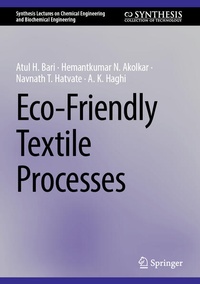
Eco-Friendly Textile Processes
Description

The textile industry is a major environmental polluter. Despite some progress in textile treatment processes and in energy saving, progress is slow, and CO2 emissions continue to rise. In order to better manage the environmental impact of textile treatment processes, it is necessary to understand their principles to be able to improve or replace them with a more environmentally friendly process.
This book begins by introducing sustainable practices in the textile industry that are less polluting followed by eco-friendly finishing treatments. Next, the principle of heat and mass transport in fabrics and the practical applications of these theories are explained. Finally emerging environmentally friendly technologies are discussed.
More details
Other editions
Additional editions
Persons
Atul H. Bari, PhD, is an assistant Professor at the Institute of Chemical Technology Mumbai, Marathwada Campus, Jalna. He obtained his B.Tech (Chemical Technology) degree in 2008 from LIT Nagpur, India; M.Chem. Eng in 2011 and PhD (Chemical Engineering) in 2016 from ICT Mumbai India. His research interests are wastewater treatment, mathematical modelling and simulation, chemical kinetics, crystallization and drying, nanomaterial synthesis. He has published 17 papers and was granted a patent by WIPO (World Intellectual Property organization).
Hemantkumar N. Akolkar, PhD, is currently working as Associate Professor in the Department of Chemistry at Rayat Shikshan Sanstha's Abasaheb Marathe Arts and New Commerce Science College, Maharashtra, India. He is an academician and researcher who has taught for the last 14 years at both undergraduate and postgraduate levels. He has published 55+ research papers in national and international journals and conferences of repute. His areas of interest are heterocyclic chemistry, synthetic organic chemistry, and green chemistry. He is a reviewer of several international journals in chemistry.
Navnath T. Hatvate, PhD, is an assistant professor at the Institute of Chemical Technology, Mumbai, Marathwada Campus, Jalna. He holds a Master of Pharmacy and a PhD from the Department of Pharmaceutical Sciences and Technology at the Institute of Chemical Technology, Mumbai. His areas of expertise and research interests include the development of new chemical entities (NCE) and their analogues, modifications of excipients and their applications in drug delivery, the use of AI and ML in drug discovery and drug delivery, process chemistry of APIs and intermediates, and total synthesis of natural products, bio-active compounds, application of novel technologies in organic synthesis.
A. K. Haghi, PhD, is a retired professor of engineering sciences and has published 250+ academic research-oriented books and 1000+ research papers in various journals and conference proceedings. His leadership in academic publishing includes founding and serving as Editor-in-Chief of prestigious journals. Professor Haghi's extensive educational background and supervisory roles underscore his expertise and contributions to the field of engineering sciences. He is currently appointed as Honorary Research Associate (HRA) at University of Coimbra, Portugal.
Content
Chapter 1 Sustainable Practices in the Textile Industry.- Chapter 2 Eco-efficient Textile Finishing Treatments.- Chapter 3 Heat Transport in Textiles.- Chapter 4 Emerging Trends and Future Directions.
