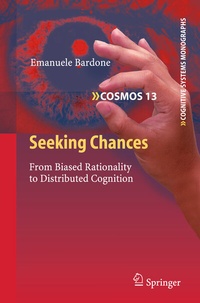
Seeking Chances
Description

One of the most distinguishing abilities that human beings display is the ability of turning almost everything into a clue to make a problem affordable in relation to what one knows and, most of all, to what one does not know. That is what characterizes humans as chance seekers. A poor pattern of reasoning and even our ignorance may help us make a decision, and eventually solve a problem. This is the rationale of biased rationality. However, not everything leads us always to a good decision. Some people are not satisfied with weak arguments or it-is-just-so strategies. They want something better. This second attitude points to a different form of rationality that takes advantage of the idea of distributed cognition. Basically, human beings improve their survival strategies by building cognitive niches capable of delivering potentially ever more symptomatic information. It is through various manipulations of the environment that we gain new and more reliable chances which can be used to de-bias our rationality. Through the laborious activity of cognitive niche construction, we come up with situations in which we are better afforded by our environment, and thus biases or fallacies cease to be appealing.
Reviews / Votes
From the reviews:
"It is a refreshing read that triggers many research ideas on a multiple array of disciplines, including cognitive science, social cognition, social psychology, sociology, organisational behaviour, applied psychology, and decision making. In short, it is a must read!" (Davide Secchi, Biosemiotics, Vol. 6, 2013)
"Seeking Chances: From Biased Rationality to Distributed Cognition is a most welcome book. It discusses many contemporary issues that are appearing in different disciplines . . it is well suited to be a course material in various disciplines, since it provides a framework that uses many different disciplines . . I am strongly suggesting the book . to all who are interested in broader context on how humans deal with the current world and with the changes that are already in process in our niches." (Merja Bauters, Mind & Society, Vol. 11, 2012)
More details
Other editions
Additional editions