

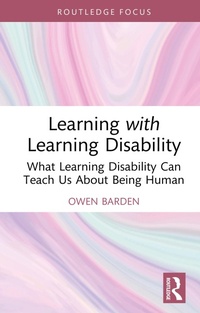
Learning with Learning Disability
What Learning Disability Can Teach Us About Being Human
Published on 9. July 2025
120 pages
978-1-040-43094-1 (ISBN)
Description

This book uses the concept of "learning disability" to explore what it means to be human. It argues that we need to learn with rather than from or about learning disability. This crucial distinction means being open to what learning disability can teach us about what it means to be human. This approach comes from recognising learning disability as an organising concept - a concept which radically transforms our sense of what it means to be - or not be - a person.
After reflecting on the author's relationship to learning disability, the book explores relationships and tensions between conceptualisations of learning disability and of the human. Through historical ontology, the book initially examines how the phenomenon of "learning disability" came into being. It then explores ways in which the concept of learning disability has, over the course of the 20th and 21st centuries, radically transformed our sense not only of education and learning, but also of who is or is not deemed entitled to full citizenship and the associated rights, and so who is or is not fully human.
Each chapter of the book exposes tensions and contradictions apparent in the ways we tend to think about personhood and learning disability, illuminating them through a series a binary oppositions: human and not fully human; menacing and vulnerable; controlled and abandoned; capable and incapable; human and posthuman.
The book concludes by drawing together these tensions and contradictions to challenge the prevailing metanarrative of disability and make the case for a more inclusive conceptualisation of what it means to be human.
It will be of interest to all scholars and students of disability studies, the history of learning disability, humanism and posthumanism, and learning disability advocacy.
After reflecting on the author's relationship to learning disability, the book explores relationships and tensions between conceptualisations of learning disability and of the human. Through historical ontology, the book initially examines how the phenomenon of "learning disability" came into being. It then explores ways in which the concept of learning disability has, over the course of the 20th and 21st centuries, radically transformed our sense not only of education and learning, but also of who is or is not deemed entitled to full citizenship and the associated rights, and so who is or is not fully human.
Each chapter of the book exposes tensions and contradictions apparent in the ways we tend to think about personhood and learning disability, illuminating them through a series a binary oppositions: human and not fully human; menacing and vulnerable; controlled and abandoned; capable and incapable; human and posthuman.
The book concludes by drawing together these tensions and contradictions to challenge the prevailing metanarrative of disability and make the case for a more inclusive conceptualisation of what it means to be human.
It will be of interest to all scholars and students of disability studies, the history of learning disability, humanism and posthumanism, and learning disability advocacy.
More details
Series
Language
English
Place of publication
London
United Kingdom
Publishing group
Taylor & Francis Ltd
Target group
College/higher education
Illustrations
6 Halftones, black and white; 6 Illustrations, black and white
File size
3,00 MB
ISBN-13
978-1-040-43094-1 (9781040430941)
Copyright in bibliographic data and cover images is held by Nielsen Book Services Limited or by the publishers or by their respective licensors: all rights reserved.
Schweitzer Classification
Other editions
Additional editions
Owen Barden
Learning with Learning Disability
What Learning Disability Can Teach Us About Being Human
Book
07/2025
1st Edition
Routledge
€77.70
Shipment within 10-20 days
Person
Owen Barden is Assistant Professor in Intellectual Disability and Inclusion at Trinity College Dublin, Ireland. He has published extensively on learning disability, with particular interests in histories of learning disabilities and participatory methodologies.
Content
1.Introduction. 2.Human and Not Fully Human. 3.Vulnerable and Menacing. 4.Controlled and Abandoned. 5.Human and Posthuman. 6.Conclusion.
