

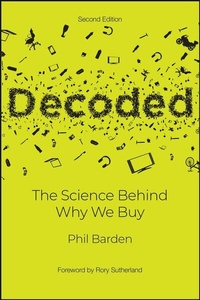
Decoded
Description

If you understand why people buy, you are already one step ahead in reaching out to them effectively with your products and services. Decoded: The Science Behind Why We Buy offers a groundbreaking exploration into the science of purchasing. The book specifically demonstrates why decision science has proven invaluable to the field of marketing by helping to explain purchasing behaviours.
Decoded delivers a practical framework and guidelines for applying science to the marketing practices you use every day. As a marketing professional, you can look to this book for behavioural knowledge, timely case studies, and an understanding of methodologies. You'll gain advice on how to employ knowledge about behaviours for more effective brand management, from strategy to implementation to new product development.
You'll also gain useful insight into the latest research on consumer motivations that lead to purchasing decisions. Learn more about what happens in the human brain as buyers make their choices. This updated edition of Decoded provides new material that marketers can apply to informed, successful practices.
* Gain an understanding of the Jobs to Be Done (JTBD) approach
* Take a closer look at the Ferrero neuroscience study that supports JTBD
* See updated and relevant case studies of JTBD at work
* Discover how to engage customers through digital touchpoints
If you're a marketing practitioner, an understanding of decision science will enhance your day-to-day work. Decoded helps you see how science and marketing come together. Immerse yourself in the science of why people buy and gain a stronger base of knowledge as you develop strategies, implement marketing plans, and meet customer needs through innovation.
More details
Other editions
Additional editions
Person
Content
Preface xvii
1. Decision Science: Understanding the Why of Consumer Behaviour 1
2. The Moment of Truth: Decoding Purchase Decisions 37
3. Decoding the Interface: How the Autopilot Perceives Touchpoints 69
4. Optimizing the Path to Purchase: The Decision Interface Makes the Difference 129
5. Goals: The Driving Forces of Purchase Decisions 167
6. From Positioning to Touchpoints: Bringing Value to Life 213
7. Case Studies 269
Closing Remarks 287
Recommended Reading 289
About the Author 303
Index 305
Preface
I spent 25 years of my life in Unilever, Diageo, and T-Mobile trying to influence consumer behaviour in favour of my brands and products. In order to achieve this, we as marketers accumulate a huge quantity of information and sophisticated analyses about our customers. Indeed, companies such as those for which I worked have developed models and processes that capture years of collective experience. These models guide our multimillion investments in product development and innovation, communication and research. However, the true reasons why we, as human beings, do what we do remain a mystery. Otherwise the failure rate of new products would be nowhere near the reported 80-90% and advertising budgets would be totally efficient and effective.
But marketing life is not like that. Sometimes my activities were successful, sometimes they were not, and based on my personal experience, and in common with many marketers, I built my own mental model of how consumers decide. I knew that this belief system was far from perfect, but no one had a better one to offer - each had his own belief system, which of course led to massive internal discussions (or arguments!), ending in decisions based on personal preferences, often dictated by hierarchy.
This is symptomatic of a more general point, and one that should concern all marketers - a study by the Fournaise Marketing Group among 1200 CEOs (Chief Executive Officers) across North America, Europe, and Asia Pacific reported that 80% of chief executives believe marketers are 'disconnected' from business results and focus on the wrong areas. More specifically, 78% of respondents said that marketers 'too often lose sight of what their real job is' - namely, to increase demand for goods and services in a quantifiable way. The research concluded that marketers will have to transform themselves into true return on investment-driven business people if they are to earn the trust of CEOs and if they want to have a bigger impact in the boardroom. Otherwise, they will forever remain in what 65% of CEOs call 'marketing la-la land'. Perhaps this explains why, barely five years ago, only 34 of the Fortune 1000 companies in the United States had a Marketing Director on their Boards, and the number is only slightly higher in the United Kingdom.
A sobering challenge indeed, yet marketers hold the key to company revenue - understanding consumers, and translating that into compelling product and service propositions. As brand custodians we have always known that brands have some sort of intangible quality over and above the pure functionality of whatever product or service they grace. This is what we've called brand 'equity', but it has always been difficult to pin down, explain, and make tangible. No wonder CEOs think marketing is 'fluffy' and trust their CFOs (Chief Finance Officers) more than their CMOs (Chief Marketing Officers). To step out of la-la land and earn that trust we must make brand equity tangible and understandable and explain better why it is by no means trivial. It is what enables brands to command a price premium compared with more commodity-like alternatives. Consumers are willing to pay £3-4 for a coffee in Starbucks, yet they know, objectively, that for the price of two cups they could buy a whole jar of coffee in a supermarket. So they must be buying something else. Some sort of value applies over and above the physical product, but what is it? How does the brain perceive such value? In short, how do consumers decide?
Whenever science enters a domain it adds significant value, but, ironically, the mental model we apply in marketing today is still based on 1970s' thinking - almost half a century ago! In this time, the understanding in the areas of decision science has advanced dramatically. It behoves us to update the way we think about how consumers decide. From my perspective, the knee-jerk reaction of the marketing community in the past few years has been to delegate this scientific evolution to their market researchers, utilizing new ways of measurement like brain scanning. But do we really think that we need even more data? And what if such new methodologies generate similar results - a likely outcome since most of them are validated using existing models and metrics? Or what if they show differences? What then is right and what is wrong, and how should we make this judgement? As long as we continue to ask the same questions and don't update our mental model for consumer decision making, we will not be able to exploit the powerful insights that decision science offers. This requires a paradigm shift in marketing, not just a change of tools.
So why have I written this book? Because my belief system was significantly shaken in my last client-side role. I was then Vice-President Brand Development for T-Mobile, taking the brand through changes in brand architecture and positioning. I was confronted by a totally new mental model for marketing and consumer decision making based on decision science: the conclusions from the latest collective learnings from neuroscience, behavioural economics, and cognitive and social psychology. I found it fascinating because it offered me explanations of consumer behaviour, which previously had mystified me, but at the same time it was irritating because it disproved some of my very basic assumptions about how consumers decide. It was the first time I had experienced the power of an approach that was based not on beliefs and assumptions but on the latest scientific findings. Using this knowledge not only yielded new vocabulary that was more valuable in understanding why consumers do what they do but at the same time provided a profound framework for marketing - from brand strategy and positioning, through to innovation, advertising, and interactive media.
This approach was not only fascinating and different, it proved to be a huge financial success for the brand, inspiring the 'Dance' flash mob advertising in the United Kingdom in 2009. In a fiercely competitive market, the results were stunning:
- 146% ROI
- sales increased by 49%
- market share grew by 6%
- customer acquisition costs halved
- brand consideration tripled
- retail store footfall doubled and conversion grew by 20%
- existing customers increased their usage of the services, spending 11% more than the market
- 41.7 million YouTube views, 68 Facebook groups.
(Source: T-Mobile and IPA)
Consequently, this approach was applied across all other T-Mobile brand 'touch points', such as proposition development, retail store design, and customer services. According to Lysa Hardy, the T-Mobile VP in the United Kingdom at the time, the combined effect of these changes, and subsequent advertising based on the same communications platform, was to halve T-Mobile's customer churn (the percentage of customers who leave the network). From having the worst churn in the UK mobile network market, it became the best. The approach was subsequently rolled out by the brand across Europe, resulting in over 400 awards for brand communications and design, including an award for the best brand relaunch. Hans-Christian Schwingen, Chief Brand Officer at Deutsche Telekom until March 2020, attested to this in a personal communication
'In 2008 Deutsche Telekom started gathering all the T-brands, products, and services, which had more or less taken on a life of their own in the years prior, under ONE "T" roof. Based on DECODE's insights from behavioural science, Telekom repositioned the brand under the unified brand promise "Life is for sharing". Not only were the product roadmaps noticeably unified across Europe, but the markets also converged communications, in terms of agenda-setting, content and style. After ranking 4th in Europe's most valuable telecommunications brands in 2008, Telekom has consistently topped this list since 2014 as the undisputed No. 1, and is now the second most valuable telco brand globally. It has increased its brand value nearly 7x in 13 years.'
Inspired by my experience, I started to dive deep into the literature of decision science. As I suspected, the mental model I had applied for all those years was far from complete - and, in many cases, simply wrong. I became more and more fascinated by what I learned and its value in building brands and driving revenue. This experience was so profound and exciting that it inspired me to switch careers. I left my job at T-Mobile and joined DECODE, the consultancy responsible for the step change I had experienced at T-Mobile.
DECODE was founded, and is staffed, by former scientists from the fields of decision science. To stay at the leading edge of developments, DECODE collaborates with leading universities for neuro-economics, such as the California Institute of Technology (US). In addition, its consultants still practice, at professorial and doctoral level, in academe. They have been complemented by practitioners from B2B (business to business) and B2C (business to consumer) brand management (who, as clients of DECODE, had similar experiences to mine and, as a result, chose to join DECODE), as well as by advertising agency, planning directors, and shopper marketers. Together, we form an interdisciplinary team of experts with a unique blend of capabilities, translating the latest scientific learnings into pragmatic and concrete marketing application. This bridge from science to day-to-day marketing practice is what this book is about.
The goal of...
