

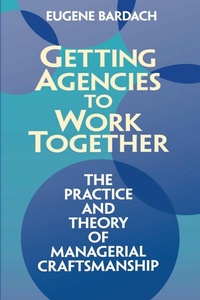
Getting Agencies to Work Together
The Practice and Theory of Managerial Craftsmanship
1st Edition
Published on 1. October 1998
348 pages
978-0-8157-9128-7 (ISBN)
Description

Collaboration between government agencies, an old joke goes, is an unnatural act committed by nonconsenting adults. Eugene Bardach argues that today's opinion climate favoring more results-oriented government makes collaboration a lot more natural--though it is still far from easy. In this book, Bardach diagnoses the difficulties, explains how they are sometimes overcome, and offers practical ideas for public managers, advocates, and others interested in developing interagency collaborative networks.
Bardach provides examples from diverse policy areas, including children, youth, and family services; welfare-to-work; antipollution enforcement; fire prevention; and ecosystem management.
Bardach provides examples from diverse policy areas, including children, youth, and family services; welfare-to-work; antipollution enforcement; fire prevention; and ecosystem management.
More details
Edition
1. Auflage
Language
English
Place of publication
New York
United States
Publishing group
Bloomsbury Publishing Plc
ISBN-13
978-0-8157-9128-7 (9780815791287)
Copyright in bibliographic data and cover images is held by Nielsen Book Services Limited or by the publishers or by their respective licensors: all rights reserved.
Schweitzer Classification
Other editions
Additional editions
Book
10/1998
Brookings Institution
€33.60
Shipment within 10-20 days
Book
10/1998
Brookings Institution
€73.26
Article exhausted; check different version
Person
Eugene Bardach is professor of public policy in the Richard and Rhoda Goldman School of Public Policy at the University of California at Berkeley. He is the author o f The Eight-Step Path of Policy Analysis: A Handbook for Practice (Berkeley Academic Press), for which he received the 1998 Donald T. Campbell award of the Policy Studies Organization for creative contributions to the methodology of policy analysis.
Content
- Cover
- Contents
- 1 Creating Value through Collaboration
- A New Optimism
- Craftsmanship Theory
- The Pluralism Problem
- The Obsolescence Problem
- Reorganizing Versus Collaborating
- Summary
- 2 Craftsmanship Theory
- Capacity as the Dependent Variable
- Previous Theories
- Explaining Success and Failure
- Qualities Analysis and Explanation of Variation
- Summary
- Appendix: Some Generic Opportunities in Policy Design and Management
- 3 Methods and Cases
- Choosing the Cases
- Collecting Data: Informants' Reports
- Strategies for Conceptualization
- Rating ICC "Success" and Other Attributes
- School-Linked Services
- Children, Family, and Youth Services
- Community Organizing
- Welfare to Work
- Antitobacco Education (Medium)
- Preventing Fires (High)
- Regulation
- Natural Resources and Ecosystems Management
- Military Base Closure and Reuse
- Summary
- 4 The Operating System
- Flexibility
- Motivating Lower-Level Staff
- Mutual Intelligibility and Trust
- Accountability and Quality
- Money and Quality
- Summary
- 5 How an Interagency Collaborative Acquires Resources
- The Variety of Protectionist Purposes
- Countervailing Purposes
- Summary
- 6 How an Interagency Collaborative Steers a Course
- Steering Well
- Smart Practices in the Design of Steering Processes
- Summary
- 7 The Culture of Joint Problem Solving
- Pragmatism and the Culture of Bureaucracy
- Negotiating
- Structural and Dynamic Aspects of the Negotiation Process
- Developing Trust
- Summary
- 8 Developmental Dynamics
- Platforming
- Momentum
- How the Development Process Can Be Disrupted
- Summary
- 9 Craftsmanship Theory Applied and Appreciated
- Building Interagency Collaborative Capacity
- Lead Poisoning Revisited
- The Craftsmanship Conceptual Framework
- References
- Index
- A
- B
- C
- D
- E
- F
- G
- H
- I
- J
- K
- L
- M
- N
- O
- P
- Q
- R
- S
- T
- U
- V
- W
- Y
