

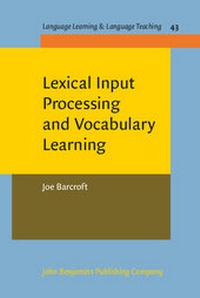
Lexical Input Processing and Vocabulary Learning
1st Edition
Published on 11. December 2015
XI, 194 pages
978-90-272-6805-1 (ISBN)
Description

This book focuses on theory, research, and practice related to lexical input processing (lex-IP), an exciting field exploring how learners allocate their limited processing resources when exposed to words and lexical phrases in the input. Unit 1 specifies parameters of lex-IP research among other levels of input processing as well as key components (form, meaning, mapping) and contexts (incidental/intentional) of vocabulary learning. Unit 2 highlights theoretical advances, such as the type of processing - resource allocation (TOPRA) model, consistent with research on tasks (sentence writing, word copying, word retrieval) that learners may perform during vocabulary learning. Unit 3 highlights patterns in partial word form learning and input-based effects, including the value of increased exposure, drawbacks of presenting vocabulary in semantic sets, and advantages of input enhancement, particularly with regard to increasing talker, speaking-style, and speaking-rate variability in spoken input. The book unifies a range of research pertinent to lex-IP, summarizes theoretical and instructional implications, and proposes intriguing new directions for future research.
More details
Other editions
Additional editions
Joe Barcroft
Lexical Input Processing and Vocabulary Learning
Book
12/2015
John Benjamins Publishing Co
€100.70
Shipment within 10-15 days
Person
Content
- Lexical Input Processing and Vocabulary Learning
- Editorial page
- Title page
- LCC data
- Table of contents
- Acknowledgments
- Chapter 1. Introduction
- Research on lexical input processing
- Goals of the book
- Subprocesses in lex-IP for different subcomponents of vocabulary learning
- Task-based effects
- Input-based effects
- Lex-IP at the intersection of SLA and psychology
- Implications of lex-IP theory and research for vocabulary instruction
- Intended audience of the book
- Organization of the book
- Unit 1. Understanding lex-IP
- Chapter 2. Multiple levels of input processing and language learning
- Different levels and types of input processing
- Lex-IP and vocabulary learning
- A new dimension in input processing
- Different types of input processing yield different types of memory and learning
- Examples of processing resource allocation in multilevel input processing
- Input processing for different types of form-meaning relationships
- The construct of "intake" in lex-IP
- The central role of lex-IP in linguistic development
- Differences in the meaning of "direct teaching" for morphosyntax versus lexis
- Incidental and intentional vocabulary learning
- Methodological issues in research on lex-IP and vocabulary learning
- Chapter 3. Three key components of learning a word: Form, meaning, mapping
- What is a word?
- What does it mean to know a word?
- What are the limits of the conceptual and semantic space of lexical items?
- How do we learn new words? Necessary ingredients and basic mechanisms
- The incremental nature of vocabulary learning
- Chapter 4. Contexts of lexical input processing: L1/L2 and incidental/intentional
- Lex-IP in L1 and L2 vocabulary learning
- Similarities between L1 and L2 vocabulary learning
- Differences between L1 and L2 vocabulary learning
- L1, L2, and the "learning burden" in vocabulary learning
- The case of learning new words and new meanings for the first time in L2
- Lex-IP in both intentional and incidental learning contexts
- What are the parameters of a lex-IP study?
- Distinguishing between research on lex-IP and research on lexical processing
- "Incidental" versus "incidentally oriented" vocabulary learning: A clarification
- The incidental-intentional continuum in vocabulary learning
- Six areas of research on L2 vocabulary across the incidental-intentional continuum
- Four other areas of research related to L2 vocabulary
- Research on lex-IP and intentional L2 vocabulary learning
- Research on lex-IP and incidental L2 vocabulary learning
- Unit 2. Task-based effects
- Chapter 5. Specificity in type of processing and learning: The TOPRA model
- Processing resource allocation
- Specificity in type of processing
- Semantic elaboration, LOP, and vocabulary learning
- Impacts of LOP on ideas about semantic processing and vocabulary learning
- Transfer appropriate processing
- The type of processing - resource allocation (TOPRA) model
- A pivotal study on TOPRA and intentional L2 vocabulary learning
- Specificity in type of processing and type of human memory and learning
- Chapter 6. Effects of tasks involving semantic and structural elaboration
- Studies on intentional vocabulary learning
- What is the effect of sentence writing?
- What is the effect of questions about word meaning?
- What is the effect of different types of instructions regarding focus on word meaning and word form
- What is the effect of referent token variability?
- What is the effect of pleasantness ratings and letter counting on mapping?
- The Keyword Method, mnemonics, and the TOPRA model
- Studies on incidental vocabulary learning
- What is the effect of synonym generation?
- What is the effect of pleasantness ratings and letter counting?
- What are the effects of type (semantic, structural) and amount of processing?
- The involvement load hypothesis, the TOPRA model, and lex-IP
- Summary and analysis
- Instructional implications
- Chapter 7. Effects of output with and without access to meaning
- Research on output without access to meaning and L2 vocabulary learning
- What are the effects of copying target words?
- What are the effects of copying target words and word fragments?
- What are the effects of choral repetition?
- What are the effects of spoken output on learning novel L2 phonemic contrasts?
- Research on output with access to meaning and L2 vocabulary learning
- Output with access to meaning and L2 vocabulary: A study by Royer (1973)
- Summary and analysis
- Chapter 8. Effects of opportunities for target word retrieval
- Retrieval opportunities and research on human memory
- Retrieval opportunities and intentional L2 vocabulary learning
- Do benefits of retrieval opportunities extend to incidental vocabulary learning?
- Summary and implications
- Unit 3. Input-based effects
- Chapter 9. Privileging and patterns in partial word form learning
- Is the "receptive-productive" distinction an artefact of partial word form knowledge?
- Research on the bathtub effect
- Research on partial word form learning
- Bathtub versus recliner effects
- Summary and implications
- Chapter 10. Effects of increased and spaced exposure
- Time of exposure and the meaning of effectiveness
- Length of exposure interval and number of exposures (repetitions)
- The spacing effect in L2 vocabulary learning
- Expanding rehearsal and L2 vocabulary learning
- Summary and implications
- Chapter 11. Effects of semantic versus thematic sets
- Arguments in favor of semantic clustering
- Arguments against semantic clustering
- Research on semantic and thematic clustering
- Lexical networks, semantic relatedness, and lex-IP
- Summary and implications
- Chapter 12. Effects of input enhancement
- What counts as input enhancement for L2 vocabulary learning?
- Why might input enhancement lead to better L2 vocabulary learning?
- Research on input enhancement and L2 vocabulary learning
- The relationship between input enhancement and lex-IP
- Summary and implications
- Chapter 13. Effects of acoustically varied input
- Acoustic variability and L1 speech processing
- Acoustic variability and learning L2 phonemic contrasts
- Acoustic variability and vocabulary learning
- Summary of research findings in support of EPRH
- A visual model of the effects of acoustic variability across the lifespan
- Acoustic variability, vocabulary learning, and lex-IP
- Acoustic variability and vocabulary instruction
- Unit 4. Conclusions and future research
- Chapter 14. Summary of theoretical and instructional implications
- Summary of theoretical implications
- Thirty observations about lex-IP and vocabulary learning
- Summary of instructional implications
- Chapter 15. Directions for future research
- Understanding multilevel input processing
- Quantifying predictions of the TOPRA model
- Assessing tasks in incidental contexts
- Advancing our understanding of dissociable types of processing
- Evaluating different input-retrieval patterns
- Isolating benefits of input enhancement
- Appraising the qualitative effects of acoustic variability
- Concluding remarks
- References
- Appendix A
- Appendix B
- Index
