

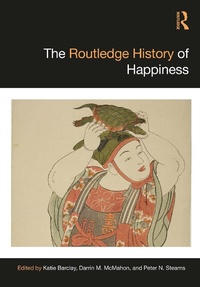
The Routledge History of Happiness
1st Edition
Published on 9. May 2024
490 pages
978-1-040-02070-8 (ISBN)
Description

Unmatched in originality, breadth, and scope, The Routledge History of Happiness features chapters that explore the history, anthropology, and psychology of happiness across the globe.
Through a chronological approach that ranges from the Classical and Postclassical to the twenty-first century, this volume balances intellectual-history treatments and wider efforts to deal with relevant popular culture and experience, including consumerism. It explores how and why the history of happiness has emerged in recent decades, as well as psychological and social science approaches to happiness, with a history of how relevant psychological research has unfolded. Chapters examine early cultural traditions concerning happiness, including material on Buddhist and Chinese traditions, and how they continue to influence ideas about happiness in the present day. Overall, each section emphasises wide geographical coverage, with particular attention paid to East Asia, Latin America, Europe, Russia, and Africa.
The Routledge History of Happiness is of great use to all undergraduates, postgraduates, and scholars interested in the global history of emotions.
Through a chronological approach that ranges from the Classical and Postclassical to the twenty-first century, this volume balances intellectual-history treatments and wider efforts to deal with relevant popular culture and experience, including consumerism. It explores how and why the history of happiness has emerged in recent decades, as well as psychological and social science approaches to happiness, with a history of how relevant psychological research has unfolded. Chapters examine early cultural traditions concerning happiness, including material on Buddhist and Chinese traditions, and how they continue to influence ideas about happiness in the present day. Overall, each section emphasises wide geographical coverage, with particular attention paid to East Asia, Latin America, Europe, Russia, and Africa.
The Routledge History of Happiness is of great use to all undergraduates, postgraduates, and scholars interested in the global history of emotions.
Reviews / Votes
'In an age when happiness is the subject of hundreds of self-help books, global surveys, and government initiatives, The Routledge History of Happiness is an essential read. It brings together leading historians of the emotions to address how ideas and experiences of happiness have changed over time and varied across the globe. The volume's scope is wide, with perspectives on happiness and the well-lived life in childhood and old age, in the ancient Greco-Roman world and in modern Bhutan, in consumer contexts, and in family rituals. The book offers an all too rare comparative view of the subject, addressing differences and similarities across time, culture, and the life course. Brilliantly conceived and carefully curated, this volume is an important contribution to happiness studies and the history of emotions and psychology.'Susan Matt, Weber State University, USA
'The Routledge History of Happiness is a delightfully deep and detailed exploration of one of the key drivers of individual and collective human life across time and culture. Readers interested in more than the superficial treatment this topic often receives will be grateful for-and fascinated by-this volume's nuanced chapters, which carefully cover ancient, medieval, modern, and contemporary viewpoints, including perspectives from the East as well as the West, and from the Global South and well as the Global North. This insightful volume demonstrates the essential role the humanities have to play in the study and cultivation of human flourishing, and as such, is a valued contribution to the new field of the Positive Humanities.'
James O. Pawelski, University of Pennsylvania, USA
More details
Series
Edition
1. Auflage
Language
English
Place of publication
London
United Kingdom
Publishing group
Taylor & Francis Ltd
Target group
College/higher education
Professional and scholarly
Product notice
Reflowable
Illustrations
9 Tables, black and white; 3 Line drawings, black and white; 18 Halftones, black and white; 21 Illustrations, black and white
ISBN-13
978-1-040-02070-8 (9781040020708)
Copyright in bibliographic data and cover images is held by Nielsen Book Services Limited or by the publishers or by their respective licensors: all rights reserved.
Schweitzer Classification
Other editions
Additional editions
Katie Barclay | Darrin McMahon | Peter N. Stearns
The Routledge History of Happiness
Book
approx. 07/2026
1st Edition
Routledge
€63.50
Not yet published
Katie Barclay | Darrin McMahon | Peter N. Stearns
The Routledge History of Happiness
Book
05/2024
1st Edition
Routledge
€311.60
Shipment within 10-20 days
Persons
Katie Barclay is Head of Historical and Classical Studies and Co-Director of the Fay Gale Centre for Research on Gender, University of Adelaide. She writes widely on the history of emotions, gender and family life. Her recent publications include Caritas: Neighbourly Love and the Early Modern Self (2021) and with Leanne Downing, Emotions, Memes and the Making of History (2023).
Darrin M. McMahon is the David W. Little Class of 1944 Professor and Chair of the Department History at Dartmouth College and the author or editor of eight books, including Happiness: A History (2006), History and Human Flourishing (2023), and most recently, Equality: The History of an Elusive Idea (2023).
Peter N. Stearns is a Distinguished University Professor of History at George Mason University. He has written widely about the history of emotion and a variety of topics in world history, including a short book on Happiness in World History (2021). With a colleague, he is currently completing a history of contemporary American childhood.
Darrin M. McMahon is the David W. Little Class of 1944 Professor and Chair of the Department History at Dartmouth College and the author or editor of eight books, including Happiness: A History (2006), History and Human Flourishing (2023), and most recently, Equality: The History of an Elusive Idea (2023).
Peter N. Stearns is a Distinguished University Professor of History at George Mason University. He has written widely about the history of emotion and a variety of topics in world history, including a short book on Happiness in World History (2021). With a colleague, he is currently completing a history of contemporary American childhood.
Content
1. A History of Happiness: an Introduction Part One: Continuity and Change 2. Buddhism and Happiness: A Modern Romance or Tale as Old as Time? 3. Happiness and Grieving Well: Family Bonds and Mourning Practices in China 4. The Transition from Early to Modern Happiness in Bhutan 5. Happiness in Old Age: A Very Brief History of a Complex Topic Part Two: Classical and Postclassical 6. Happiness in the Classical Greco-Roman World 7. Qur'anic Happiness: With Remarks on Late Antique Fear of God, Asceticism, and Emotions as Moral Understanding 8. Medieval Happiness Reconsidered: The Unstable Human Heart in This World and the Next Part Three: Early Modern 9. Historicizing Happiness Management in the Joseon Korean Kingdom 10. Family, Care and the Affective Universe of Novohispanic Baroque Happiness: The Chiaroscuros of an Enduring Tradition 11. Shakespeare's Unhappiness Archive and the Early Modern Social 12. Western Laughter and Happiness in Transition Part Four: Eighteenth and Nineteenth Centuries 13. Happiness and the Enlightenment 14. Happiness and Industrialization: Western Society in the Nineteenth Century 15. Definitions of Happiness in Ottoman Syria: Hegemonic and Subordinate Voices during the Nineteenth Century 16. Who Can be Happy in Russia? Part Five:Twentieth Century 17. "We Strive to Make the People a Little Happier Every Day." Political Discourse and Practices of Happiness in Brazil and Argentina in Mid-Twentieth Century 18. Happiness and the Origins of Modern Consumerism 19. The Rise of Positive Psychology 20. Politics and Happiness, an Unhappy Inheritance: Liberal Democracies and the Return of Fascist Populism Part Six: Twenty-first Century 21. How to be Happy in Botswana 22. Happy Japan: An Essay 23. In Pursuit of the Good Life: Young Men's Cultivation of Enjoyment in Niger Part Seven: Interdisciplinary Contexts 24. The History of Happiness in Academic Psychology 25. Decades of Scientific Research on Human Happiness: Questions, Findings, and Urgent Future Directions 26. Contemporary Happiness Efforts 27. Epilogue: Joy's Futures
