

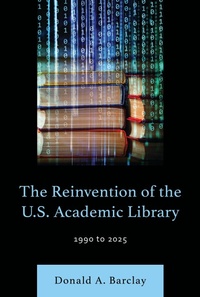
The Reinvention of the U.S. Academic Library
1990 to 2025
1st Edition
Published on 10. July 2025
224 pages
979-8-7651-5481-6 (ISBN)
Description

Focusing on U.S. academic libraries, The Reinvention of the U.S. Academic Library begins by providing a concise history of the traditional role and function of academic libraries from their earliest times up to the dawn of the Digital Age and the spread of digital technology into all aspects of academic research and scholarly communication. This introduction is followed by chapters analyzing how digital technology has transformed, over the course of a few swift decades, not only the role and function of academic libraries, but also the nature of scholarly communication itself.
Specifically, The Reinvention of the U.S. Academic Library will consider how digital technology has changed the way academic libraries:
- Acquire and exercise bibliographic control over collections.
- Provide equitable access to information. Allocate and utilize library space. Instruct and guide students, faculty, and others.
- Relate to the larger academic and scholarly publishing communities. Sustain scholarly communications.
Specifically, The Reinvention of the U.S. Academic Library will consider how digital technology has changed the way academic libraries:
- Acquire and exercise bibliographic control over collections.
- Provide equitable access to information. Allocate and utilize library space. Instruct and guide students, faculty, and others.
- Relate to the larger academic and scholarly publishing communities. Sustain scholarly communications.
More details
Edition
1. Auflage
Language
English
Place of publication
New York
United States
Publishing group
Bloomsbury Publishing Plc
Target group
Professional and scholarly
College/higher education
Illustrations
7 b/w photos; 8 tables
ISBN-13
979-8-7651-5481-6 (9798765154816)
Copyright in bibliographic data and cover images is held by Nielsen Book Services Limited or by the publishers or by their respective licensors: all rights reserved.
Schweitzer Classification
Other editions
Additional editions
Book
09/2025
Rowman & Littlefield Publishers
€38.50
Shipment within 3-4 weeks
Person
Donald A. Barclay worked as an academic librarian from 1990 until his retirement in 2022, during his library career holding positions at New Mexico State University, the University of Houston, the Texas Medical Center, and the University of California, Merced. Barclay began working at the University of California, Merced in 2002, before ground was broken on what would become the first (and thus far only) new U.S. research university of the twenty-first century. The unique opportunity of creating an academic research library from the ground up at a time when digital technology was expanding into every aspect of human life and radically transforming scholarly communication allowed him to both closely observe and actively participate in the biggest technological change to hit libraries since the advent of printing from moveable type.
Barclay has authored numerous articles and books over the course of his career on topics ranging from the literature of the American West to children's literature to library and information science. His book, Fake News, Propaganda, and Plain Old Lies: How to Find Trustworthy Information in the Digital Age, was published by Rowman and Littlefield in June 2018 and spent two months as an Amazon #1 New Release. His follow up book, Disinformation: The Nature of Facts and Lies in the Post-Truth Era, was published by Rowman and Littlefield in 2022.
Barclay earned his bachelor's degree from Boise State University and holds masters' degrees in both English and Library and Information Science from the University of California, Berkeley. Prior to working as a librarian, he spent four years teaching college writing as well as ten seasons working as a wildland fire fighter, mostly as a member of a U.S. Forest Service Hotshot Crew. He lives in Merced, California with his wife Caroline Dawson and their three daughters, Tess, Emily, and Alexandra.
Barclay has authored numerous articles and books over the course of his career on topics ranging from the literature of the American West to children's literature to library and information science. His book, Fake News, Propaganda, and Plain Old Lies: How to Find Trustworthy Information in the Digital Age, was published by Rowman and Littlefield in June 2018 and spent two months as an Amazon #1 New Release. His follow up book, Disinformation: The Nature of Facts and Lies in the Post-Truth Era, was published by Rowman and Littlefield in 2022.
Barclay earned his bachelor's degree from Boise State University and holds masters' degrees in both English and Library and Information Science from the University of California, Berkeley. Prior to working as a librarian, he spent four years teaching college writing as well as ten seasons working as a wildland fire fighter, mostly as a member of a U.S. Forest Service Hotshot Crew. He lives in Merced, California with his wife Caroline Dawson and their three daughters, Tess, Emily, and Alexandra.
Content
The Reinvention of the U.S. Academic Library: 1990 to 2025
Acknowledgements
Introduction
Chapter 1: Acquiring Information in Digital Containers: Old Wine in New Bottles
Chapter 2: Electronic Journals Take the Field
Chapter 3: The Open Access Revolution
Chapter 4: From the Card Catalog to the Semantic Web: The Digital Odessey of Cataloging and Technical Services
Chapter 5: Distinctive Collections Go Digital
Chapter 6: Reference, Instruction, and Facilities: The Challenge of Meeting Changing User Expectations in the Digital Age
Chapter 7: The Future of the U.S. Academic Library
Author Bio
Acknowledgements
Introduction
Chapter 1: Acquiring Information in Digital Containers: Old Wine in New Bottles
Chapter 2: Electronic Journals Take the Field
Chapter 3: The Open Access Revolution
Chapter 4: From the Card Catalog to the Semantic Web: The Digital Odessey of Cataloging and Technical Services
Chapter 5: Distinctive Collections Go Digital
Chapter 6: Reference, Instruction, and Facilities: The Challenge of Meeting Changing User Expectations in the Digital Age
Chapter 7: The Future of the U.S. Academic Library
Author Bio
