

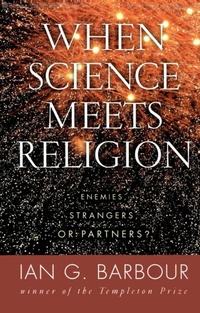
When Science Meets Religion
Enemies, Strangers, or Partners?
Published on 5. February 2013
202 pages
978-0-06-227377-2 (ISBN)
Description

For centuries, scientists, theologians, and the general public have debated the question: what impact should scientific discoveries have on religion? The argument has been so heated at times that some scientists, like Galileo, were forced to recant their conclusions by Church authorities.
In When Science Meets Religion, nuclear physicist and theologian Ian Barbour presents a clear, contemporary introduction to the essential issues, ideas, and solutions in the relationship between religion and science. Barbour, who was awarded the 1999 Templeton Prize for Progress in Religion for his pioneering role in advancing the study of religion and science, addresses creation and the Big Bang, quantum physics and ultimate reality, evolution and continuing creation, and many other fascinating topics that cross the boundary between laboratory and pulpit. Ian Barbour is Professor Emeritus of Physics and Religion at Carleton College, Northfield, Minn. He was named the winner of 1999 Templeton Prize for Progress in Religion for his pioneering role in establishing the study of religion and science. He donated the $1.42 million prize to the Berkeley Center for the Study of Theology and Science and to Carleton College. He is the author of many books, including Religion and Science, Ethics in an Age of Technology, and Religion in an Age of Science. "No surer and fairer guide to the proliferating literature on the relation of science and religion can be found than Ian Barbour." - Arthur Peacocke, Oxford University, author of From DNA to Dean: Reflections & Explorations of a Priest-ScientistMore details
Other editions
Additional editions
Ian G. Barbour
When Science Meets Religion
Book
05/2000
HarperSanFrancisco
€21.50
Shipment within 15-20 days
Person
Ian G. Barbour has retired from Carleton College where he was professor of physics, professor of religion, and Bean Professor of Science, Technology, and Society. The "preeminent synthetic in the field" (Cross Currents,) he is the author of several influential books, including Ethics in an Age of Technology and Myths Models, and Paradigms, which was nominated for the National Book Award. He gave the world-renowned Gifford Lectures, 1989-1991.
Content
- Intro
- Dedication
- Contents
- Preface
- Introduction
- Chapter One: Four Views of Science and Religion
- Chapter Two: Astronomy and Creation
- Chapter Three: The Implications of Quantum Physics
- Chapter Four: Evolution and Continuing Creation
- Chapter Five: Genetics, Neuroscience, and Human Nature
- Chapter Six: God and Nature
- Searchable Terms 1
- Searchable Terms 2
- Notes
- About the Author
- Praise
- Copyright
- About the Publisher
