

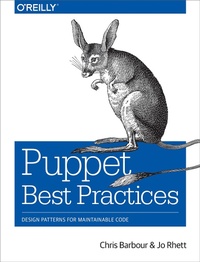
Puppet Best Practices
Design Patterns for Maintainable Code
Published on 24. August 2018
308 pages
978-1-4919-2305-4 (ISBN)
Description

If you maintain or plan to build Puppet infrastructure, this practical guide will take you a critical step further with best practices for managing the task successfully. Authors Chris Barbour and Jo Rhett present best-in-class design patterns for deploying Puppet environments and discuss the impact of each. The conceptual designs and implementation patterns in this book will help you create solutions that are easy to extend, maintain, and support.
Essential for companies upgrading their Puppet deployments, this book teaches you powerful new features and implementation models that weren't available in the older versions. DevOps engineers will learn how best to deploy Puppet with long-term maintenance and future growth in mind.
- Explore Puppet's design philosophy and data structures
- Get best practices for using Puppet's declarative language
- Examine Puppet resources in depth?the building blocks of state management
- Learn to model and describe business and site-specific logic in Puppet
- See best-in-class models for multitiered data management with Hiera
- Explore available options and community experience for node classification
- Utilize r10k to simplify and accelerate Puppet change management
- Review the cost benefits of creating your own extensions to Puppet
- Get detailed advice for extending Puppet in a maintainable manner
More details
Other editions
Additional editions
Book
09/2018
O'Reilly
€47.00
Shipment within 10-20 days
