

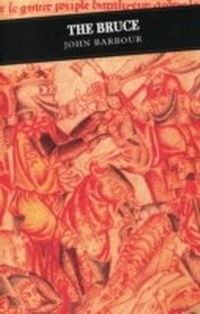
The Bruce
Published on 1. May 2009
800 pages
978-1-84767-594-1 (ISBN)
Description

A! Fredome is a noble thing
Fredome mays man to haiff liking
Fredome all solace to man giffis
He levys at es that frely levys
These are some of the most famous lines in Scottish literature. They were written c.1375 by John Barbour, Archdeacon of Aberdeen, as a celebration of the Age of Chivalry - an age of bravery, valour, and above all loyalty. Its twin heroes are Robert the Bruce and James Douglas, his faithful companion.
The epic sweep and scale of the poem catch the full drama of Bruce's life - from being pursued by dogs in Galloway to his great triumph at Bannockburn, from hunted fugitive surrounded by traitors to kingship of a free nation. The poem is one of the key sources for any life of Bruce and incorporates much information not found elsewhere.
The language of the poem is easy to read and its vigour and imagery provide a marvellous insight into the medieval mind. This is the first accessible modern edition of The Bruce featuring a full historical introduction, a special commentary on Bannockburn, a facing page translation with extensive annotation and six detailed maps. This edition also includes the other great nationalist statement about the reign of Robert the Bruce, The Declaration of Arbroath.
A.A.M. Duncan's work on The Bruce represents the culmination of a life-long interest and this book, comprehensively revised in 2007, marks a radical reassessment of the history of Robert the Bruce as recounted in the poem which bears his name.
Fredome mays man to haiff liking
Fredome all solace to man giffis
He levys at es that frely levys
These are some of the most famous lines in Scottish literature. They were written c.1375 by John Barbour, Archdeacon of Aberdeen, as a celebration of the Age of Chivalry - an age of bravery, valour, and above all loyalty. Its twin heroes are Robert the Bruce and James Douglas, his faithful companion.
The epic sweep and scale of the poem catch the full drama of Bruce's life - from being pursued by dogs in Galloway to his great triumph at Bannockburn, from hunted fugitive surrounded by traitors to kingship of a free nation. The poem is one of the key sources for any life of Bruce and incorporates much information not found elsewhere.
The language of the poem is easy to read and its vigour and imagery provide a marvellous insight into the medieval mind. This is the first accessible modern edition of The Bruce featuring a full historical introduction, a special commentary on Bannockburn, a facing page translation with extensive annotation and six detailed maps. This edition also includes the other great nationalist statement about the reign of Robert the Bruce, The Declaration of Arbroath.
A.A.M. Duncan's work on The Bruce represents the culmination of a life-long interest and this book, comprehensively revised in 2007, marks a radical reassessment of the history of Robert the Bruce as recounted in the poem which bears his name.
More details
Series
Edition
Main
Language
English
Place of publication
Edinburgh
United Kingdom
Publishing group
Canongate Books
Product notice
Reflowable
File size
4,48 MB
ISBN-13
978-1-84767-594-1 (9781847675941)
Copyright in bibliographic data and cover images is held by Nielsen Book Services Limited or by the publishers or by their respective licensors: all rights reserved.
Schweitzer Classification
Other editions
Additional editions
Person
John Barbour (1320-95) was an early Scottish poet and the first major author to write in Scots. His main surviving work is The Bruce, a verse epic about the life of Robert the Bruce, and a significant historical source.
John Barbour lived between 1330 and 1395. Most of his working life was spent as archdeacon of Aberdeen, and the poem was written in 1375 in the reign of Robert II. He is thus a rough contemporary of Chaucer, but his verse chronicle falls rather more into the tradition of Froissart and the other great chroniclers of the age of chivalry. The language of the poem is Scots at an early stage of development. The range of imagery and references provides an insight into the medieval mind. The editor A.A.M. Duncan is the author of "The Making of the Kingdom".
John Barbour lived between 1330 and 1395. Most of his working life was spent as archdeacon of Aberdeen, and the poem was written in 1375 in the reign of Robert II. He is thus a rough contemporary of Chaucer, but his verse chronicle falls rather more into the tradition of Froissart and the other great chroniclers of the age of chivalry. The language of the poem is Scots at an early stage of development. The range of imagery and references provides an insight into the medieval mind. The editor A.A.M. Duncan is the author of "The Making of the Kingdom".
Content
- Intro
- Cover
- Title Page
- Table of Contents
- Preface
- INTRODUCTION
- LIST OF MAPS
- BOOK I
- BOOK 2
- BOOK 3
- BOOK 4
- BOOK 5
- BOOK 6
- BOOK 7
- BOOK 8
- BOOK 9
- BOOK 10
- BOOK 11
- Bannockburn Commentary
- BOOK 12
- BOOK 13
- BOOK 14
- BOOK 15
- BOOK 16
- BOOK 17
- BOOK 18
- BOOK 19
- BOOK 20
- APPENDIX
- Index
- About the Author
- Copyright
