

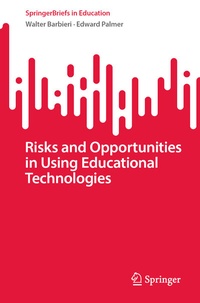
Risks and Opportunities in Using Educational Technologies
Description

This book provides another perspective to the way educators think about and use educational technologies in secondary and tertiary classrooms. Technology in learning settings has often been used in cautious ways, typically replicating existing, non-technological educational processes. This book proposes that educators be more ambitious with the way they conceive of, and use, technology in secondary and tertiary classrooms. It provides guidance towards that end by considering the history of application of educational technologies, by interrogating common fears around their use, and by exploring the benefits of contemporary uses of technology in assessment and virtual reality, for learning through the presentation and analysis of empirical research. It also charts a history of application of various educational technologies amid the dominant pedagogies in which they are introduced. This book offers another perspective on the role of technology in education, and provides ample practical applications. It serves as a useful resource for educators and educational leaders in secondary and tertiary institutions.
More details
Other editions
Additional editions
Persons
Dr Walter Barbieri is a Senior Lecturer in Education at the University of Adelaide, Australia. He coordinates the School of Education's eLearning Program and teaches a range of undergraduate and postgraduate courses, focusing on the optimal use of technologies in the classroom. Walter's research interests span the breadth of educational technologies, but are more closely focused on: personalised mobile technologies and their impact on learning and assessment; online engagement; augmented reality and its impact on education.
Edward Palmer is Professor of Educational Technologies at the University of Adelaide, Australia. He is interested in how people learn using technology, and how assessment and design drives that learning. Edward is a national award winner in using technology for learning, and is interdisciplinary in his skills, with degrees in engineering, science, medicine and the arts. He has worked in fields ranging from online formative learning approaches in medicine and physics, and focuses on the role technology, narrative and media plays in promoting learning. Edward is currently looking at the role of artificial intelligence in education and is working on virtual reality projects investigating situational awareness and medical training. He aims to improve the way we use technology to learn and train in schools, and in the workplace.
Content
Introduction.- Raising acceptance.- Learning theories and learning technologies.- Mobile Learning.
