

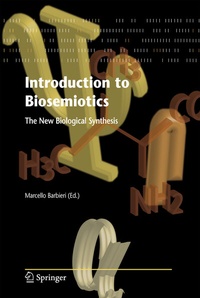
Introduction to Biosemiotics
Description

Combining research approaches from biology, philosophy and linguistics, the field of Biosemiotics proposes that animals, plants and single cells all engage in semiosis - the conversion of objective signals into conventional signs. This has important implications and applications for issues ranging from natural selection to animal behavior and human psychology, leaving biosemiotics at the cutting edge of the research on the fundamentals of life.
Drawing on an international expertise, the book details the history and study of biosemiotics, and provides a state-of-the-art summary of the current work in this new field. And, with relevance to a wide range of disciplines - from linguistics and semiotics to evolutionary phenomena and the philosophy of biology - the book provides an important text for both students and established researchers, while marking a vital step in the evolution of a new biological paradigm.
Reviews / Votes
From the reviews:
"Biosemiotics is the study of semiotic phenomena in animals, and eventually in all living creatures. . Each chapter is self-contained; however, the editor has done a remarkable job of maintaining continuity and flow. . Each contains its own extensive collection of references. The fine index will assist many readers in locating related material from the individually written chapters. Summing Up: Recommended. Graduate students and above." (J. Beidler, CHOICE, Vol. 44 (10), June, 2007)
More details
Other editions
Additional editions
Person
MARCELLO BARBIERI is University professor of Embryology at the University of Ferrara, Italy. He has conducted research on embryonic development and ribosome crystallization at the Medical Research Council in Cambridge, UK, the National Institutes of Health in Bethesda, USA, and the Max-Planck-Institut für Molekulare Genetik in Berlin.
He has published books on embryology and evolution, and has taught biophysics, molecular embryology and theoretical biology respectively at the Universities of Bologna, Sassari and Turin. His research interests include embryology, evolution and biosemiotics.
He is president of the Italian Association for Theoretical Biology and Editor-in-Chief of the Journal of Biosemiotics. His major books include The Semantic Theory of Evolution (1985), Harwood Academic Publishers, New York, and The Organic Codes. An Introduction to Semantic Biology (2003), Cambridge University Press, Cambridge UK.
Web page: www.cambridge.org/uk/catalogue/catalogue.asp?isbn=0521531004
Web site: http://www.biologiateorica.it
