

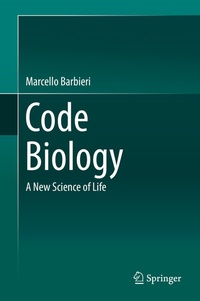
Code Biology
Description

This book is the study of all codes of life with the standard methods of science. The genetic code and the codes of culture have been known for a long time and represent the historical foundation of this book. What is really new in this field is the study of all codes that came after the genetic code and before the codes of culture. The existence of these organic codes, however, is not only a major experimental fact. It is one of those facts that have extraordinary theoretical implications. The first is that most events of macroevolution were associated with the origin of new organic codes, and this gives us a completely new reconstruction of the history of life. The second implication is that codes involve meaning and we need therefore to introduce in biology not only the concept of information but also the concept of biological meaning. The third theoretical implication comes from the fact that the organic codes have been highly conserved in evolution, which means that they are the greatest invariants of life. The study of the organic codes, in short, is bringing to light new mechanisms that have operated in the history of life and new fundamental concepts in biology.
Reviews / Votes
"Barbieri (embryology, Univ. of Ferrara, Italy) lays out the case for multiple codes, each corresponding with, and instrumental in the origin of, different levels of biological organization: from the origin of life (genetic), the three kingdoms of life (signal transduction), the nucleus (splicing code), regulation of eukaryotic genomes (histone code), cell division (the cytoskeletal code), to mind and language (the organic code). . Summing Up: Recommended. Upper-division undergraduates, graduate students, and researchers/faculty." (B. K. Hall, Choice, Vol. 53 (1), September, 2015)
More details
Other editions
Additional editions
Person
Content
Acknowledgments
Introductory Chapter.- The Life and Education of Jakob von Uexküll. The Basis of the Environmental Theory.- The Subjective World of the Umwelt.- The Structure of the Umwelt.- Environment and Meaning.- Influences and Interpretations of the Work of Uexküll.- Conclusion. References.- Index.
