

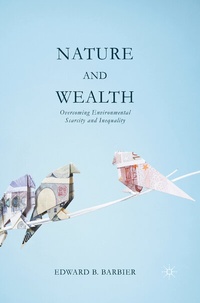
Nature and Wealth
Description

Reviews / Votes
'In an enormously ambitious and significant research programme, Professor Barbier has been reworking economic history from the deep past to the present by including environmental assets in societal accounts. In this book he adds to that account of history by providing quantitative estimates of the place of those assets in a society's wealth. This is work of a very high order and insight.' Sir Partha Dasgupta, Frank Ramsey Professor Emeritus of Economics, University of Cambridge, UK
'Ed Barbier has masterfully brought together environmental degradation and wealth inequality into a coherent and practical development strategy. He spells out how pricing nature and targeting inefficient natural resource use can be combined with human capital investment to tackle poverty in developing countries. It is a blueprint for a sustainable future.' - Dieter Helm, author of Natural Capital Valuing the Planet
'In Nature and Wealth Ed Barbier traces the origins of today's imbalance between our economies and our environment, graphically illustrating how the economic invisibility of nature has led to a pervasive and enduring misallocation of capital: one that privileges resource extraction for short-term gains, while leaving large segments of society without the skills or jobs they need to create income and sustain livelihoods. Lucidly written and anchored in empirical data, this book makes a timely and compelling contribution to the literature showing why a fundamental realignment of market institutions, policies and prices is needed to create and sustain wealth beyond the ephemeral pursuit of growth and how this can be achieved.' Steven Stone, Chief, Economy and Trade Branch, United Nations Environment Programme
'Edward Barbier's wide-ranging and provocative book lays out the case for how low levels of human capital and the failure to account for the true costs of over-reliance on non-renewable natural resources reinforce each other, leading to unsustainable and non-inclusive patterns of economic growth. The book provides a welcome nudge to expanded collaboration on development and environmental policies.' Mike Toman, World Bank
'This thoughtful, informative, and very important book explains why countries face a double imbalance an environmental imbalance from over exploitation of environmental capital and a social imbalance from widening income inequality due to insufficient investments in human capital. The proposed Balanced Wealth Strategy lays the intellectual framework for why, and what needs to be done the challenge going forward is how to put into practice the needed incentives across advanced, emerging, and developing countries alike.' Ian Parry, Principal Environmental Fiscal Policy Expert, International Monetary Fund
'Twenty-five years ago, Edward Barbier, along with a few other leading thinkers, launched the concept of green economy with his seminal work, Blueprint for a Green Economy. Once again, Professor Barbier breaks new ground by offering a cogent analysis of why our failure to accurately value, account for, and distribute the benefits of nature has and will continue to lead us down a path of environmental degradation and increasing wealth disparity. His concrete recommendations for what can be done to overcome this imbalance between nature and wealth are lucid, precise, and most importantly, with effort and courage, achievable.' Benjamin Simmons, Head, Green Growth Knowledge Platform
'Barbier's new book, Nature and Wealth, presents an innovative and exciting approach to the twin challenges of our time: inequality and environmental scarcity. The premise is that income and human well-being are underpinned by wealth, defined in its broadest form to include not only the familiar manufactured capital, but also natural capital (all the natural resources and environmental services we depend on) and human capital (the skills and capacities of the work force). He identifiesthe cause of our current global problems in an imbalance of assets we are underpricing natural capital, and as a result we are rapidly depleting and degrading it. At the same time we are underinvesting in human capital so that only a relatively small number of people obtain the high-level skills needed to generate high incomes, resulting in growing inequality. The book provides a sweeping historical review of human development over millennia but the innovation is to view this through the lens of wealth and the accumulation of wealth. This provides a fresh perspective on inequality and the role of natural capital in human history. This focus on natural capital makes the book a useful companion to the recent, widely acclaimed work by Thomas Piketty, Capital in the 21st Century. Furthermore he doesn't just leave us with an incisive analysis of our current problems but also, in the Balanced Wealth Strategy, he also suggests a way out to restore the right mix of different kinds of wealth needed for a more equitable and sustainable world. The book is written in a passionate manner, without sacrificing economic rigor, that will be enjoyed a wide audience. It is a very useful and engaging exposition for anyone interested in the critical challenges the world faces today.' - Glenn-Marie Lange, Global Partnership for Wealth Accounting and Valuation of Ecosystem Services (WAVES), The World Bank
More details
Other editions
Additional editions
Person
Content
1. The Origins Of Economic Wealth
2. Natural Capital And Economic Development
3. Wealth, Structure And Functioning Of Modern Economies
4. The Age Of Ecological Scarcity
5. Structural Imbalance
6. The Under-Pricing Of Nature
7. Wealth Inequality
8. Redressing The Structural Imbalance
9. Making The Transition
10. Conclusion
