

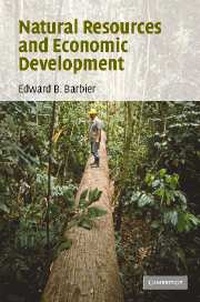
Natural Resources and Economic Development
1st Edition
Published on 5. February 2006
978-0-511-13338-1 (ISBN)
Description

Natural Resources and Economic Development, first published in 2005, explores a key paradox: why is natural resource exploitation not yielding greater benefits to the poor economies of Africa, Asia and Latin America? Part I examines this paradox both through a historical review of resource use and development and through examining current theories which explain the under-performance of today's resource-abundant economies, and proposes a frontier expansion hypothesis as an alternative explanation. Part II develops models to analyse the key economic factors underlying land expansion and water use in developing countries. Part III explores further the 'dualism within dualism' structure of resource dependency, rural poverty and resource degradation within developing countries, and through illustrative country case-studies, proposes policy and institutional reforms necessary for successful resource-based development.
Reviews / Votes
'Barbier's book will bring to the forefront the oft-neglected role of natural resources in the development process. The range of this book is remarkable, weaving together as it does both solid economic theory and abundant analysis of what is actually going on in the developing world today, while also providing a fascinating tour of resources through economic history as well as thoughtful policy prescriptions for the future. This is an indispensable contribution.' James Gustave Speth, Dean, School of Forestry & Environmental Studies, Yale University 'Ed Barbier stands practically alone in his commitment to, and grasp of, the manifold issues surrounding the relation between natural resources and economic development in the smaller latitudes. He is at his best here - exploring issues, challenging conventional wisdom, bringing empirical evidence to bear on vexing problems, and generally probing the successes and failures in economic policies and performance.' Daniel W. Bromley, Anderson-Bascom Professor of Applied Economics, University of Wisconsin 'Much of the development economics community still seems unconvinced that natural resource conservation has much to do with lifting the poor out of poverty. In a fine selection of case studies and rigorous arguments, Ed Barbier shows that they could not be more mistaken. Few writers can compete with Barbier's authority in this area - he commands respect for his combination of field experience, sound theory and applied analysis. This is a volume to pore over and digest, but not at leisure. The problems are urgent and Barbier points the way to their solution.' David Pearce, Emeritus Professor of Environmental Economics, University College London 'This is the first treatise to have been written on poverty and the environmental resource base that takes not only geography, but also history seriously. Both the choice and organization of materials are illuminating and the exposition is consistently clear and rigorous. The book is a triumph and will be read for a long time.' Partha Dasgupta, Frank Ramsey Professor of Economics, University of Cambridge 'Barbier's book begins by posing the following key query: Why is it that, despite the salience of natural capital for sustainable economic development, increasing reliance on natural resources seems to impact negatively on economic growth and development in today's low-and middle-income nations? ... he offers and discusses in considerable detail what he calls the frontier expansion hypothesis, using an interesting theoretical model to demonstrate that 'under certain conditions frontier expansion in a small open economy can be associated with sustained growth' ... this is a clearly written and interesting book on a subject of considerable contemporary significance.' Development Policy Review '... the book offers interesting insights on some crucial issues for development and environmental economics.' Development and ChangeMore details
Language
English
Place of publication
Cambridge
United Kingdom
Publishing group
Cambridge University Press
Target group
Professional and scholarly
Illustrations
Worked examples or Exercises; 30 Tables, unspecified
File size
3,10 MB
ISBN-13
978-0-511-13338-1 (9780511133381)
Copyright in bibliographic data and cover images is held by Nielsen Book Services Limited or by the publishers or by their respective licensors: all rights reserved.
Schweitzer Classification
Other editions
Additional editions
Edward B. Barbier
Natural Resources and Economic Development
Book
06/2007
Cambridge University Press
€57.40
Article exhausted; check for reprint
Edward B. Barbier
Natural Resources and Economic Development
Book
11/2005
Cambridge University Press
€61.90
Article exhausted; check for reprint
Person
Edward B. Barbier is currently the John S. Bugas Professor of Economics in the Department of Economics and Finance, University of Wyoming. He has over twenty years' experience as an environmental and resource economist, working mainly on the economics of environment and development issues.
Content
Preface; 1. Natural resources and developing countries: an overview; 2. Natural resource-based economic development in history; 3. Does natural resource dependence hinder economic development?; 4. Frontier expansion and economic development; 5. Explaining land use change in developing countries; 6. The economics of land conversion; 7. Does water availability constrain economic development?; 8. Rural poverty and resource degradation; 9. Can frontier-based development be successful?; 10. Policies for sustainable resource-based development in poor economies.
