
How Long Do We Live?
Description
Alles über E-Books | Antworten auf Fragen rund um E-Books, Kopierschutz und Dateiformate finden Sie in unserem Info- & Hilfebereich.
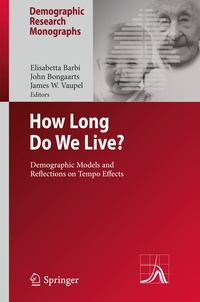
The most widely used measure of longevity is the period life expectancy at birth which is calculated from age specific death rates by life table methods. In 2002, John Bongaarts and Griffith Feeney introduced the revolutionary idea that this conventional estimate of period life expectancy is distorted by a tempo effect whenever longevity is changing. The tempo effect is defined as an inflation or deflation of the period incidence of a demographic event resulting from a rise or fall in the mean age at which the event occurs. Some demographers agree with this radical argument; others disagree. The book reviews the debate on how best to measure period longevity. In the various chapters, leading experts in demography critically examine the existence of the tempo effect in mortality, present extensions and applications, and compare period and cohort longevity measures. The book provides a deeper understanding of and new insights into the fundamental question "How long do we live"?
More details
Other editions
Additional editions

Content
System requirements
File format: PDF
Copy protection: Watermark-DRM (Digital Rights Management)
System requirements:
- Computer (Windows; MacOS X; Linux): Use the free software Adobe Reader, Adobe Digital Editions, or any other PDF viewer of your choice (see eBook Help).
- Tablet/Smartphone (Android; iOS): Install the free app Adobe Digital Editions or another reading app for eBooks, e.g., PocketBook (see eBook Help).
- E-reader: Bookeen, Kobo, Pocketbook, Sony, Tolino and many more (only limited: Kindle).
The file format PDF always displays a book page identically on any hardware. This makes PDF suitable for complex layouts such as those used in textbooks and reference books (images, tables, columns, footnotes). Unfortunately, on the small screens of e-readers or smartphones, PDFs are rather annoying, requiring too much scrolling.
This eBook uses Watermark-DRM, a „soft” copy protection. This means that there are no technical restrictions to prevent illegal distribution. However, there is a personalised watermark embedded in the eBook that can be used to identify the purchaser of the eBook in the event of misuse and to provide evidence for legal purposes.
For more information, see our eBook Help page.