

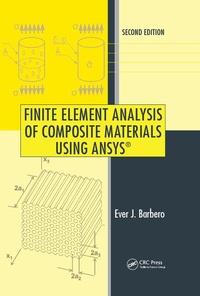
Finite Element Analysis of Composite Materials Using ANSYS
2nd Edition
Published on 11. December 2013
366 pages
978-1-4665-1690-8 (ISBN)
Description

Designing structures using composite materials poses unique challenges, especially due to the need for concurrent design of both material and structure. Students are faced with two options: textbooks that teach the theory of advanced mechanics of composites, but lack computational examples of advanced analysis, and books on finite element analysis
Reviews / Votes
"To my knowledge, Professor Barbero's current text is the only text on the market that addresses the formal teaching of the finite element analysis of composites. There is a growing demand in the composites community for such a text."-Jim Sherwood, University of Massachusetts-Lowell, USA
"I already have a copy ... and I like to use it as a reference for some topics that are related to composite structure analysis. Due to the way the book is assembled, it is perfect for a teaching course."
-Gasser F. Abdelal, Queen's University Belfast, UK
"... a great book, covering not only essentials for mechanics and composites, but also advanced topics, bucking, viscoelasticity, failure and damage model. It is good for a reference on your shelf, text book for training and students."
-Chuanyu Feng, Oil & Gas Industry, Houston, Texas
"This book is a powerful tool to learn composite materials through computational implementations of composite structures using commercial codes. ... The ANSYS codes are so well commented that it complements the examples as if they are part of the text, and because they are complete, you know that you can just copy-paste and modify the codes for your personal computer experiments, or personal projects. At the end you realize and appreciate that the structure and smart organization of the book actually has given you a thorough explanation of a tough and complex subject as it is composite materials, and modeling composite material structures.
-Fritz A. Campo, Ph.D., Blade Dynamics, LLLP.
"This text is well designed, comprehensive, and has a large number of examples and end-of-chapter problems. It is suitable for graduate students and perhaps some well-qualified undergraduates."
-Robert C Wetherhold, University at Buffalo, SUNY
"This book bridges the gap between the Finite Element analysis tools and analysis of composite structures. Extensive Finite Element examples are provided covering a wide range of topics. Although these examples are based on ANSYS, they can be applied to other software with necessary modifications. This book can be used not only as a textbook for graduate students, but also a reference for design engineers."
-An Chen, Department of Civil Engineering, University of Idaho
"I particularly like the approach in which the author explains the various concepts using very simple examples first and then take the readers to a full treatment."
-Jingzhe Pan, Department of Engineering, University of Leicester, UK
"... an excellent text of composite materials analysis for graduate students and practicing engineers. After an initial introduction to stress analysis and to finite element method the chapters introduce to the reader how to model composites with FE codes. ... The BOOK provides a practical framework that allow the reader to improve and learn in several aspects: FE modeling, composites, ... and, also, to learn how to implement engineering problems in ANSYS and MatLab"-Joan-Andreu Mayugo, Universitat de Girona (Spain)
"I think that the book gives an exhaustive explanation about the basic concepts on composite materials and their finite elements analysis."
-Antonio Madeo, University of Calabria
"I am aware of several books on vomposite materials, but this is rather unique with an equal emphasis on commercial software."
-Dr. Grama Bhashyam, ANSYS Inc.
More details
Series
Edition
2nd edition
Language
English
Place of publication
Baton Rouge
United States
Publishing group
Taylor & Francis Inc
Target group
College/higher education
Edition type
Revised edition
Illustrations
89 s/w Abbildungen, 24 s/w Tabellen
89 b/w images and 24 tables
ISBN-13
978-1-4665-1690-8 (9781466516908)
Copyright in bibliographic data and cover images is held by Nielsen Book Services Limited or by the publishers or by their respective licensors: all rights reserved.
Schweitzer Classification
Other editions
Additional editions
Ever J. Barbero
Finite Element Analysis of Composite Materials Using ANSYS
Book
12/2013
2nd Edition
CRC Press
€194.30
Shipment within 15-20 days
Person
Ever J. Barbero holds a BSME-BSEE from Universidad Nacional de Rio Cuarto, Argentina and a Ph.D from Virginia Polytechnic Institute and State University, Blacksburg, USA. He is ASME and SAMPE fellow, a professor at West Virginia University, Morgantown, USA, and honorary professor at Universidad Nacional de Trujillo, Peru. Holder of two US patents, author of over 100 peer-reviewed publications, and recipient of numerous teaching and research awards, he is recognized internationally for his work on material models for composite materials.
Content
Mechanics of Orthotropic Materials. Introduction to Finite Element Analysis. Elasticity and Strength of Laminates. Buckling. Free Edge Stresses. Computational Micromechanics. Viscoelasticity. Continuum Damage Mechanics. Discrete Damage Mechanics. Delaminations. Appendices. References. Index.
