

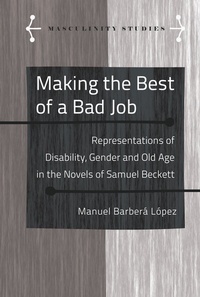
Making the Best of a Bad Job
Description

This book explores the representations of disability, gender and old age in the novels of Samuel Beckett. His works go against the foundations of Western thought, which has been traditionally focused on success, clarity, learning and ability, while Beckett chose to focus on failure, confusion, decay and impotence. This study purports to show the central importance of the three categories chosen for the general understanding of the writer's work. It constitutes an attempt to provide a gendered interpretation of Beckett's protagonists, who are increasingly unable to reason, talk or move properly, extremely old and do not fit hegemonic models of masculinity. Beckett, who denies his own ability as an author to understand and explain a chaotic world, chooses these disabled, old men as the ultimate representatives of the human condition and the best models to transmit his worldview. This is a book combining different perspectives and getting to conclusions regarding power structures which are particularly interesting for researchers or students taking courses on the dialectics of alterity, masculinities studies or new readings of Samuel Beckett's works. The author's research is based on the main arguments of feminist thought, masculinities studies, disability studies, ageing studies and recent work on Beckett. The ultimate goal of such interdisciplinary approach is to show how different systems of oppression work in similar ways and to draw the political implications of Beckett's literary choices, in terms of visibility and solidarity.
More details
Other editions
Additional editions
Person
Manuel Barberá López earned his PhD in literature (Cum Laude and with an International Mention) at Universitat de València in 2020. He works as a post-doctoral researcher at Universidad de Castilla-La Mancha, where he analyses representations of ageing masculinities in European literatures and cinemas.
Content
Acknowledgements - List of Abbreviations - Introduction: "To fail as no other dare fail" - The Damaged Brain: Ruptures in Perception and Memory - The Fragmented Speech: The Impossibility of Communication and the Road to Silence - The Broken Body: Motility, Paralysis and Isolation - Disability in Samuel Beckett: The Trauma of Life and the Contagious Nature of Resilience - Men as Agents: Narration, Impotence and the Loss of Masculine Mastery - The Representation of Men: Rejection of Hegemonic Masculinity and of the Heterosexual Matrix - The Representation of Women: Deactivation of the Feminine Mystique - Gender in Samuel Beckett: A System of Reciprocal Dependency - The Life Course and Its Meaning: Aging and the Novels - The End of Wandering: Representations of Old Age and Death - Old Age in Samuel Beckett: Intersections, the Social Stigma and Taking a Stand - Conclusions: "Making the best of a bad job" - Index.
