

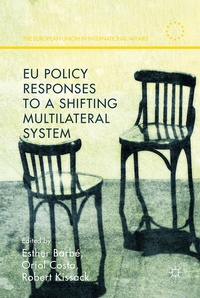
EU Policy Responses to a Shifting Multilateral System
Description

This book explores how the EU, as an international actor, is adapting to recent transformations in the multilateral system. The international identity of the European Union is built upon its support for effective multilateralism and its commitment to core norms and values. Until recently, there was no need to choose between these goals. Emerging powers in the international system are not only demanding more power in multilateral institutions, but also sometimes seeking to influence their purpose and function, away from those championed by the EU. This presents a dilemma for EU foreign policy - framed in this edited volume as either accommodating changes in order to support multilateral institutions or entrenching the EU position in order to uphold values. Using a common analytical framework, the chapters include case studies on important multilateral institutions such as the United Nations Security Council, the International Monetary Fund, the World Trade Organization and the International Criminal Court, as well as key policy areas such as energy, climate change, nuclear non-proliferation, and human rights.
Reviews / Votes
"This book edited by three Professors of International Relations at IBEI . is definitely useful to understand topical trends in international politics, such as the intensification of contradictions between the transnational and the national or between the economy and the political. . This non-Eurocentric perspective brought by non-Anglo-Saxon researchers is very welcomed. The specific approach taken by the authors is actually the main contribution of the book within the literature on European foreign policy." (Marlène Rosano-Grange, European Review of International Studies, Vol. 05 (01), 2018)More details
Other editions
Additional editions
Persons
Esther Barbé is Professor of International Relations at the Universitat Autònoma de Barcelona and Research Programme Coordinator at the Institut Barcelona d'Estudis Internacionals, Spain.
Oriol Costa is Assistant Professor of International Relations at the Universitat Autònoma de Barcelona and Associate Researcher at the Institut Barcelona d'Estudis Internacionals, Spain.
Robert Kissack is Head of Studies at the Institut Barcelona d'Estudis Internacionals, Spain. He has previously taught at the London School of Economics and the University of East Anglia.
Content
Tables and figures.- Preface and acknowledgements.- Abbreviations.- Contributors.- 1. Accommodating or entrenching? How the EU is dealing with changes in the multilateral system; Oriol Costa, Robert Kissack and Esther Barbé.- 2. The irony of history: European responses to the contested evolution of the nuclear non-proliferation and disarmament regime; Benjamin Kienzle.- 3. An Upstream Battle: The EU and the Reform of the Energy Charter Treaty; Anna Herranz-Surrallés.- 4. The Defence of an Institution under Challenge: The EU and the International Criminal Court; Gemma Collantes-Celador.- 5. EU trade policy reaction to the BIC: from accommodation to entrenchment; Patricia Garcia-Duran, Montserrat Millet and Jan Orbie.- 6. Beijing after Kyoto? The EU and the new climate in climate negotiations; Oriol Costa.- 7. Supporting practices inspired by solidarist ideas: The EU in the UNSC Open Debates on Women, Peace andSecurity; Esther Barbé.- 8. The Global Financial Crisis and Emerging Economies: EU accommodation and entrenchment in the IMF;
