

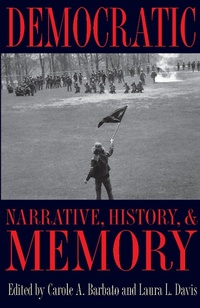
Democratic Narrative, History, and Memory
Description

The essays in this volume explore the complex relationships among events, memory, and portrayal of those events and the deepest questions of human experience, all viewed through a range of disciplinary lenses but grouped into three sections, each with its own focus and meaning.
The first group of essays focuses on the events of May 4, 1970, when the Ohio National Guard shot Kent State University students, killing four of them and causing shock waves that continue to resonate among those concerned with peace and violence, silence, and giving voice. Essays in the second group address the part played by corporate and noncorporate media in shaping public memory and raising public consciousness. The final section examines acts of remembrance and reconciliation within local communities and the long history of discrimination within the national community, directly and indirectly proposing ways in which society can move toward social justice.
For four decades, the Kent State University community has worked to preserve the stories of those who were lost on May 4th, both to honor them and to reveal the universal meanings behind the events. The community is negotiating, in a literal sense, the space between memory and history and between social remembering and historical analysis. For many at Kent State and in other communities that have experienced violence, the historical event is a lived event. Acts of scholarship are sometimes acts of remembrance and commemoration at the same time.
This volume emanates from a commemorative act-the University's tenth Symposium on Democracy, founded in 2000 as a living memorial to the four students who lost their lives and as an enduring dedication to scholarship that seeks to prevent violence and promote democratic values and civil discourse. The work in this collection pursues historical meaning that holds relevance for a particular community and speaks indelibly to the entire human community.
More details
Other editions
Additional editions
Persons
Content
- Intro
- Title
- Copyright
- Contents
- Preface
- Part I: From History to Humanity
- Introduction
- Kent State and Historical Memory
- Kent State Comes to Canada: Internationalizing the Antiwar Movement
- Remembering Injustice and the Social Construction of Silence
- Part II: Corporate Media Culture and Public Memory
- Introduction
- Visualizing the Limits of Democracy in the Silence of the Cold War: The Photography of Life Magazine and the Unraveling of the American Century
- Lost History/Lost Democracy: Media Culture and the 1960s
- "Of Loss and Learning": How Anniversary Coverage Affects Understanding of May 4, 1970
- Wars on Trial in Three Landmark Documentary Films: Night and Fog, Hearts and Minds, and Taxi to the Dark Side
- Part III: Memory, History, and Justice
- Introduction
- The Role of Forgetting in Remembering: The Desegregation of Central High School in Little Rock, Arkansas
- Confronting the Legacies of Violence: Lessons from Kent State and Greensboro, North Carolina
- Social Remembering and Kent State
- Appendix: This We Know: Chronology of the Shootings at Kent State, May 1970
- Bibliography
- Contributors
- Index
