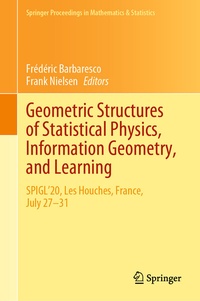
Geometric Structures of Statistical Physics, Information Geometry, and Learning
Description

Machine learning and artificial intelligence increasingly use methodological tools rooted in statistical physics. Conversely, limitations and pitfalls encountered in AI question the very foundations of statistical physics. This interplay between AI and statistical physics has been attested since the birth of AI, and principles underpinning statistical physics can shed new light on the conceptual basis of AI. During the last fifty years, statistical physics has been investigated through new geometric structures allowing covariant formalization of the thermodynamics. Inference methods in machine learning have begun to adapt these new geometric structures to process data in more abstract representation spaces.
This volume collects selected contributions on the interplay of statistical physics and artificial intelligence. The aim is to provide a constructive dialogue around a common foundation to allow the establishment of new principles and laws governing these two disciplines in a unified manner. The contributions were presented at the workshop on the Joint Structures and Common Foundation of Statistical Physics, Information Geometry and Inference for Learning which was held in Les Houches in July 2020. The various theoretical approaches are discussed in the context of potential applications in cognitive systems, machine learning, signal processing.
More details
Other editions
Additional editions