

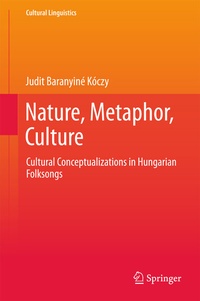
Nature, Metaphor, Culture
Description

This book analyses the emotional message of Hungarian folksongs from a Cultural Linguistic perspective, employing a wide range of empirical devices. It combines theoretical notions with analytical devices and has a multidisciplinary essence: it relies on the latest Cultural Linguistic findings, employing spatial semantics, cognitive linguistics, cognitive psychology and ethnography.
The book addresses key questions including: How is nature conceptualized by a folk cultural group? How are emotions and other mental states expressed via nature imagery with respect to metaphors and construal schemas? The author argues that folksongs reflect the Hungarian peasant communities' specific treatment of emotions, captured in an underlying cultural schema 'reservedness.' This schema is grounded in principals of morality and tradition, and governs the various levels of representation.
The main topics discussed are related to two core issues: cultural metaphors and cultural
schemas of construal in folksongs. It provides a detailed example, based on over 1000 folksongs, of how a cultural group's cognition can be analyzed and better understood through a representative corpus-based linguistic approach. The research is also pioneering in constructing a comprehensive analysis framework adapted to folk poetry, and offers an example of how cultural conceptualizations can be investigated in various discourse types. Last but not least, the book offers insights into the work of Hungarian linguists and folklorists concerning cultural conceptualizations, which have largely been unavailable in English.More details
Other editions
Additional editions
Person
Judit Baranyiné Kóczy studied English language and literature and Hungarian language and literature at Pázmány Péter Catholic University in Piliscsaba. She was a PhD student from 2008 to 2011 at Eötvös Lóránd University, Budapest, where she joined the Doctoral School of Linguistics and specialised in cognitive linguistics. She obtained her summa cum laude PhD degree in 2014 completing her thesis on A Spatial Semantic Approach to Hungarian Folksongs. At present her main interests of research involve language and culture, cultural conceptualisations, metaphors in culture, spatial semantics, and folklore discourse types, where she applies theoretical issues to empirical, corpus-based study. At present she is a senior lecturer at the Széchenyi István University, Gyor.
Content
Folksongs from a Cultural Linguistic perspective.- Spatial metaphors in the natural imagery.- Cultural metaphors in folksongs.- Cultural schemas of construal.- Cultural conceptualisations of folksongs: cross-cultural and intra-cultural studies.- Conclusions.
