

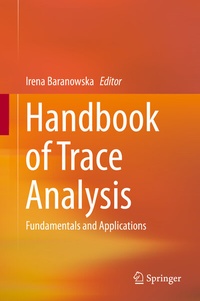
Handbook of Trace Analysis
Description

This handbook is unique in its comprehensive coverage of the subject and focus on practical applications in diverse fields. It includes methods for sample preparation, the role of certified reference materials, calibration methods and statistical evaluation of the results. Problems concerning inorganic and bioinorganic speciation analysis, as well as special aspects such as trace analysis of noble metals, radionuclides and volatile organic compounds are also discussed.
A significant part of the content presents applications of methods and procedures in medicine (metabolomics and therapeutic drug monitoring); pharmacy (the analysis of contaminants in drugs); studies of environmental samples; food samples and forensic analytics - essential examples that will also facilitate problem solving in related areas.
Reviews / Votes
"This handbook will be useful to both students and scientist who want to broaden their horizons with procedures and techniques used in the world of trace analysis and to people that have been just introduced to this complicated world. It will be of particular interest to analytical chemists, biochemists, physical chemists and radiochemists." (Panayot Petrov, Analytical and Bioanalytical Chemistry, Vol. 409, 2017)More details
Other editions
Additional editions
Person
Irena Baranowska is a full professor at the Silesian University of Technology in Gliwice, Poland. For 20 years she has been Head of the Department of Analytical Chemistry at Chemical Faculty. She was vice-president of the Committee of Analytical Chemistry of the Polish Academy of Sciences (9 years) and presently is a member of its Presidium. Irena Baranowska also was a member of a section in the State Committee for Scientific Research (KBN) in Warsaw and currently she is member of team of experts in National Science Centre in Krakow. She was awarded the Wiktor Kemula medal for outstanding scientific achievements in analytical chemistry. Her research focuses on analysis of organic compounds, especially pharmaceuticals and their metabolites, as well as endogenous compounds in clinical and environmental samples. She has supervised 19 PhD theses, is reviewer of 21 applications for the title of professor, 30 habilitation dissertations and 45 PhD theses.
