

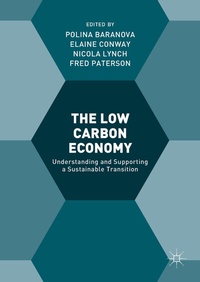
The Low Carbon Economy
Description

This edited collection explores the challenges and opportunities presented by the transition to a low carbon economy, and outlines the different approaches taken to ensure the sustainability of such a transition. Chapters explore the nature of the transformation from a 'brown' to 'green' economy, the importance of effective carbon measurement and management methodologies, the use of behaviour economics, and the application of a growth-enabling approach. Offering valuable insights into how various stakeholders respond to the challenges of green growth and focusing in particular on the support of universities, The Low Carbon Economy covers themes of leadership, systems approach, stakeholder management, and collaborative action. This comprehensive study provides readers with constructive ideas for maximising the opportunities of transitioning to a low carbon economy, and will serve as a useful tool for practitioners and academics interested in sustainability.
Reviews / Votes
"We are in the midst of a metamorphosis. Much of today's thinking, governance structures, leadership styles and managerial methods are inured in the mechanistic 'caterpillar logic' of yesterday. It's time to move. The transition to a low-carbon economy is an important part of a profound shift afoot that challenges who we are as human beings and our sense of place and purpose in this world. Transformational times demand transformational leadership that facilitates and catalyses this necessary metamorphosis. This book provides insightful and important guidance, sign-posts and tools for those of us actively engaged in the day-to-day practicalities of this unfolding and emancipating yet challenging and demanding metamorphosis while learning to let-go of yesterday's strictures and structures. The transition to a more sustainable and harmonious world is seismic and systemic in nature. This book goes to the heart of what this means for place-based transformation and the dawning of a new 'civic consciousness'." (Giles Hutchins, author of Future Fit and other books, and Chairman of The Future Fit Leadership Academy)"This timely, scholarly contribution focuses on the significant issues surrounding sustainable transitions to a low carbon economy. Each author successfully elucidates hitherto complex aspects of important topics in the field under enquiry. It successfully draws on current research findings and other scholarly activities to present each chapter topic. Comprehensive coverage offers a welcome addition to this growing body of literature, and will prove interesting to both academic and practitioner audiences/readerships." (Professor Joyce Liddle Professor of Public Leadership and Management, Institute of Public Management &Territorial Governance, Aix-Marseille University, France)
"The arguments and ideas developed in this work appear at a critical time - and the authors make an important contribution to our understanding of the opportunities and challenges that are presented by the transition to a low-carbon economy. The implicit call in this work for a re-think of leadership and governance at all levels resonates with a growing recognition that if we are to encourage workable solutions to the many and complex problems posed by climate change, then we must invest in collaborative and creative working at all geographical scales. This book is a 'must-read' for all of those who are researching, promoting and enacting genuinely sustainable and humane approaches to the world's transition towards a low-carbon economy." (John Gibney, Senior Fellow, University of Birmingham)
"This is a thoughtful and well-researched analysis of the challenges that need to be faced as we transition to a low carbon economy. Strengths of this volume are that it brings together insights from different disciplinary perspectives, draws in a creative way on a wide literature, and shows how it is essential to develop stronger approaches to inclusive, place-based leadership if we are to create a sustainable future. Written in an accessible style I welcome this book as it opens new doors for academics, policy makers and activists." (Robin Hambleton, Emeritus Professor of City Leadership, University of the West of England, Bristol and author of Leading the Inclusive City, 2015)
More details
Other editions
Additional editions
Persons
Polina Baranova is Senior Lecturer in Strategic Management and Programme Leader for MBA Global and Global Finance at the Derby Business School, University of Derby, UK.
Elaine Conway is Senior Lecturer in Accounting and Finance at the Derby Business School, UK.
Nicola Lynch is Head of the Economics and Finance division at the College of Business, Law and Social Sciences, University of Derby, UK.
Fred Paterson is Senior Lecturer in Leadership Development at the Derby Business School, UK, where he also leads the Sustainable Business Research Cluster.
